Research Associate, Division of Psychological Medicine and Clinical Neurosciences, Cardiff University, UK.
Professor, Christchurch Health and Development Study, Department of Psychological Medicine, University of Otago Christchurch, New Zealand.
Br J Psychiatry. 2019 Feb;214(2):96-102. doi: 10.1192/bjp.2018.227. Epub 2018 Nov 26.
Studies involving clinically recruited samples show that genetic liability to schizophrenia overlaps with that for several psychiatric disorders including bipolar disorder, major depression and, in a population study, anxiety disorder and negative symptoms in adolescence.AimsWe examined whether, at a population level, association between schizophrenia liability and anxiety disorders continues into adulthood, for specific anxiety disorders and as a group. We explored in an epidemiologically based cohort the nature of adult psychopathology sharing liability to schizophrenia.
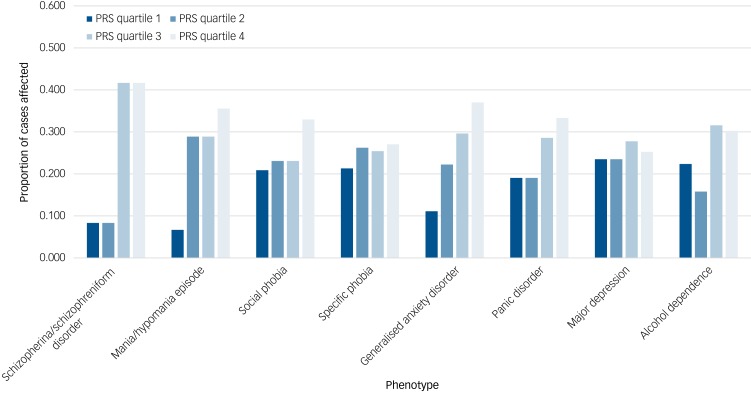
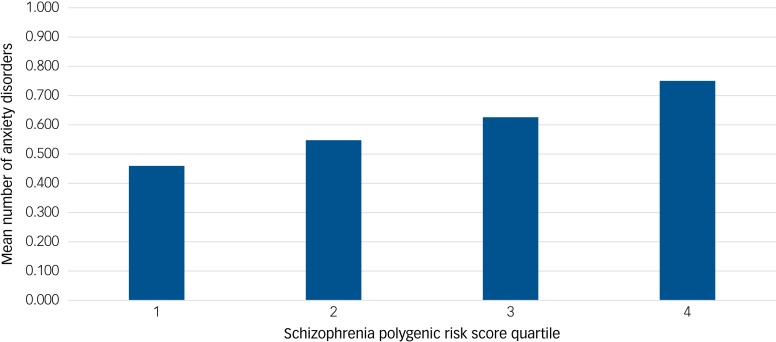
Schizophrenia polygenic risk scores (PRSs) were calculated for 590 European-descent individuals from the Christchurch Health and Development Study. Logistic regression was used to examine associations between schizophrenia PRS and four anxiety disorders (social phobia, specific phobia, panic disorder and generalised anxiety disorder), schizophrenia/schizophreniform disorder, manic/hypomanic episode, alcohol dependence, major depression, and - using linear regression - total number of anxiety disorders. A novel population-level association with hypomania was tested in a UK birth cohort (Avon Longitudinal Study of Parents and Children).
Schizophrenia PRS was associated with total number of anxiety disorders and with generalised anxiety disorder and panic disorder. We show a novel population-level association between schizophrenia PRS and manic/hypomanic episode.
The relationship between schizophrenia liability and anxiety disorders is not restricted to psychopathology in adolescence but is present in adulthood and specifically linked to generalised anxiety disorder and panic disorder. We suggest that the association between schizophrenia liability and hypomanic/manic episodes found in clinical samples may not be due to bias.Declarations of interestNone.
涉及临床招募样本的研究表明,精神分裂症的遗传易感性与包括双相情感障碍、重度抑郁症在内的几种精神障碍重叠,并且在一项人群研究中,与青少年时期的焦虑障碍和阴性症状重叠。
我们研究了在人群水平上,精神分裂症易感性与焦虑障碍之间的关联是否会持续到成年期,包括特定的焦虑障碍和作为一个整体的焦虑障碍。我们在一个基于流行病学的队列中探索了与精神分裂症易感性相关的成年精神病理学的性质。
为了计算 590 名来自基督城健康与发展研究的欧洲裔个体的精神分裂症多基因风险评分(PRS),我们使用了逻辑回归来检验精神分裂症 PRS 与四种焦虑障碍(社交恐惧症、特定恐惧症、惊恐障碍和广泛性焦虑障碍)、精神分裂症/分裂情感障碍、躁狂/轻躁狂发作、酒精依赖、重度抑郁症之间的关联,并使用线性回归检验与焦虑障碍总数之间的关联。我们在一个英国出生队列(阿冯纵向研究父母和孩子)中测试了一种新的人群水平关联与轻躁狂的关联。
精神分裂症 PRS 与焦虑障碍总数以及广泛性焦虑障碍和惊恐障碍相关。我们展示了精神分裂症 PRS 与躁狂/轻躁狂发作之间的一种新的人群水平关联。
精神分裂症易感性与焦虑障碍之间的关系不仅限于青春期的精神病理学,而且存在于成年期,并且与广泛性焦虑障碍和惊恐障碍特异性相关。我们认为,在临床样本中发现的精神分裂症易感性与轻躁狂/躁狂发作之间的关联可能不是由于偏倚造成的。
无。