Department of Psychology and Logopedics, University of Helsinki, Helsinki, Finland.
Department of Clinical Chemistry, Fimlab Laboratories, and Finnish Cardiovascular Research Center, Tampere, Finland.
Mol Psychiatry. 2022 Aug;27(8):3286-3293. doi: 10.1038/s41380-022-01581-z. Epub 2022 May 3.
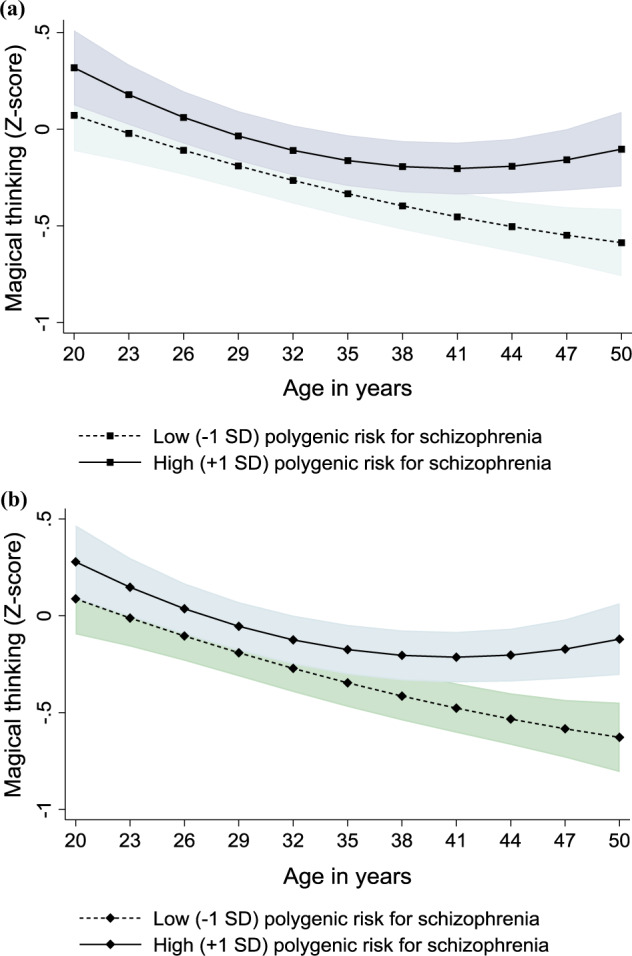
A strong genetic background for psychoses is well-established. Most individuals with a high genetic risk for schizophrenia, however, do not develop the disorder. We investigated whether individuals, who have a high genetic risk for schizophrenia but no non-affective psychotic disorders, are predisposed to develop milder forms of deviant thinking in terms of magical thinking. Participants came from the population-based Young Finns Study (n = 1292). The polygenic risk score for schizophrenia (PRS) was calculated on the basis of the most recent genome-wide association study (GWAS). Psychiatric diagnoses over the lifespan were collected up to 2017 from the registry of hospital care. Magical thinking was evaluated with the Spiritual Acceptance Scale (e.g., beliefs in telepathy, miracles, mystical events, or sixth sense) of the Temperament and Character Inventory in 1997, 2001, and 2012 (participants were 20-50-year-olds). We found that, among those who did not develop non-affective psychotic disorders, high PRS predicted higher magical thinking in adulthood (p = 0.001). Further, PRS predicted different developmental courses: a low PRS predicted a steady decrease in magical thinking from age 20 to 50 years, while in individuals with high PRS the decrease in magical thinking ceased in middle age so that their level of magical thinking remained higher than expected for that age. These findings remained when controlling for sex, childhood family environment, and adulthood socioeconomic factors. In conclusion, if high PRS does not lead to a non-affective psychotic disorder, it predicts milder forms of deviant thinking such as elevated magical thinking in adulthood, especially in middle age. The finding enhances our understanding of different outcomes of high genetic psychosis risk.
精神疾病的强烈遗传背景已得到充分证实。然而,大多数遗传易感性高的精神分裂症患者并未出现该疾病。我们研究了那些遗传易感性高但没有非情感性精神病障碍的个体,是否更容易出现轻微的思维异常,如迷信思维。参与者来自基于人群的“年轻芬兰人研究”(Young Finns Study)(n=1292)。基于最新的全基因组关联研究(GWAS)计算了精神分裂症的多基因风险评分(PRS)。通过医院护理登记系统,在 2017 年之前收集了终生的精神疾病诊断数据。通过气质和性格问卷(Temperament and Character Inventory)中的精神接受量表(Spiritual Acceptance Scale)评估了迷信思维,该量表包含了例如心灵感应、奇迹、神秘事件或第六感的信仰等问题(参与者年龄在 20-50 岁之间)。我们发现,在那些没有发展为非情感性精神病障碍的个体中,高 PRS 预测成年期的迷信思维较高(p=0.001)。此外,PRS 还预测了不同的发展轨迹:低 PRS 预测从 20 岁到 50 岁期间迷信思维的稳步下降,而在高 PRS 的个体中,中年时迷信思维的下降停止,因此他们的迷信思维水平仍高于该年龄段的预期水平。在控制了性别、童年家庭环境和成年社会经济因素后,这些发现仍然存在。总之,如果高 PRS 不导致非情感性精神病障碍,它预测成年期出现更轻微的思维异常,如迷信思维增加,尤其是在中年时期。该发现增进了我们对高遗传精神病风险不同结果的理解。