State Key Laboratory of Natural and Biomimetic Drugs, School of Pharmaceutical Sciences, Peking University, 38 Xueyuan Road, Beijing 100191, China.
U.S. Army Medical Research Institute of Infectious Diseases, Fort Detrick, MD 21702, USA.
Sci Adv. 2018 Nov 21;4(11):eaau8408. doi: 10.1126/sciadv.aau8408. eCollection 2018 Nov.
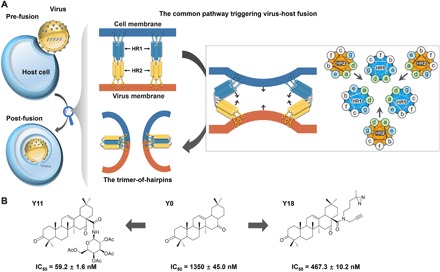
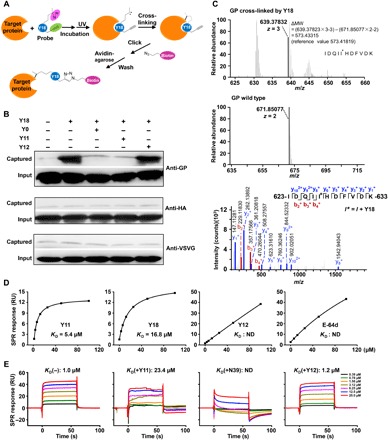
A trimer-of-hairpins motif has been identified in triggering virus-cell fusion within a variety of viral envelopes. Chemically manipulating such a motif represents current repertoire of viral fusion inhibitors. Here, we report that triterpenoids, a class of natural products, antagonize this trimer-of-hairpins via its constitutive heptad repeat-2 (HR2), a prevalent α-helical coil in class I viral fusion proteins. Triterpenoids inhibit the entry of Ebola, Marburg, HIV, and influenza A viruses with distinct structure-activity relationships. Specifically, triterpenoid probes capture the viral envelope via photocrosslinking HR2. Profiling the Ebola HR2-triterpenoid interactions using amino acid substitution, surface plasmon resonance, and nuclear magnetic resonance revealed six residues accessible to triterpenoids, leading to wrapping of the hydrophobic helix and blocking of the HR1-HR2 interaction critical in the trimer-of-hairpins formation. This finding was also observed in the envelopes of HIV and influenza A viruses and might potentially extend to a broader variety of viruses, providing a mechanistic insight into triterpenoid-mediated modulation of viral fusion.
发夹三聚体基序已在多种病毒包膜中被鉴定为触发病毒-细胞融合的关键。化学修饰这种基序代表了当前病毒融合抑制剂的作用方式。在这里,我们报告三萜类化合物作为一类天然产物,通过其组成型七肽重复 2(HR2)拮抗这种三聚体发夹,HR2 是 I 类病毒融合蛋白中普遍存在的α-螺旋卷曲。三萜类化合物以不同的结构-活性关系抑制埃博拉、马尔堡、HIV 和甲型流感病毒的进入。具体来说,三萜类探针通过光交联捕获病毒包膜 HR2。通过氨基酸取代、表面等离子体共振和核磁共振对埃博拉 HR2-三萜类相互作用进行分析,揭示了六个三萜类化合物可接触的残基,导致疏水性螺旋的包裹和 HR1-HR2 相互作用的阻断,这对三聚体发夹的形成至关重要。在 HIV 和甲型流感病毒的包膜中也观察到了这一发现,这可能会扩展到更广泛的病毒种类,为三萜类化合物介导的病毒融合调节提供了机制上的见解。