Center for Membrane and Cell Physiology, University of Virginia, Charlottesville, VA 22908, USA.
Department of Molecular Physiology and Biological Physics, University of Virginia, Charlottesville, VA 22908, USA.
Sci Adv. 2017 Jun 28;3(6):e1700338. doi: 10.1126/sciadv.1700338. eCollection 2017 Jun.
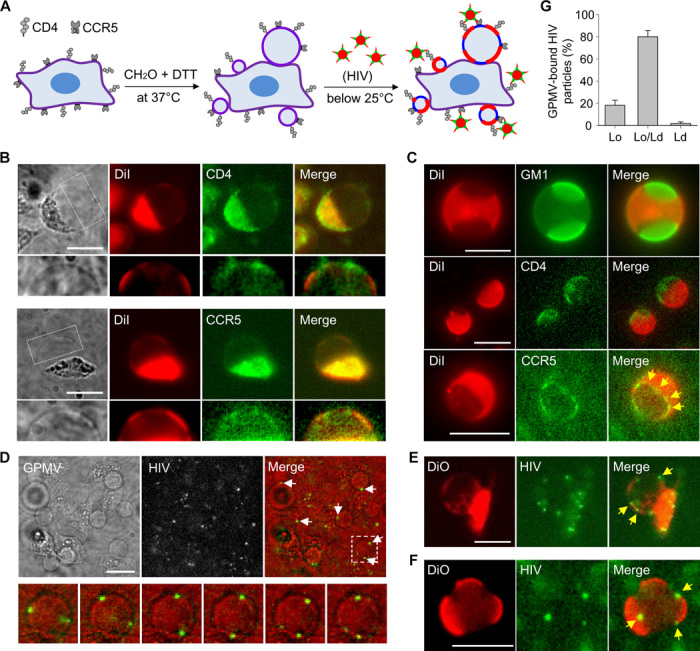
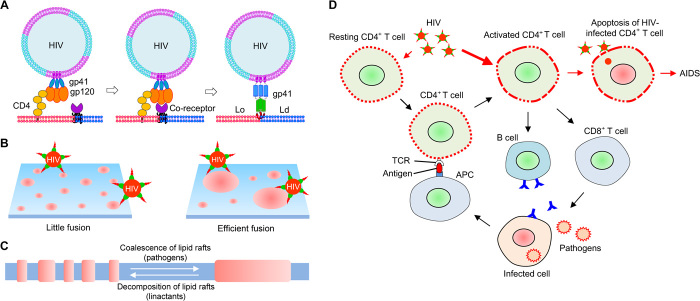
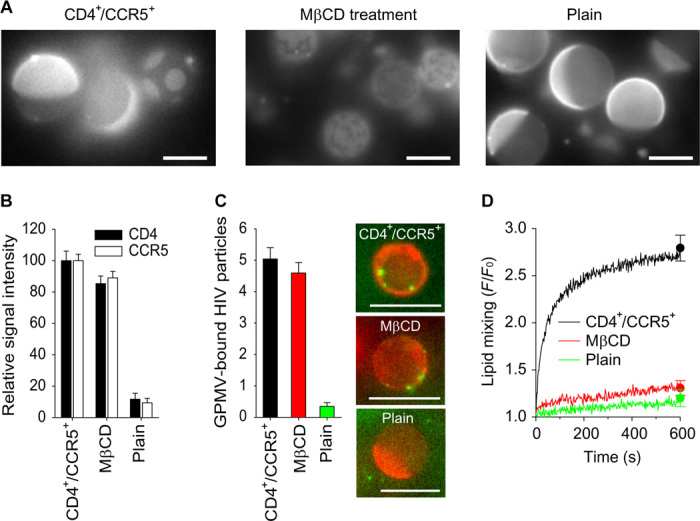
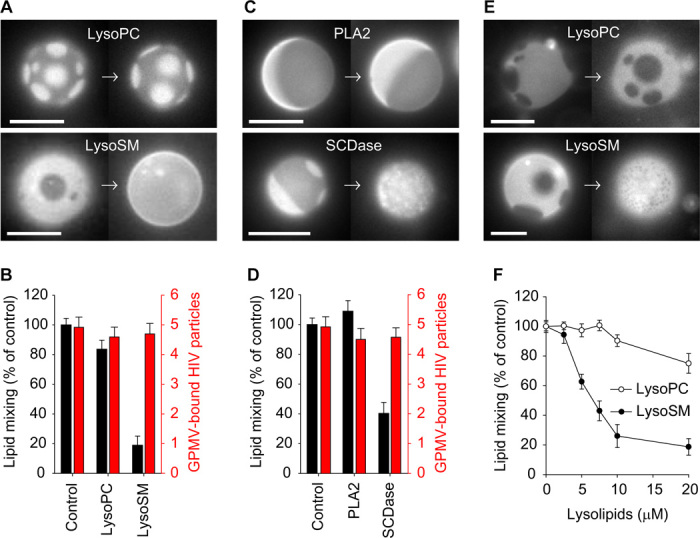
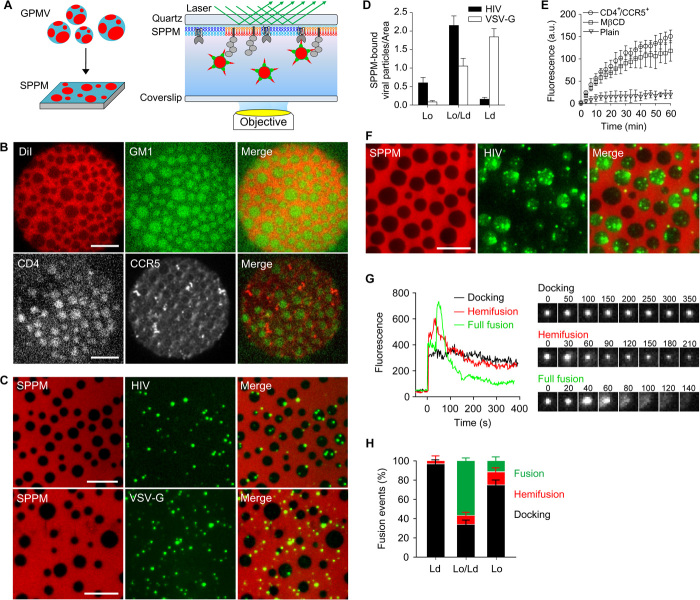
It has been proposed that cholesterol in host cell membranes plays a pivotal role for cell entry of HIV. However, it remains largely unknown why virions prefer cholesterol-rich heterogeneous membranes to uniformly fluid membranes for membrane fusion. Using giant plasma membrane vesicles containing cholesterol-rich ordered and cholesterol-poor fluid lipid domains, we demonstrate that the HIV receptor CD4 is substantially sequestered into ordered domains, whereas the co-receptor CCR5 localizes preferentially at ordered/disordered domain boundaries. We also show that HIV does not fuse from within ordered regions of the plasma membrane but rather at their boundaries. Ordered/disordered lipid domain coexistence is not required for HIV attachment but is a prerequisite for successful fusion. We propose that HIV virions sense and exploit membrane discontinuities to gain entry into cells. This study provides surprising answers to the long-standing question about the roles of cholesterol and ordered lipid domains in cell entry of HIV and perhaps other enveloped viruses.
有人提出,宿主细胞膜中的胆固醇在 HIV 进入细胞中起着关键作用。然而,为什么病毒更喜欢富含胆固醇的不均匀膜而不是均匀的流动膜来进行膜融合,这在很大程度上仍然未知。使用含有富含胆固醇的有序和胆固醇贫乏的流动脂质域的巨大质膜囊泡,我们证明 HIV 受体 CD4 被大量隔离在有序域中,而共受体 CCR5 则优先定位于有序/无序域边界。我们还表明,HIV 不是从质膜的有序区域内部融合,而是在其边界处融合。有序/无序脂质域共存不是 HIV 附着所必需的,但却是成功融合的前提条件。我们提出,HIV 病毒颗粒感知并利用膜不连续性进入细胞。这项研究为关于胆固醇和有序脂质域在 HIV 以及其他包膜病毒进入细胞中的作用的长期存在的问题提供了令人惊讶的答案。