Lin Yu-Hsien, Chang Feng-Shuo, Chen Kun-Hui, Huang Kui-Chou, Su Kuo-Chih
Department of Orthopedic Surgery, Taichung Veterans General Hospital, 1650, Taiwan Boulevard Sect. 4, Taichung City, 40705, Taiwan.
Department of Biomedical Engineering, Hungkuang University, 1018, Sec. 6, Taiwan Boulevard, Shalu District, Taichung City, 43302, Taiwan.
BMC Musculoskelet Disord. 2018 Nov 24;19(1):411. doi: 10.1186/s12891-018-2335-9.
Reasons for dissatisfaction with total knee arthroplasty (TKA) include unequal flexion or extension gap, soft tissue imbalance, and patella maltracking, which often occur with mismatch between femoral and tibial coronal bony alignment in the knee joint or extremely varus or valgus alignment. However, lower limb coronal alignment classification is based only on hip-knee-ankle angle (HKAA), leading to oversight regarding a mismatch between femoral and tibial coronal alignment. We aimed to classify alignment of the lower limbs according to the mechanical alignment of the femur and tibia in a healthy population.
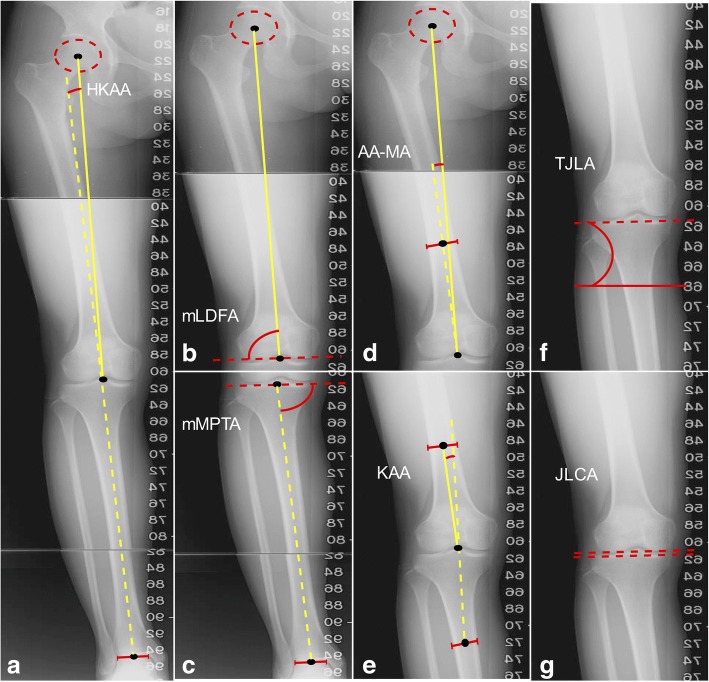
All 214 normal triple films were reviewed retrospectively. HKAA, mechanical lateral distal femoral angle (mLDFA), mechanical medial proximal tibial angle (mMPTA), angle between the femoral anatomical axis and the mechanical axis (AA-MA), and knee alignment angle (KAA) were measured. Subjects were categorized into one of five types based on the mechanical alignment of femur and tibia.
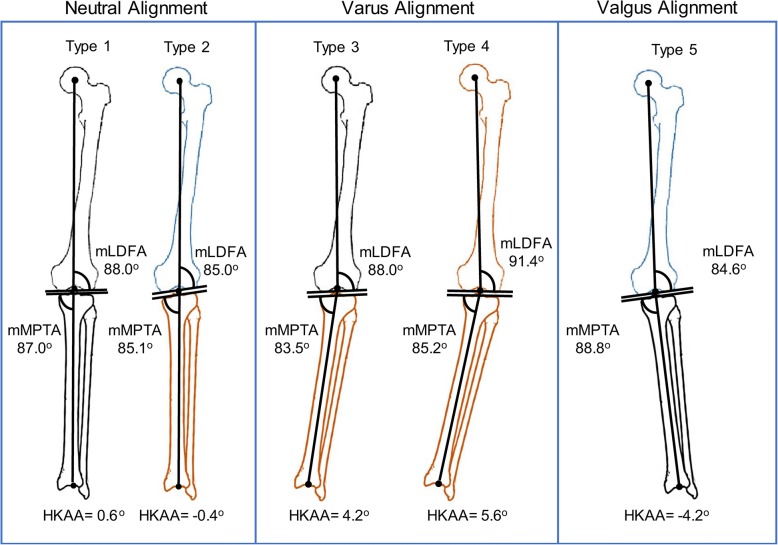
Mean HKAA, mLDFA, and mMPTA of all subjects were 1.2°, 87.3°, and 85.8°, respectively. All subjects were classified into one of five types with significant differences (p < 0.001). About 61% of subjects showed neutral alignment, of which nearly 40% were type 2 (valgus of the femur and varus of the tibia with oblique joint line: mLDFA 85.0° ± 1.4°, mMPTA 85.1° ± 1.2°, TJLA 2.7° ± 2.4°) and 60% exhibited neutral alignment with a neutral femur and tibia (type 1). In varus and valgus types, mismatch between the mechanical angle of the femur and tibia was common. Varus alignment, including types 3 (varus of the tibia: mLDFA 88.0° ± 1.4°, mMPTA 83.5° ± 1.6°) and 4 (varus of both the tibia and femur: mLDFA 91.4° ± 1.4°, mMTPA 85.2° ± 2.0°), was found in 30% of subjects. Valgus alignment (type 5 valgus of femur: mLDFA 84.6° ± 1.6°, mMPTA 88.8° ± 2.0°) accounted for 8.9% of all subjects.
Mismatch between mechanical alignment of the femur and tibia was common in varus and valgus alignment types. Joint line obliquity was also observed in 40% of the neutral alignment population. This classification provides a quick, simple interpretation of femoral and tibial coronal alignment, and more detailed guidance for preoperative planning for TKA than the traditional varus-neutral-valgus classification.
全膝关节置换术(TKA)患者不满意的原因包括屈伸间隙不等、软组织失衡和髌骨轨迹不良,这些情况常发生于膝关节股骨与胫骨冠状面骨对线不匹配或存在极重度内翻或外翻对线时。然而,下肢冠状面对线分类仅基于髋-膝-踝角(HKAA),导致对股骨与胫骨冠状面对线不匹配的情况有所忽视。我们旨在根据健康人群中股骨和胫骨的机械对线情况对下肢对线进行分类。
回顾性分析214例正常三联X线片。测量HKAA、机械性股骨远端外侧角(mLDFA)、机械性胫骨近端内侧角(mMPTA)、股骨髓腔轴与机械轴之间的夹角(AA-MA)以及膝关节对线角(KAA)。根据股骨和胫骨的机械对线情况将受试者分为五种类型之一。
所有受试者的平均HKAA、mLDFA和mMPTA分别为1.2°、87.3°和85.8°。所有受试者被分为五种类型之一,差异有统计学意义(p < 0.001)。约61%的受试者显示为中立对线,其中近40%为2型(股骨外翻、胫骨内翻且关节线倾斜:mLDFA 85.0°±1.4°,mMPTA 85.1°±1.2°,TJLA 2.7°±2.4°),60%表现为股骨和胫骨均为中立的中立对线(1型)。在内翻和外翻类型中,股骨和胫骨的机械角度不匹配很常见。内翻对线,包括3型(胫骨内翻:mLDFA 88.0°±1.4°,mMPTA 83.5°±1.6°)和4型(胫骨和股骨均内翻:mLDFA 91.4°±1.4°,mMTPA 85.2°±2.0°),在30%的受试者中被发现。外翻对线(5型股骨外翻:mLDFA 84.6°±1.6°,mMPTA 88.8°±2.0°)占所有受试者的8.9%。
在内翻和外翻对线类型中,股骨和胫骨的机械对线不匹配很常见。在40%的中立对线人群中也观察到关节线倾斜。这种分类方法能快速、简单地解读股骨和胫骨的冠状面对线情况,并且相较于传统的内翻-中立-外翻分类,能为TKA术前规划提供更详细的指导。