Veterinary Services Program, Walter Reed Army Institute of Research, Silver Spring, MD.
Performance Assessment and Chemical Evaluation (PACE) Laboratory, Department of Behavioral Biology, Center for Military Psychiatry and Neuroscience, Walter Reed Army Institute of Research, Silver Spring, MD.
PLoS One. 2018 Nov 26;13(11):e0207804. doi: 10.1371/journal.pone.0207804. eCollection 2018.
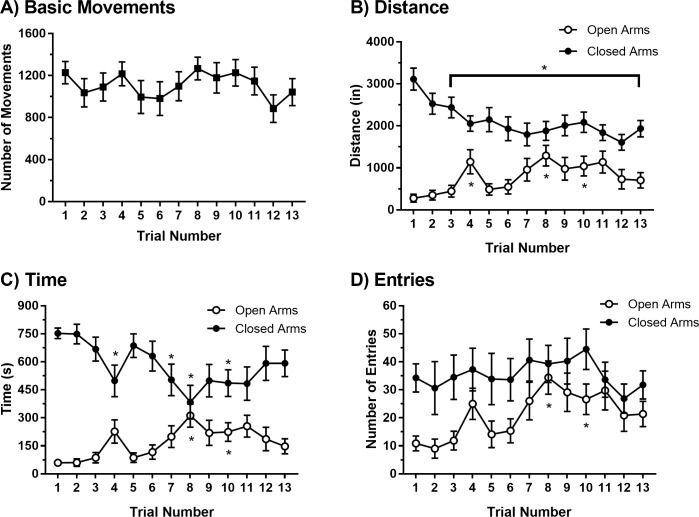
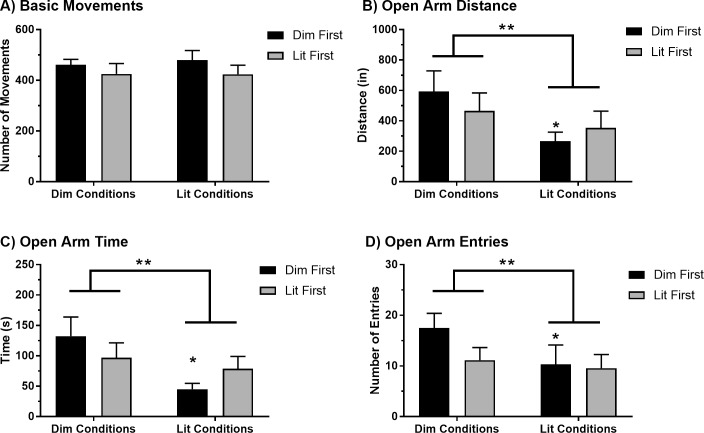
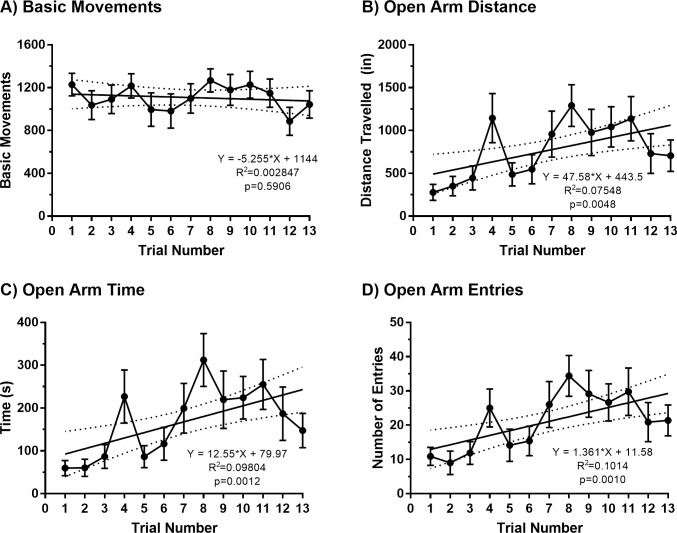
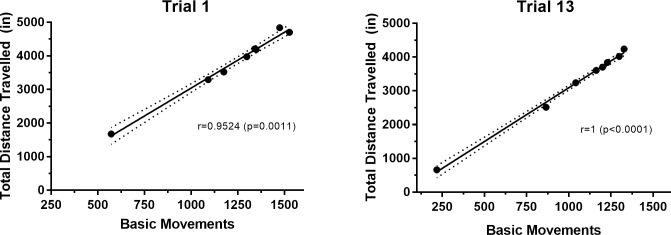
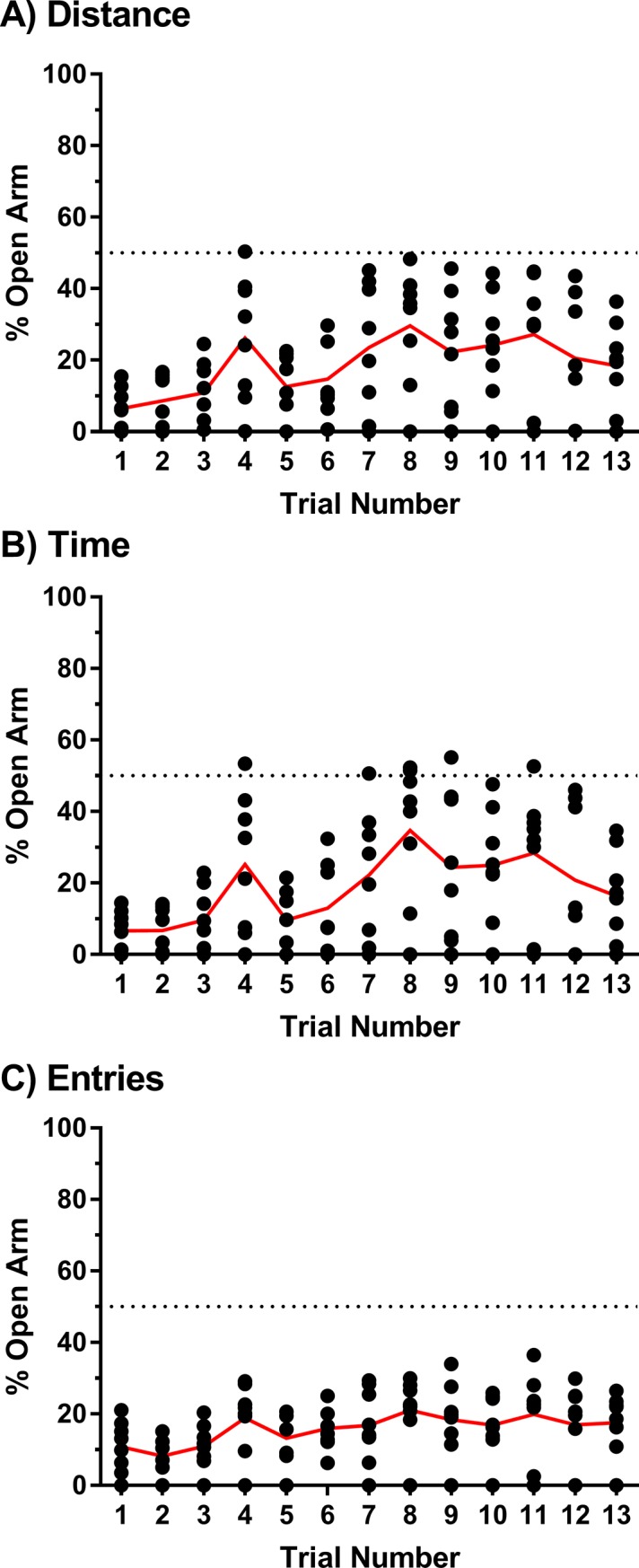
The elevated plus maze (EPM) is routinely used in neuroscience research to evaluate emotional behavior in rodents by measuring general exploratory performance and avoidance of the aversive open arms of the maze. According to standard practice, behavior on the EPM is evaluated during a single trial to avoid the possibility of habituation to the apparatus that would result in lost sensitivity of key outcome measures. However, this possibility has not been systematically evaluated across repeated trials or across different environmental conditions. In the current study, we assessed within-subject behavior on the EPM in adult male rats over thirteen trials (tested twice weekly) repeated under identical conditions. We also assessed within-subject behavior on the EPM in adult male rats under dim (1 lux in the closed arm) and lit (246 lux in the closed arm) environmental conditions. We found that measures of general performance (basic movements and total distanced travelled throughout the maze) were stable across repeated trials and environmental conditions. We found that measures of open arm avoidance (distance travelled in, time spent in and entries in to the open arm) varied across trials and environmental conditions and were sensitive to the lighting conditions of the initial test. Though measures of open arm avoidance did show a linear trend indicative of habituation across repeated trials, this effect was variable across trials. Notably, preference for the open arm over the closed arm (measured as % of time spent in the open arm) assessed among individual animals occurred rarely and was never observed on the group level across the thirteen repeated trials. Together, these data demonstrate that measures of general performance such as basic movements and total distance traveled are robust to repeated testing and changing environmental lighting conditions. In contrast, measures of open arm avoidance show habituation with repeated testing and are sensitive to changing environmental lighting conditions. Based on these results, we suggest that within-subjects repeated testing on the EPM is valid in well-controlled studies that include an untreated control group to account for inter-trial variability and habituation.
高架十字迷宫(EPM)通常用于神经科学研究,通过测量一般探索性能和回避迷宫厌恶的开放臂,来评估啮齿动物的情绪行为。根据标准实践,在单次试验中评估 EPM 上的行为,以避免对仪器的习惯化的可能性,否则会导致关键结果测量的敏感性丧失。然而,这种可能性尚未在重复试验或不同环境条件下得到系统评估。在当前的研究中,我们在成年雄性大鼠上评估了 EPM 上的个体内行为,共进行了十三次试验(每周测试两次),并在相同条件下重复进行。我们还在成年雄性大鼠中评估了 EPM 上的个体内行为,分别在昏暗(封闭臂中的 1 勒克斯)和明亮(封闭臂中的 246 勒克斯)环境条件下进行测试。我们发现,一般性能的测量(整个迷宫中基本运动和总距离)在重复试验和环境条件下是稳定的。我们发现,回避开放臂的测量(进入、在开放臂中的时间和在开放臂中的距离)在试验和环境条件之间存在差异,并且对初始测试的照明条件敏感。尽管回避开放臂的测量确实表现出跨重复试验的习惯化线性趋势,但这种效应在试验之间是可变的。值得注意的是,在个体动物中评估的对开放臂的偏好(以在开放臂中度过的时间百分比表示)很少发生,并且在十三次重复试验中从未在群体水平上观察到。总的来说,这些数据表明,一般性能的测量,如基本运动和总距离,对重复测试和改变环境照明条件具有稳健性。相比之下,回避开放臂的测量随着重复测试而出现习惯化,并且对改变环境照明条件敏感。基于这些结果,我们建议在 EPM 上进行个体内重复测试在包括未处理对照组的精心控制研究中是有效的,以解释试验间的变异性和习惯化。