Lemaire Stéphane D, Tedesco Daniele, Crozet Pierre, Michelet Laure, Fermani Simona, Zaffagnini Mirko, Henri Julien
Laboratoire de Biologie Moléculaire et Cellulaire des Eucaryotes, Institut de Biologie Physico-Chimique, Unité Mixte de Recherche 8226 CNRS Sorbonne Université, 13 rue Pierre et Marie Curie, 75005 Paris, France.
Bio-Pharmaceutical Analysis Section (Bio-PhASe), Department of Pharmacy and Biotechnology, University of Bologna, via Belmeloro 6, 40126 Bologna, Italy.
Antioxidants (Basel). 2018 Nov 23;7(12):171. doi: 10.3390/antiox7120171.
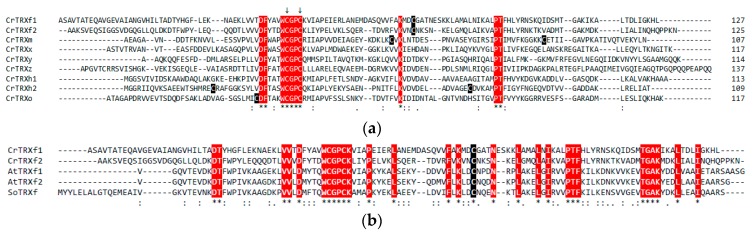
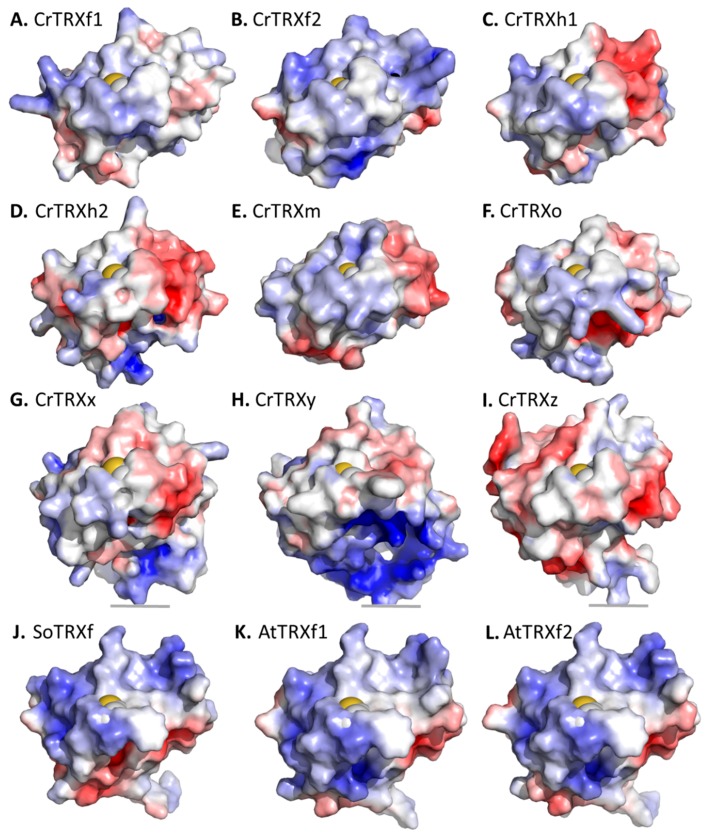
Protein disulfide reduction by thioredoxins (TRXs) controls the conformation of enzyme active sites and their multimeric complex formation. TRXs are small oxidoreductases that are broadly conserved in all living organisms. In photosynthetic eukaryotes, TRXs form a large multigenic family, and they have been classified in different types: f, m, x, y, and z types are chloroplastic, while o and h types are located in mitochondria and cytosol. In the model unicellular alga , the TRX family contains seven types, with f- and h-types represented by two isozymes. Type-f TRXs interact specifically with targets in the chloroplast, controlling photosynthetic carbon fixation by the Calvin⁻Benson cycle. We solved the crystal structures of TRX f2 and TRX h1 from . The systematic comparison of their atomic features revealed a specific conserved electropositive crown around the active site of TRX f, complementary to the electronegative surface of their targets. We postulate that this surface provides specificity to each type of TRX.
硫氧还蛋白(TRXs)介导的蛋白质二硫键还原作用控制着酶活性位点的构象及其多聚体复合物的形成。TRXs是一类在所有生物中广泛保守的小型氧化还原酶。在光合真核生物中,TRXs形成了一个庞大的多基因家族,它们被分为不同类型:f、m、x、y和z型存在于叶绿体中,而o型和h型位于线粒体和细胞质中。在模式单细胞藻类中,TRX家族包含七种类型,f型和h型各有两种同工酶。f型TRXs与叶绿体中的靶标特异性相互作用,通过卡尔文-本森循环控制光合碳固定。我们解析了来自[具体来源未给出]的TRX f2和TRX h1的晶体结构。对它们原子特征的系统比较揭示了TRX f活性位点周围有一个特定的保守正电冠,与其靶标的负电表面互补。我们推测该表面赋予了每种类型的TRX特异性。