Yu Kenneth H, Ricigliano Mark, McCarthy Brian, Chou Joanne F, Capanu Marinela, Cooper Brandon, Bartlett Andrew, Covington Christina, Lowery Maeve A, O'Reilly Eileen M
Memorial Sloan Kettering Cancer Center, New York, NY 10065, USA.
Weill Cornell Medical College, New York, NY 10065, USA.
Cancers (Basel). 2018 Nov 24;10(12):467. doi: 10.3390/cancers10120467.
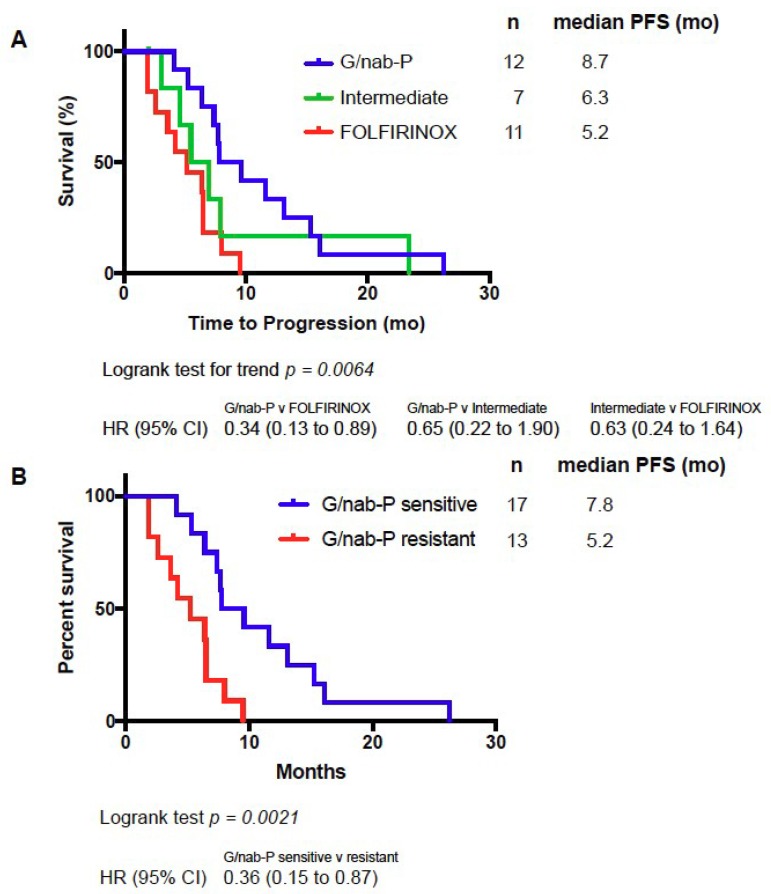
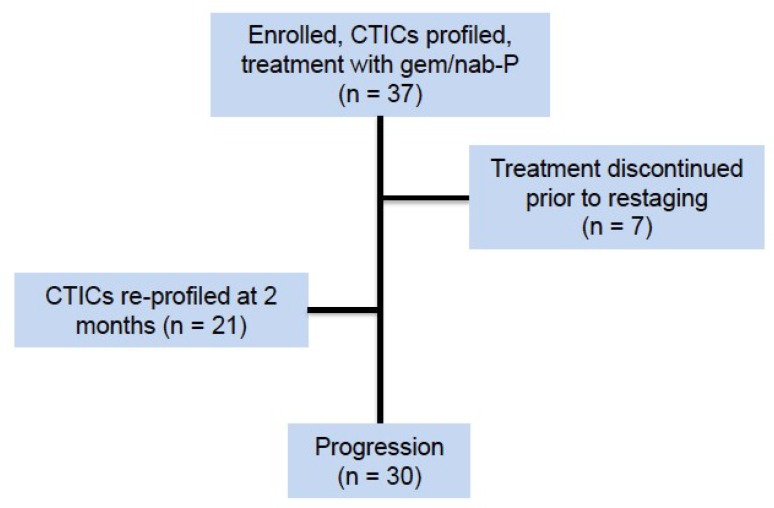
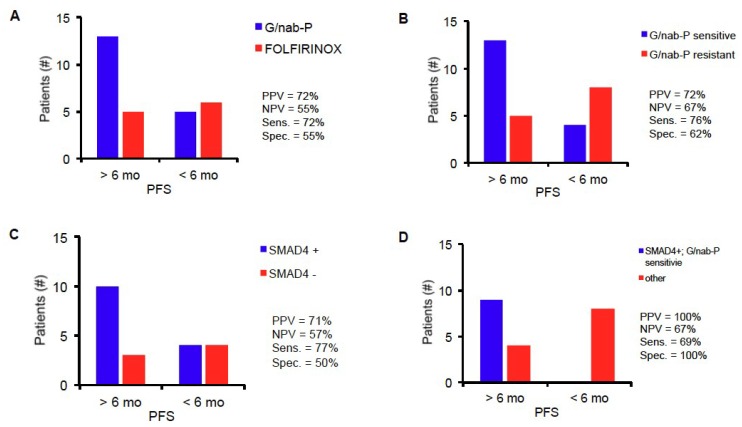
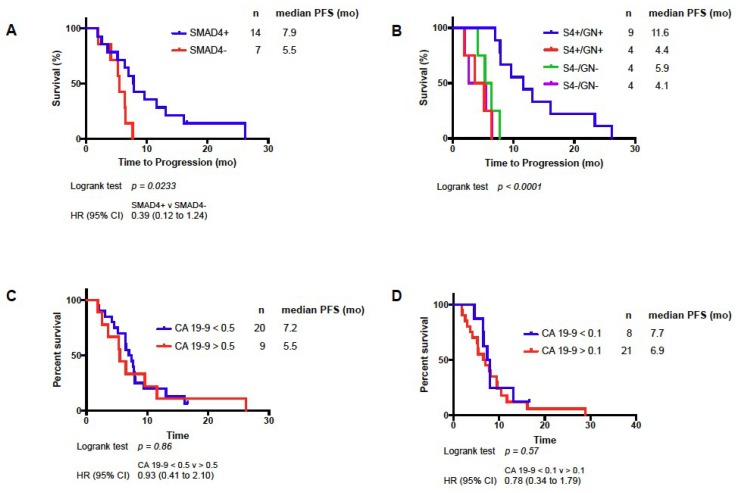
Previous studies have shown that pharmacogenomic modeling of circulating tumor and invasive cells (CTICs) can predict response of pancreatic ductal adenocarcinoma (PDAC) to combination chemotherapy, predominantly 5-fluorouracil-based. We hypothesized that a similar approach could be developed to predict treatment response to standard frontline gemcitabine with nab-paclitaxel (G/nab-P) chemotherapy. Gene expression profiles for responsiveness to G/nab-P were determined in cell lines and a test set of patient samples. A prospective clinical trial was conducted, enrolling 37 patients with advanced PDAC who received G/nab-P. Peripheral blood was collected prior to treatment, after two months of treatment, and at progression. The CTICs were isolated based on a phenotype of collagen invasion. The RNA was isolated, cDNA synthesized, and qPCR gene expression analyzed. Patients were most closely matched to one of three chemotherapy response templates. Circulating tumor and invasive cells' expression was measured serially. The CTICs were reliably isolated and profiled from peripheral blood prior to and during chemotherapy treatment. Individual patients could be matched to distinct response templates predicting differential responses to G/nab-P treatment. Progression free survival was significantly correlated to response prediction and Δ was significantly associated with disease progression. These findings support phenotypic profiling and Δ of CTICs as promising clinical tools for choosing effective therapy in advanced PDAC, and for anticipating disease progression.
先前的研究表明,循环肿瘤细胞和侵袭性细胞(CTICs)的药物基因组学模型可以预测胰腺导管腺癌(PDAC)对联合化疗(主要是基于5-氟尿嘧啶的化疗)的反应。我们假设可以开发一种类似的方法来预测对标准一线吉西他滨联合白蛋白结合型紫杉醇(G/nab-P)化疗的治疗反应。在细胞系和一组患者样本测试集中确定了对G/nab-P反应的基因表达谱。进行了一项前瞻性临床试验,招募了37例接受G/nab-P治疗的晚期PDAC患者。在治疗前、治疗两个月后和疾病进展时采集外周血。根据胶原侵袭表型分离CTICs。分离RNA,合成cDNA,并分析qPCR基因表达。患者与三种化疗反应模板之一进行最密切匹配。连续测量循环肿瘤细胞和侵袭性细胞的表达。在化疗治疗前和治疗期间,可以从外周血中可靠地分离出CTICs并进行分析。个体患者可以与不同的反应模板相匹配,从而预测对G/nab-P治疗的不同反应。无进展生存期与反应预测显著相关,Δ与疾病进展显著相关。这些发现支持将CTICs的表型分析和Δ作为在晚期PDAC中选择有效治疗方法以及预测疾病进展的有前景的临床工具。