Health Surveillance Department, Divinópolis, Minas Gerais 35500-007, Brazil.
Dentistry Department, Federal University of Sergipe, Aracaju, Sergipe 49060-108, Brazil.
Int J Environ Res Public Health. 2018 Nov 25;15(12):2641. doi: 10.3390/ijerph15122641.
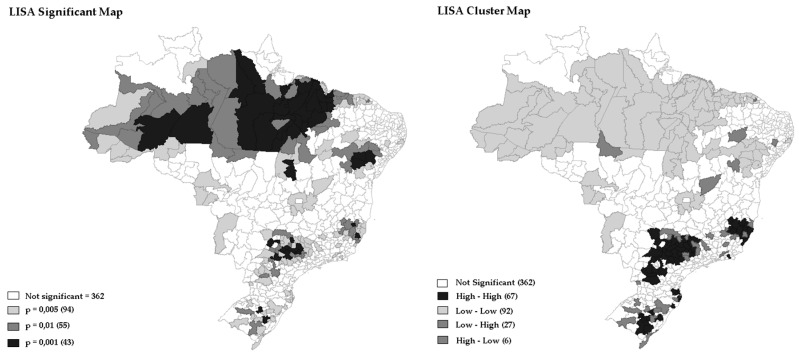
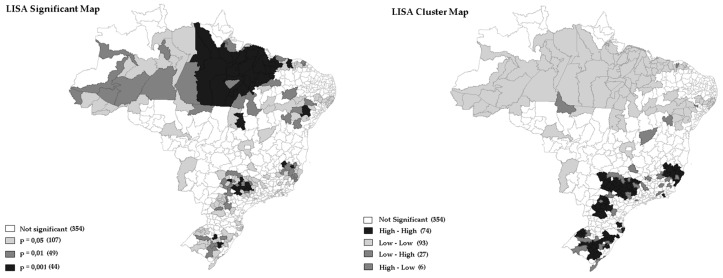
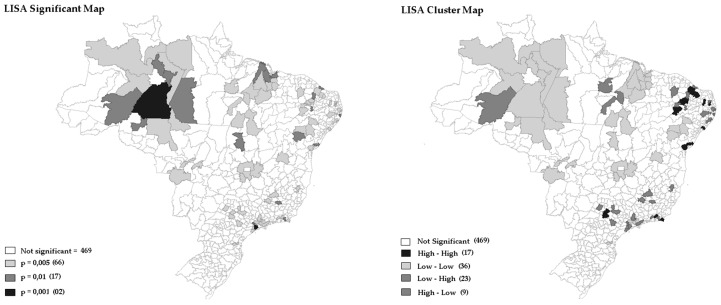
Recent studies have shown a high number of deaths from oral and oropharyngeal cancer worldwide, Brazil included. For this study, the deaths data (ICD-10, chapter II, categories C00 to C14) was obtained from Mortality Information System (SIM) and standardized by gender and population for each of the 554 Microregions of Brazil. The raw mortality rates were adopted as the standard and compared to the application of smoothing by the Bayesian model. In order to describe the geographical pattern of the occurrence of oral cancer, thematic maps were constructed, based on the distributions of mortality rates for Microregions and gender. : There were 7882 deaths registered due to oral and oropharyngeal cancer in Brazil, of which 6291 (79.81%) were male and 1591 (20.19%) female. The Empirical Bayesian Model presented greater scattering with mosaic appearance throughout the country, depicting high rates in Southeast and South regions interpolated with geographic voids of low rates in Midwest and North regions. For males, it was possible to identify expressive clusters in the Southeast and South regions. : The Empirical Bayesian Model allowed an alternative interpretation of the oral and oropharynx cancer mortality mapping in Brazil.
最近的研究表明,全球范围内口腔和口咽癌的死亡率很高,包括巴西。在这项研究中,死亡数据(ICD-10 第二章,类别 C00 至 C14)来自死亡信息系统(SIM),并按性别和人口对巴西的 554 个微地区进行了标准化。原始死亡率被采用为标准,并与贝叶斯模型的平滑应用进行了比较。为了描述口腔癌发生的地理模式,根据微地区和性别死亡率的分布,构建了专题地图。巴西有 7882 人死于口腔和口咽癌,其中 6291 人(79.81%)为男性,1591 人(20.19%)为女性。经验贝叶斯模型在全国范围内呈现出更大的散射和镶嵌外观,显示出东南部和南部地区的高死亡率,而中西部和北部地区的地理空缺则显示出低死亡率。对于男性,可以在东南部和南部地区识别出显著的集群。经验贝叶斯模型允许对巴西口腔和口咽癌死亡率进行另一种解释。