From the Department of Neurology, University of Kentucky, Lexington, Kentucky 40536,
the Departments of Neurology and.
J Biol Chem. 2019 Jan 18;294(3):1045-1058. doi: 10.1074/jbc.RA118.004471. Epub 2018 Nov 26.
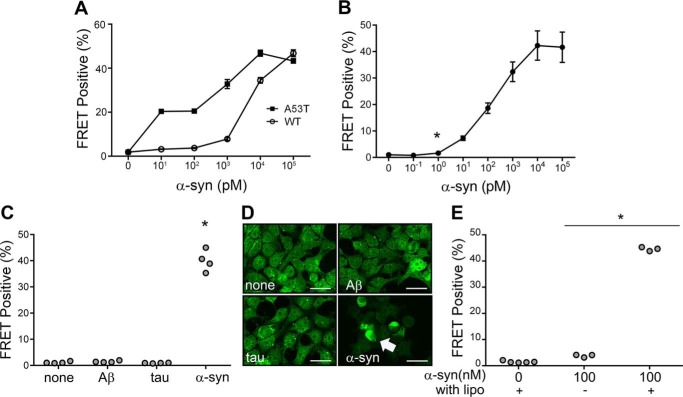
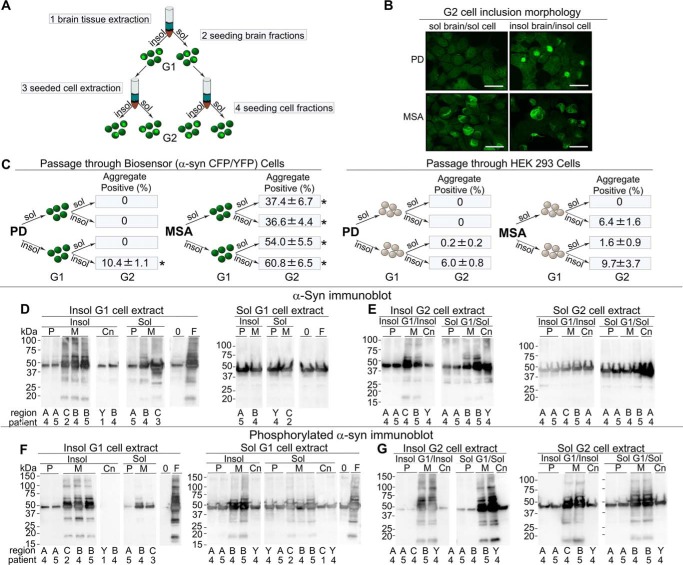
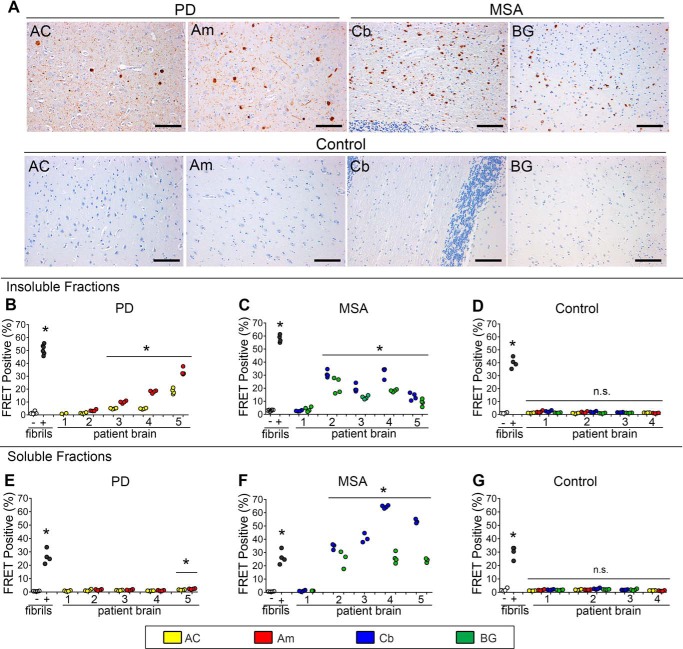
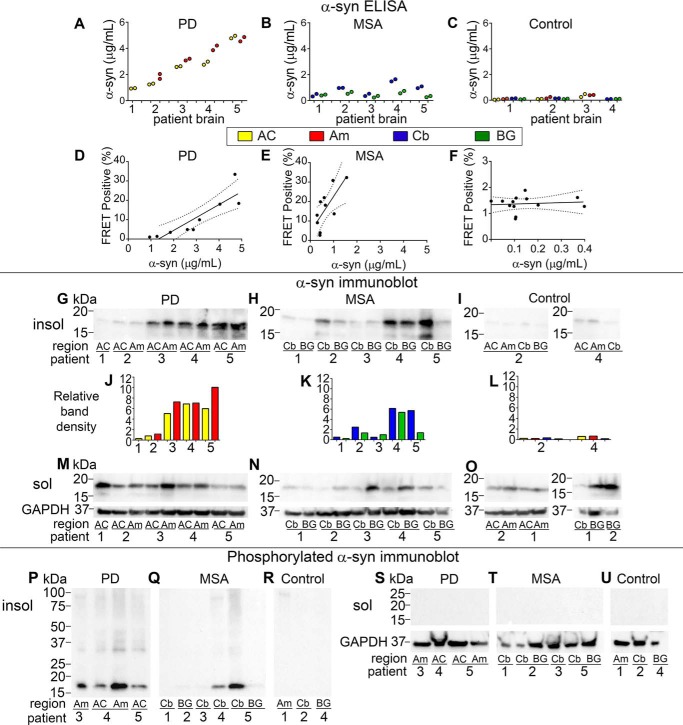
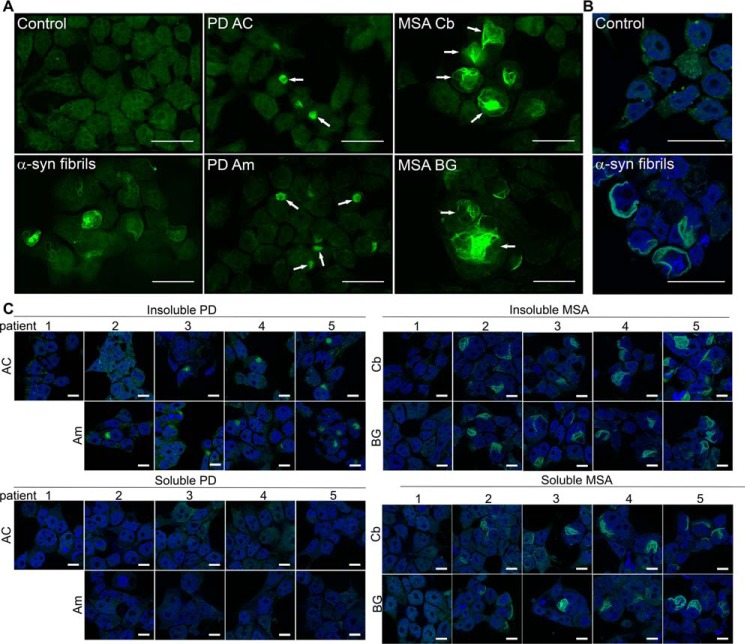
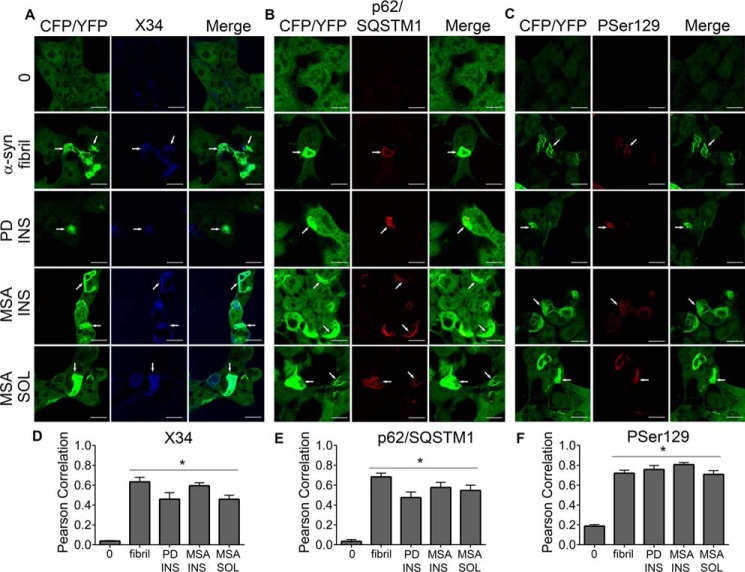
Parkinson's disease (PD) and multiple system atrophy (MSA) are distinct clinical syndromes characterized by the pathological accumulation of α-synuclein (α-syn) protein fibrils in neurons and glial cells. These disorders and other neurodegenerative diseases may progress via prion-like mechanisms. The prion model of propagation predicts the existence of "strains" that link pathological aggregate structure and neuropathology. Prion strains are aggregated conformers that stably propagate and cause disease with defined incubation times and patterns of neuropathology. Indeed, tau prions have been well defined, and research suggests that both α-syn and β-amyloid may also form strains. However, there is a lack of studies characterizing PD- MSA-derived α-syn strains or demonstrating stable propagation of these unique conformers between cells or animals. To fill this gap, we used an assay based on FRET that exploits a HEK293T "biosensor" cell line stably expressing α-syn (A53T)-CFP/YFP fusion proteins to detect α-syn seeds in brain extracts from PD and MSA patients. Both soluble and insoluble fractions of MSA extracts had robust seeding activity, whereas only the insoluble fractions of PD extracts displayed seeding activity. The morphology of MSA-seeded inclusions differed from PD-seeded inclusions. These differences persisted upon propagation of aggregation to second-generation biosensor cells. We conclude that PD and MSA feature α-syn conformers with very distinct biochemical properties that can be transmitted to α-syn monomers in a cell system. These findings are consistent with the idea that distinct α-syn strains underlie PD and MSA and offer possible directions for synucleinopathy diagnosis.
帕金森病(PD)和多系统萎缩(MSA)是两种不同的临床综合征,其特征是神经元和神经胶质细胞中α-突触核蛋白(α-syn)纤维的病理性积累。这些疾病和其他神经退行性疾病可能通过朊病毒样机制进展。朊病毒传播的模型预测存在“株”,将病理性聚集结构与神经病理学联系起来。朊病毒株是稳定传播并具有定义的潜伏期和神经病理学模式的聚集构象。实际上,已经很好地定义了tau 朊病毒,并且研究表明α-syn 和 β-淀粉样蛋白也可能形成株。然而,缺乏对 PD-MSA 衍生的α-syn 株进行特征描述或证明这些独特构象在细胞或动物之间稳定传播的研究。为了填补这一空白,我们使用了一种基于 FRET 的测定法,该测定法利用稳定表达α-syn(A53T)-CFP/YFP 融合蛋白的 HEK293T“生物传感器”细胞系来检测来自 PD 和 MSA 患者脑提取物中的α-syn 种子。MSA 提取物的可溶性和不可溶性部分均具有强大的接种活性,而 PD 提取物的不可溶性部分仅显示出接种活性。MSA 接种物形成的包含物的形态与 PD 接种物形成的包含物不同。这些差异在将聚集物传播到第二代生物传感器细胞时仍然存在。我们得出的结论是,PD 和 MSA 具有具有非常不同生化特性的α-syn 构象,这些构象可以在细胞系统中传递给α-syn 单体。这些发现与以下观点一致,即 PD 和 MSA 是由不同的α-syn 株引起的,并为突触核蛋白病的诊断提供了可能的方向。