Institute of Biochemistry, Biocenter, Goethe University Frankfurt, Max-von-Laue-Straße 9, 60438, Frankfurt/Main, Germany.
Department of Structural Biology, Groningen Biomolecular Sciences and Biotechnology Institute, University of Groningen, Nijenborgh 7, 9747 AG, Groningen, The Netherlands.
Nat Commun. 2018 Nov 26;9(1):4971. doi: 10.1038/s41467-018-07319-2.
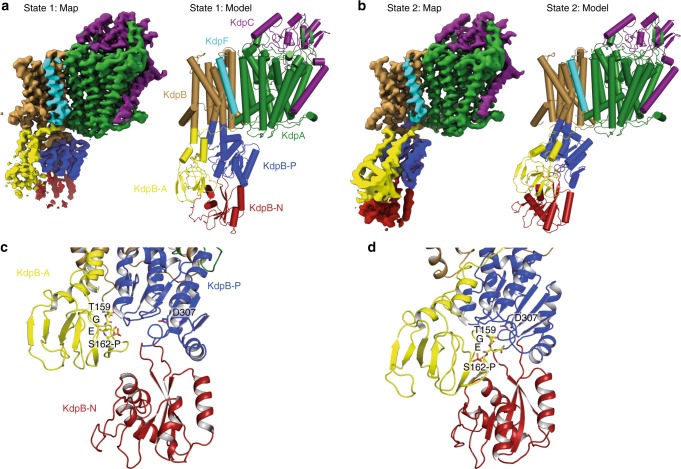
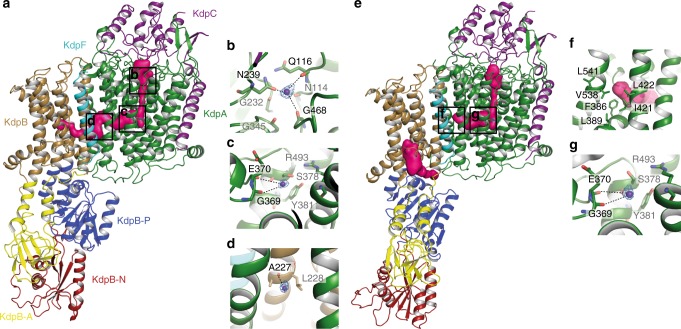
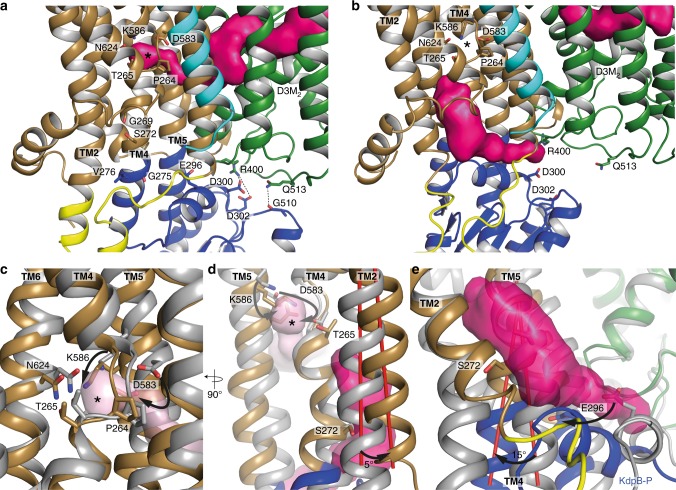
P-type ATPases ubiquitously pump cations across biological membranes to maintain vital ion gradients. Among those, the chimeric K uptake system KdpFABC is unique. While ATP hydrolysis is accomplished by the P-type ATPase subunit KdpB, K has been assumed to be transported by the channel-like subunit KdpA. A first crystal structure uncovered its overall topology, suggesting such a spatial separation of energizing and transporting units. Here, we report two cryo-EM structures of the 157 kDa, asymmetric KdpFABC complex at 3.7 Å and 4.0 Å resolution in an E1 and an E2 state, respectively. Unexpectedly, the structures suggest a translocation pathway through two half-channels along KdpA and KdpB, uniting the alternating-access mechanism of actively pumping P-type ATPases with the high affinity and selectivity of K channels. This way, KdpFABC would function as a true chimeric complex, synergizing the best features of otherwise separately evolved transport mechanisms.
P 型 ATP 酶广泛地将阳离子泵过生物膜以维持重要的离子梯度。在这些酶中,嵌合的 K 摄取系统 KdpFABC 是独特的。虽然 ATP 水解由 P 型 ATP 酶亚基 KdpB 完成,但人们一直认为 K 是由类似通道的亚基 KdpA 运输的。第一个晶体结构揭示了其整体拓扑结构,表明这种能量供应和运输单元的空间分离。在这里,我们报道了两个 cryo-EM 结构,分别在 E1 和 E2 状态下以 3.7Å 和 4.0Å 的分辨率解析了 157kDa 的不对称 KdpFABC 复合物。出乎意料的是,这些结构表明存在通过 KdpA 和 KdpB 中的两个半通道的易位途径,将主动泵送 P 型 ATP 酶的交替访问机制与 K 通道的高亲和力和选择性结合在一起。这样,KdpFABC 将作为一个真正的嵌合复合物起作用,协同来自否则分别进化的运输机制的最佳特征。