Public Health Foundation, Kavuri Hills, Madhapur, Hyderabad, 500081, India.
Department of Public Health Sciences, Karolinska Institutet, Stockholm, Sweden.
BMC Public Health. 2018 Nov 27;18(1):1299. doi: 10.1186/s12889-018-6219-6.
Hand hygiene is a simple and low-cost measure to reduce healthcare associated infection yet it has always been a concern in low as well as high resource settings across the globe. Poor hand hygiene during intra-partum and newborn care may result in sepsis, which is a major cause of death among newborns and puts a financial burden on already strained health systems.
We conducted non-participatory observations in newborn care units and labour rooms from secondary and tertiary level, public and private hospitals, as part of a baseline evaluation of a quality improvement collaborative across two southern states of India. We assessed hand hygiene compliance during examinations and common procedures, using tools adapted from internationally recommended checklists and World Health Organization's concept of five moments of hand hygiene. We assessed differences in compliance by type (public/private), level (secondary/tertiary) and case load (low/intermediate/high). Analysis was adjusted for clustering and weighted as appropriate.
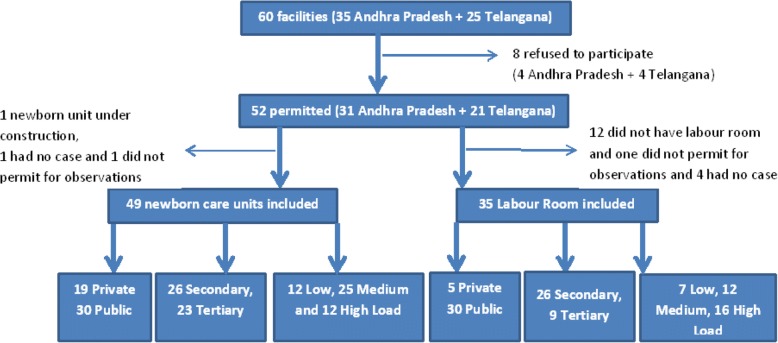
We included 49 newborn care units (19 private, 30 public) and 35 labour rooms (5 private, 30 public) that granted permission. We observed 3661 contacts with newborns and their environment, 242 per-vaginal examinations and 235 deliveries. For the newborns, a greater proportion of contacts in private newborn units than public complied with all steps of hand hygiene (44% vs 12%, p < 0.001), and similarly in tertiary than secondary units (33% vs 12%, p < 0.001) but there was no evidence of a difference by case load of the facility (low load-28%; intermediate load-14%; high load- 24%, p = 0.246). The component with lowest compliance was glove usage where indicated (20%). For deliveries, hand hygiene compliance before delivery was universal in private facilities but seen in only about one-quarter of observations in public facilities (100% vs 27%, p = 0.012). Average overall compliance for hand-hygiene during per-vaginal examinations was 35% and we found no evidence of differences by type of facility.
Observed compliance with hand hygiene was low overall, although better in private than public facilities in both newborn units and labour rooms. Glove usage was a particular problem in newborn care units.
Retrospectively registered with Clinical Trials Registry- India ( CTRI/2018/04/013014 ).
手部卫生是一种简单且低成本的措施,可以降低医源性感染,但在全球范围内,无论是在资源丰富的环境还是资源匮乏的环境中,手部卫生一直是一个令人关注的问题。在分娩期间和新生儿护理过程中,如果手部卫生不佳,可能会导致败血症,这是新生儿死亡的主要原因之一,也给已经紧张的卫生系统带来了经济负担。
我们在印度南部的两个邦进行了一项质量改进合作的基线评估,在二级和三级、公立和私立医院的新生儿护理病房和产房进行了非参与式观察。我们使用了国际推荐检查表和世界卫生组织的五个手部卫生时刻概念改编的工具,评估了检查和常见操作过程中的手部卫生依从性。我们根据类型(公立/私立)、级别(二级/三级)和病例量(低/中/高)评估了依从性的差异。分析时对聚类进行了调整,并根据需要进行了加权。
我们纳入了 49 个新生儿护理病房(19 个私立,30 个公立)和 35 个产房(5 个私立,30 个公立),这些病房都获得了许可。我们观察了 3661 次与新生儿及其环境的接触,242 次阴道检查和 235 次分娩。对于新生儿,私立新生儿病房的接触者遵守手部卫生所有步骤的比例(44%)高于公立医院(12%),三级医院高于二级医院(33%)(12%),但设施的病例量无差异(低负荷-28%;中负荷-14%;高负荷-24%,p=0.246)。最低依从性的环节是指征性戴手套(20%)。对于分娩,私立医院在分娩前普遍遵守手部卫生,但在公立医院,只有约四分之一的观察中可以看到这种情况(100%)(27%),p=0.012)。阴道检查过程中手部卫生的总体平均依从率为 35%,我们没有发现设施类型的差异。
总的来说,观察到的手部卫生依从性较低,尽管私立医院的情况要好于公立医院,无论是在新生儿病房还是产房。在新生儿护理病房,手套使用是一个特别的问题。
在印度临床试验注册处( CTRI/2018/04/013014 )进行了回顾性注册。