Lamanna Anthony, Dughetti Lauren D, Jordan-Ely Julie A, Dobson Kyla M, Dynan Megan, Foo Adeline, Kooiman Louise M P, Murakami Naomi, Fiuza Kaic, Foroughi Siavash, Leal Marcelo, Vidmar Suzanna, Catto-Smith Anthony G, Hutson John M, Southwell Bridget R
Surgical Research Group Murdoch Children's Research Institute Melbourne Victoria Australia.
Department of Paediatrics University of Melbourne Melbourne Victoria Australia.
JGH Open. 2018 Jun 27;2(4):144-151. doi: 10.1002/jgh3.12062. eCollection 2018 Aug.
Polyethylene glycol (PEG) is the gold standard for fecal disimpaction in constipation. A regimen of PEG combined with the stimulant laxative sodium picosulphate (SPS) produced fecal disimpaction in chronically constipated children in the community, but it is unknown if it is effective for more severe constipation. To determine the stool output and effect of a combined PEG and SPS regimen on fecaloma in children with severe constipation and impaction.
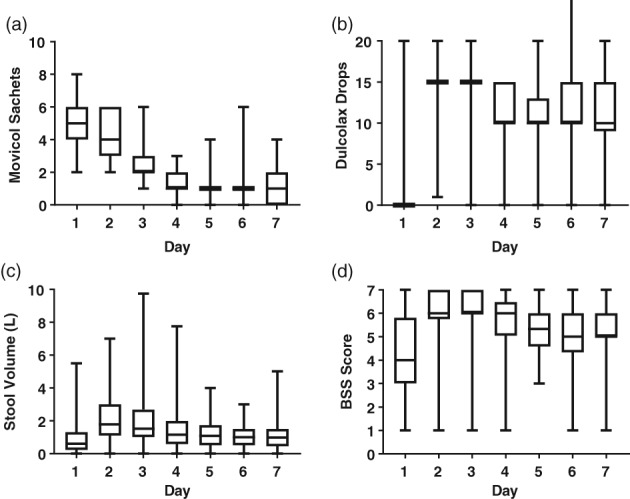
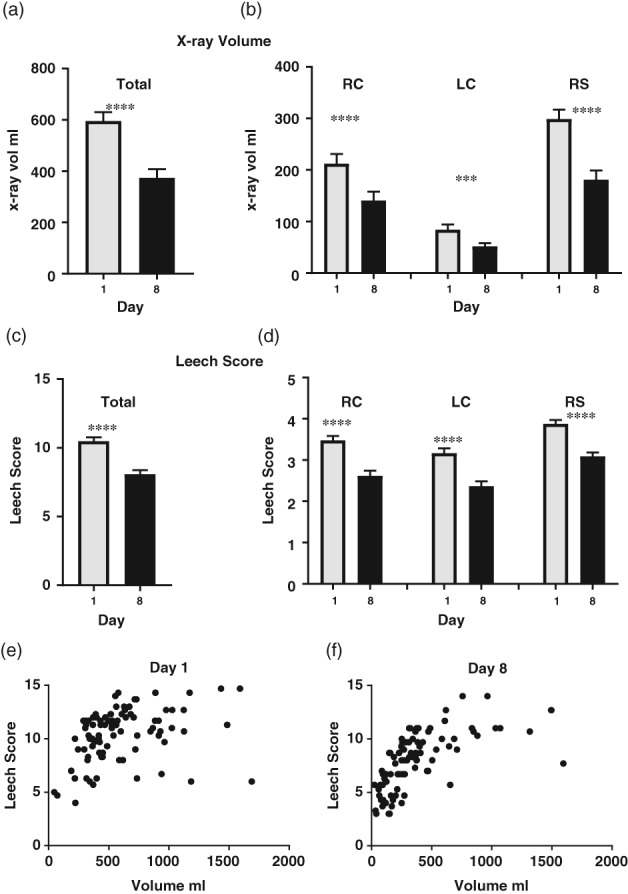
Children with symptoms for a duration of ≥2 years, a palpable fecaloma, and enlarged rectum on X-ray (rectal: pelvic ratio > 0.6) were recruited from a tertiary hospital. Daily diaries recorded laxative dose, stool frequency, volume, and consistency (Bristol stool scale, BSS). Abdominal X-rays were taken on day 1 and day 8, and stool loading was assessed using the Leech score. Laxative doses were based on the child's age. The dose of PEG with electrolytes taken was 2-8 sachets (14.7 g/sachet) on days 1-2, reducing to 2-6 sachets on day 3. The SPS dose was 15-20 drops on days 2-3.
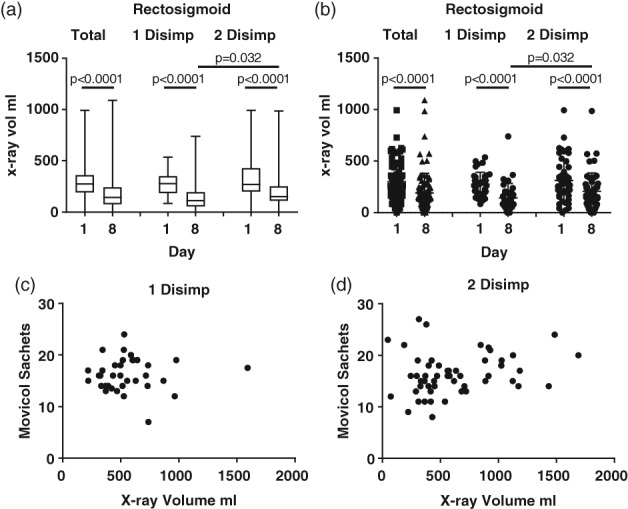
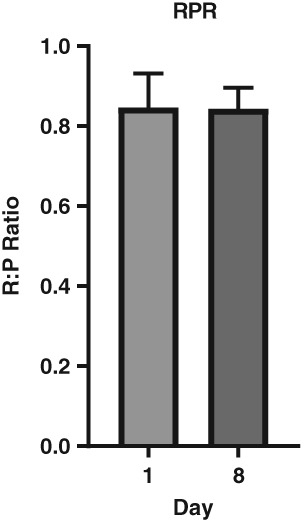
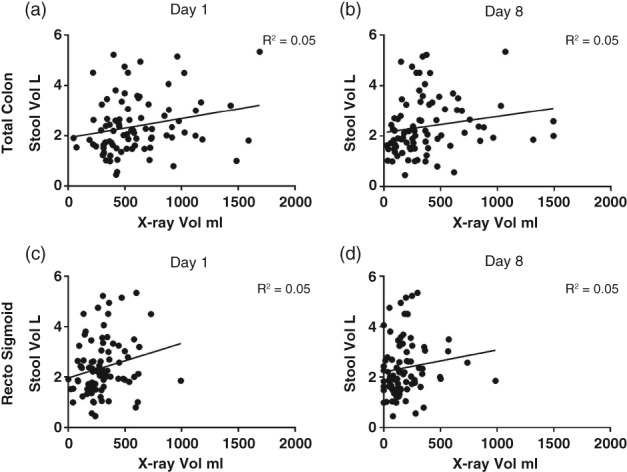
Eighty-nine children (4-18 years) produced a large volume of soft stool (median/inter-quartile-range: 2.2/1.6-3.1 L) over 7 days. Stool volume on X-rays decreased significantly in the colon ( < 0.001). Fecalomas resolved in 40 of 89 children, while 49 needed a second high dose. Rectal:pelvic ratios did not change.
A combined high dose of PEG and SPS on days 1 and 2 was effective in removing the fecaloma in half of the children. Administering high doses for a longer period should be tested to provide outpatient disimpaction for severe fecalomas. Rectums remained flaccid after emptying.
聚乙二醇(PEG)是便秘患者粪便清除的金标准。在社区中,PEG联合刺激性泻药匹可硫酸钠(SPS)的方案可使慢性便秘儿童的粪便得以清除,但对于更严重的便秘是否有效尚不清楚。本研究旨在确定PEG与SPS联合方案对严重便秘且有粪块嵌塞儿童的粪便排出量及对粪块的影响。
从一家三级医院招募症状持续时间≥2年、可触及粪块且X线显示直肠增大(直肠:骨盆比率>0.6)的儿童。每日日记记录泻药剂量、排便频率、粪便量及性状(布里斯托粪便量表,BSS)。在第1天和第8天拍摄腹部X线片,并使用水蛭评分评估粪便负荷。泻药剂量根据儿童年龄确定。第1 - 2天服用含电解质的PEG剂量为2 - 8袋(每袋14.7 g),第3天减至2 - 6袋。第2 - 3天SPS剂量为15 - 20滴。
89名儿童(4 - 18岁)在7天内排出大量软便(中位数/四分位数间距:2.2/1.6 - 3.1 L)。结肠内X线显示的粪便量显著减少(<0.001)。89名儿童中有40名的粪块消失,49名需要再次给予高剂量药物。直肠:骨盆比率未改变。
第1天和第2天联合使用高剂量的PEG和SPS可使一半儿童的粪块清除。应测试更长时间给予高剂量药物以实现严重粪块的门诊清除。排空后直肠仍松弛。