Yan Hui, Zhu Lin, Zhuo Xianyi, Shen Min, Xiang Ping
Department of Forensic Toxicology, Shanghai Key Laboratory of Forensic Medicine, Shanghai Forensic Service Platform, Institute of Forensic Science, Ministry of Justice, PRC, Shanghai, China.
Forensic Sci Res. 2016 Dec 14;1(1):22-27. doi: 10.1080/20961790.2016.1242042. eCollection 2016.
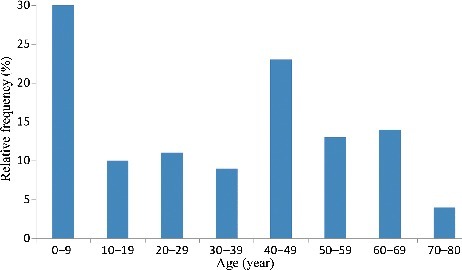
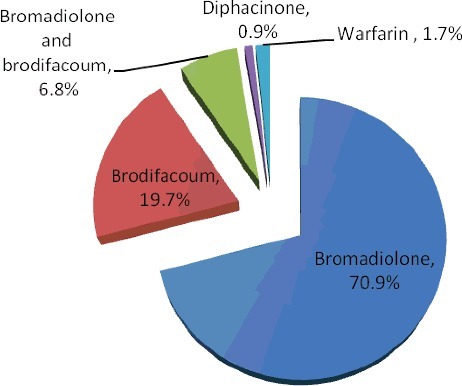
The study was designed to analyze the incidence and pattern of anticoagulant rodenticide intoxication in east China and to discuss strategies of diagnosis based on laboratory analysis experience. A total of 117 patients with anticoagulant rodenticide poisoning confirmed by toxicological analysis in east China were included in this study from 2011 to 2013. The mean concentration of anticoagulant rodenticide, age, and gender of these patients, as well as the mode and type of poisoning, were discussed. The age ranged from less than 1 to 80 years with the feeble preponderance of males (M = 53.0%, F = 47.0%). The 0-9 age group covered the largest ratio of these anticoagulant rodenticide poisoning patients. Accidental or voluntary ingestion seems to be the most common cause of intoxication, with still the poisoning cause being unknown for a large number of positive analyses. Bromadiolone was the most commonly observed anticoagulant rodenticide found in the biological samples, followed by brodifacoum. The concentrations of bromadiolone and brodifacoum that were detected in the first collected whole blood from each patient ranged from 1 to 878 ng/mL (mean 97.9 ng/mL) and from 0.5 to 1566 ng/mL (mean 225.1 ng/mL), respectively. The data analysis shows a high incidence of anticoagulant rodenticide poisoning without awareness of the poisoned subjects, clearly emphasizing the need for toxicological analysis in patients with vitamin K-dependent coagulation disorder and restriction on availability of anticoagulant rodenticide.
本研究旨在分析中国东部地区抗凝血灭鼠剂中毒的发生率及模式,并基于实验室分析经验探讨诊断策略。2011年至2013年,本研究纳入了中国东部地区经毒理学分析确诊的117例抗凝血灭鼠剂中毒患者。讨论了这些患者的抗凝血灭鼠剂平均浓度、年龄、性别,以及中毒方式和类型。年龄范围为1岁以下至80岁,男性略占优势(男性占53.0%,女性占47.0%)。0至9岁年龄组的抗凝血灭鼠剂中毒患者占比最大。意外或自愿摄入似乎是最常见的中毒原因,大量阳性分析的中毒原因仍不明。溴敌隆是生物样本中最常检测到的抗凝血灭鼠剂,其次是溴鼠灵。每位患者首次采集的全血中检测到的溴敌隆和溴鼠灵浓度分别为1至878纳克/毫升(平均97.9纳克/毫升)和0.5至1566纳克/毫升(平均225.1纳克/毫升)。数据分析显示,抗凝血灭鼠剂中毒发生率高,中毒者却未意识到,这明确强调了对维生素K依赖凝血障碍患者进行毒理学分析的必要性,以及对抗凝血灭鼠剂可用性的限制。