Girard-Bock Camille, de Araújo Carla C, Bertagnolli Mariane, Mai-Vo Thuy-An, Vadivel Arul, Alphonse Rajesh S, Zhong Shumei, Cloutier Anik, Sutherland Megan R, Thébaud Bernard, Nuyt Anne Monique
Department of Pediatrics, Sainte-Justine University Hospital Research Center, Faculty of Medicine, Université de Montréal, Montreal, Quebec, Canada.
Ottawa Hospital Research Institute, University of Ottawa, Ottawa, Ontario, Canada.
Physiol Rep. 2018 Nov;6(22):e13922. doi: 10.14814/phy2.13922.
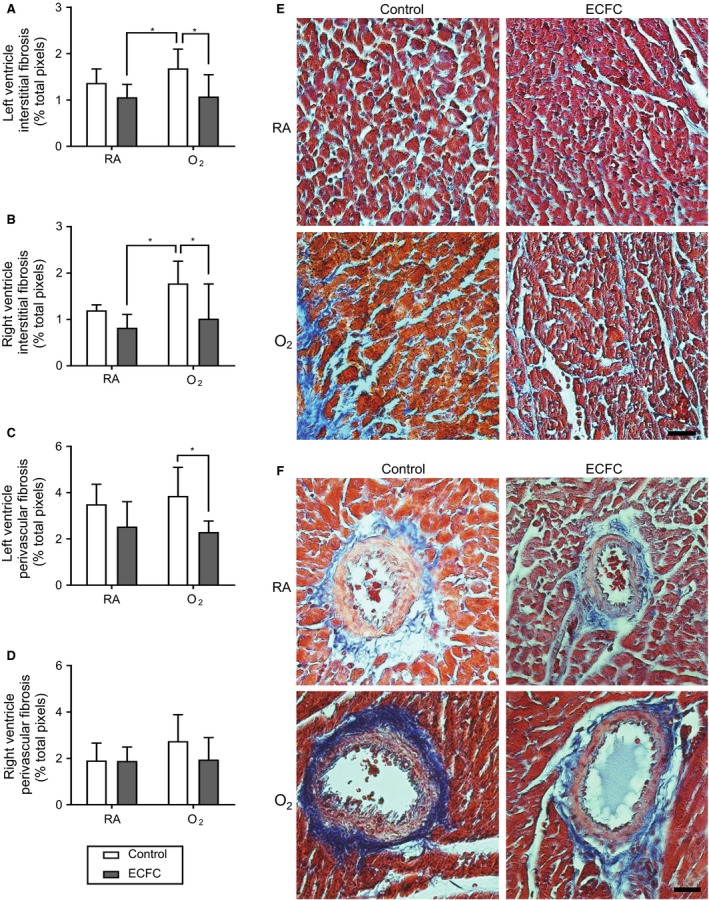
Very preterm birth is associated with increased cardiovascular diseases and changes in myocardial structure. The current study aimed to investigate the impact of endothelial colony-forming cell (ECFC) treatment on heart morphological changes in the experimental model of neonatal high oxygen (O )-induced cardiomyopathy, mimicking prematurity-related conditions. Sprague-Dawley rat pups exposed to 95% O or room air (RA) from day 4 (P4) to day 14 (P14) were randomized to receive (jugular vein) exogenous human cord blood ECFC or vehicle at P14 (n = 5 RA-vehicle, n = 8 RA-ECFC, n = 8 O -vehicle and n = 7 O -ECFC) and the hearts collected at P28. Body and heart weights and heart to body weight ratio did not differ between groups. ECFC treatment prevented the increase in cardiomyocyte surface area in both the left (LV) and right (RV) ventricles of the O group (O -ECFC vs. O -vehicle LV: 121 ± 13 vs. 179 ± 21 μm , RV: 118 ± 12 vs. 169 ± 21 μm ). In O rats, ECFC treatment was also associated with a significant reduction in interstitial fibrosis in both ventricles (O -ECFC vs. O -vehicle LV: 1.07 ± 0.47 vs. 1.68 ± 0.41% of surface area, RV: 1.01 ± 0.74 vs. 1.77 ± 0.67%) and in perivascular fibrosis in the LV (2.29 ± 0.47 vs. 3.85 ± 1.23%) but in not the RV (1.95 ± 0.95 vs. 2.74 ± 1.14), and with increased expression of angiogenesis marker CD31. ECFC treatment had no effect on cardiomyocyte surface area or on tissue fibrosis of RA rats. Human cord blood ECFC treatment prevented cardiomyocyte hypertrophy and myocardial and perivascular fibrosis observed after neonatal high O exposure. ECFC could constitute a new regenerative therapy against cardiac sequelae caused by deleterious conditions of prematurity.
极早产与心血管疾病增加及心肌结构改变有关。本研究旨在探讨内皮祖细胞(ECFC)治疗对模拟早产相关情况的新生儿高氧(O₂)诱导心肌病实验模型中心脏形态变化的影响。从出生后第4天(P4)至第14天(P14)暴露于95% O₂或空气(RA)的斯普拉格-道利大鼠幼崽在P14时被随机分组接受(颈静脉)外源性人脐带血ECFC或赋形剂(n = 5只RA-赋形剂组、n = 8只RA-ECFC组、n = 8只O₂-赋形剂组和n = 7只O₂-ECFC组),并在P28时收集心脏。各组之间的体重、心脏重量及心脏与体重比无差异。ECFC治疗可防止O₂组左心室(LV)和右心室(RV)心肌细胞表面积增加(O₂-ECFC组与O₂-赋形剂组相比,LV:121±13 vs. 179±21μm²,RV:118±12 vs. 169±21μm²)。在O₂大鼠中,ECFC治疗还与两心室间质纤维化显著减少有关(O₂-ECFC组与O₂-赋形剂组相比,LV:占表面积的1.07±0.47% vs. 1.68±0.41%,RV:1.01±0.74 vs. 1.77±0.67%),以及LV血管周围纤维化减少(2.29±0.47 vs. 3.85±1.23%),但RV无此变化(1.95±0.95 vs. 2.74±1.14),且与血管生成标志物CD31表达增加有关。ECFC治疗对RA大鼠的心肌细胞表面积或组织纤维化无影响。人脐带血ECFC治疗可预防新生儿高氧暴露后观察到的心肌细胞肥大及心肌和血管周围纤维化。ECFC可能构成一种针对早产有害状况所致心脏后遗症的新型再生疗法。