Danone Nutricia Research, Uppsalalaan 12, 3584 CT Utrecht, The Netherlands.
Utrecht Institute for Pharmaceutical Sciences (UIPS), Utrecht University, Universiteitsweg 99, 3584 CG Utrecht, The Netherlands.
Nutrients. 2018 Nov 26;10(12):1828. doi: 10.3390/nu10121828.
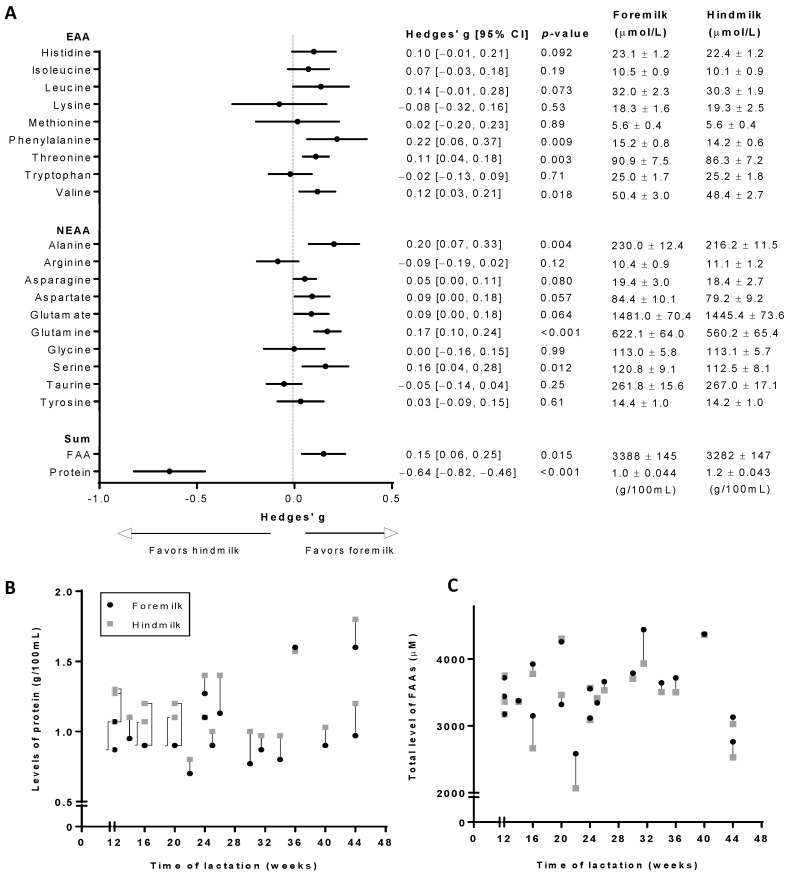
Free amino acids (FAAs) in human milk are indicated to have specific functional roles in infant development. Studies have shown differences between human milk that is expressed at the beginning of a feed (i.e., foremilk) and the remainder of the milk expressed (i.e., hindmilk). For example, it is well established that human hindmilk is richer in fat and energy than foremilk. Hence, exclusively feeding hindmilk is used to enhance weight gain of preterm, low birthweight infants. Whether FAAs occur differently between foremilk and hindmilk has never been reported, but given their bioactive capacities, this is relevant to consider especially in situations where hindmilk is fed exclusively. Therefore, this study analyzed and compared the FAA and total protein content in human foremilk and hindmilk samples donated by 30 healthy lactating women. The total protein content was found to be significantly higher in hindmilk ( < 0.001), whereas foremilk contained a significantly higher total content of FAAs ( = 0.015). With regards to individual FAAs, foremilk contained significantly higher levels of phenylalanine ( = 0.009), threonine ( = 0.003), valine ( = 0.018), alanine ( = 0.004), glutamine ( < 0.001), and serine ( = 0.012) than hindmilk. Although statistical significance was reached, effect size analysis of the milk fraction on FAA levels in milk revealed that the observed differences were only small. To what extent these differences are of physiological importance for infant development remains to be examined in future research.
人乳中的游离氨基酸(FAAs)被认为在婴儿发育中具有特定的功能作用。研究表明,在一次哺乳开始时(即前奶)和其余奶(即后奶)中,人乳存在差异。例如,人乳后奶比前奶含有更多的脂肪和能量,这是众所周知的。因此,专门喂养后奶被用于促进早产儿和低出生体重儿的体重增加。前奶和后奶中的 FAAs 是否存在差异尚未有报道,但考虑到它们的生物活性能力,这在专门喂养后奶的情况下尤其值得考虑。因此,本研究分析并比较了 30 位健康哺乳期妇女捐赠的人乳前奶和后奶样本中的 FAA 和总蛋白含量。结果发现,后奶中的总蛋白含量显著高于前奶(<0.001),而前奶中 FAA 的总含量显著较高(=0.015)。就个别 FAAs 而言,前奶中苯丙氨酸(=0.009)、苏氨酸(=0.003)、缬氨酸(=0.018)、丙氨酸(=0.004)、谷氨酰胺(<0.001)和丝氨酸(=0.012)的含量显著高于后奶。尽管达到了统计学意义,但对奶部分对奶中 FAA 水平的效应量分析表明,观察到的差异仅很小。这些差异在多大程度上对婴儿发育具有生理重要性,有待未来研究进一步探讨。