Tsekoura Maria, Billis Evdokia, Tsepis Elias, Dimitriadis Zacharias, Matzaroglou Charalampos, Tyllianakis Minos, Panagiotopoulos Elias, Gliatis John
Department of Physiotherapy, School of Health and Welfare, Technological Educational Institute (TEI) of Western Greece, 25100 Aigio, Greece.
Department of Orthopaedics, School of Medicine, University of Patras, 265 04 Patra, Greece.
J Clin Med. 2018 Nov 26;7(12):480. doi: 10.3390/jcm7120480.
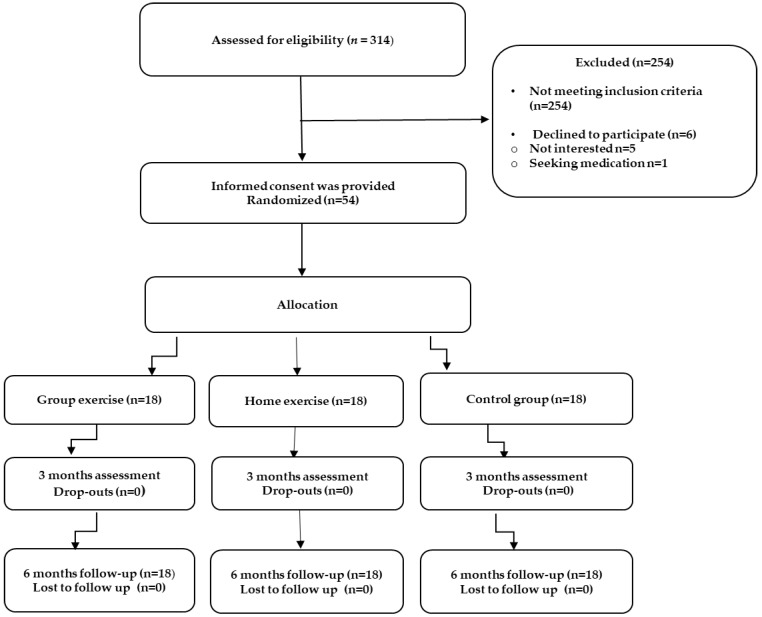
Physical exercise is effective for sarcopenic elderly but evidence for the most effective mode of exercise is conflicting. The objective of this study was to investigate the effects of a three-month group-based versus home-based exercise program on muscular, functional/physical performance and quality of life (QoL) across elderly with sarcopenia. 54 elderly (47 women, 7 men aged 72.87 ± 7 years) were randomly assigned to one of three interventions: supervised group ( = 18), individualized home-based exercise ( = 18) and control group ( = 18). Body composition was determined by bioelectrical impedance analysis, calf measurement with inelastic tape and strength assessments (grip and knee muscle strength) via hand-held and isokinetic dynamometers. Functional assessments included four-meter (4 m), Τimed-Up and Go (TUG) and chair stand (CS) tests. QoL was assessed with Greek Sarcopenia Quality of Life (SarQol_GR) questionnaire. Outcomes were assessed at baseline, immediately post-intervention (week 12), and 3 months post-intervention (week 24). Significant group x time interactions ( < 0.001) were observed in QoL, calf circumference, TUG, CS, and 4 m tests, grip and knee muscle strength. Group-based compared to home-based exercise yielded significant improvements ( < 0.05) in muscle mass index, CS and 4 m tests, calf circumference, muscle strength at 12 weeks. Most improvements at 24 weeks were reported with grouped exercise. No changes were found across the control group. Results suggest group-based exercise was more effective than home-based for improving functional performance.
体育锻炼对患有肌肉减少症的老年人有效,但关于最有效锻炼方式的证据相互矛盾。本研究的目的是调查为期三个月的基于小组的运动计划与居家运动计划对患有肌肉减少症的老年人的肌肉、功能/身体表现和生活质量(QoL)的影响。54名老年人(47名女性,7名男性,年龄72.87±7岁)被随机分配到三种干预措施之一:监督小组(n = 18)、个性化居家锻炼(n = 18)和对照组(n = 18)。通过生物电阻抗分析确定身体成分,用无弹性卷尺测量小腿围,并通过手持式和等速测力计进行力量评估(握力和膝部肌肉力量)。功能评估包括4米步行(4 m)、计时起立行走(TUG)和椅子站立(CS)测试。使用希腊肌肉减少症生活质量(SarQol_GR)问卷评估生活质量。在基线、干预后立即(第12周)和干预后3个月(第24周)评估结果。在生活质量、小腿围、TUG、CS和4米步行测试、握力和膝部肌肉力量方面观察到显著的组×时间交互作用(P < 0.001)。与居家锻炼相比,基于小组的锻炼在肌肉质量指数、CS和4米步行测试、小腿围、12周时的肌肉力量方面有显著改善(P < 0.05)。在24周时,大多数改善是通过分组锻炼报告的。对照组未发现变化。结果表明,基于小组的锻炼在改善功能表现方面比居家锻炼更有效。