Dhulikhel Hospital, Kathmandu University Hospital, Dhulikhel, Kavre, Nepal.
Kathmandu University School of Medical Sciences, Dhulikhel, Kavre, Nepal.
J Headache Pain. 2018 Nov 28;19(1):116. doi: 10.1186/s10194-018-0942-3.
Headache disorders are an important global public-health problem, but under-diagnosed, undertreated and under-prioritized. Deficiencies in health care for headache, present everywhere, are likely to be greater in poorly-resourced countries. This study reports on health-care utilization for headache in Nepal, a low-income country with high headache burden.
We took data from a cross-sectional, nationwide population-based door-to-door survey, with multistage cluster random sampling. Face-to-face structured interviews included enquiry into consultations with professional health-care providers (HCPs), and investigations and treatments for headache. Analysis included associations with sociodemographic variables and indices of symptom severity.
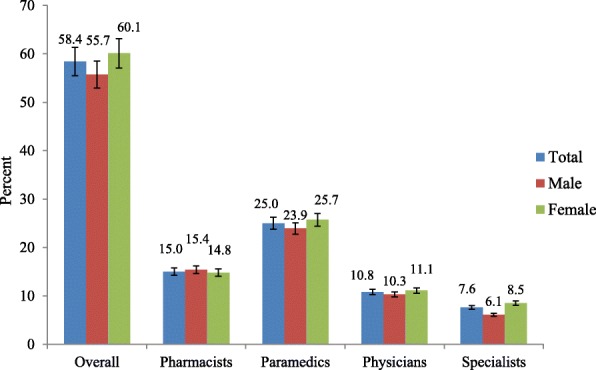
Of 2100 participants, 1794 reported headache during the preceding year (mean age 36.1 ± 12.6 years; male/female ratio 1:1.6). Of these, 58.4% (95% CI: 56.1-60.7%) had consulted at least once in the year with HCPs at any level, most commonly (25.0%) paramedical; 15.0% had consulted pharmacists, 10.8% general physicians and 7.6% specialists (of any type). Participants with probable medication-overuse headache consulted most (87.0%), followed by those with migraine (67.2%) and those with tension-type headache (48.6%; p < 0.001). A minority (11.9%) were investigated, mostly (8.9%) by eye tests. Half (50.8%) had used conventional medications for headache in the preceding month, paracetamol being by far the most common (38.0%), and 10.3% had used herbal therapies. Consultation was positively associated with rural habitation (AOR = 1.5; p < 0.001). Proportions consulting increased in line with all indices of symptom severity.
Although over half of participants with headache had consulted professional HCPs, this reflects demand, not quality of care. Although 7.6% had seen specialists, very few would have been headache specialists in any sense of this term. High persistent burden, with only half of participants with headache using conventional medications, and these not best chosen, suggests these consultations fell far short of meeting need. Health policy in Nepal should recognise this, since the consequences otherwise are costly: lost health, diminished productivity and damaged national economy. On a positive note, the proportions consulting suggest that capacity exists at multiple levels within the Nepalese health system. With this to build upon, structured headache services in line with international recommendations appear achievable in Nepal. Educational programmes are the essential requirement.
头痛疾病是一个重要的全球公共卫生问题,但未得到充分诊断、治疗和重视。在资源匮乏的国家,医疗保健对头痛的不足可能更为严重。本研究报告了尼泊尔的头痛医疗保健利用情况,尼泊尔是一个头痛负担高的低收入国家。
我们从一项全国性的、基于人群的、采用多阶段聚类随机抽样的横断面研究中获取数据。面对面的结构化访谈包括向专业医疗保健提供者(HCP)咨询的情况,以及对头痛的调查和治疗。分析包括与社会人口统计学变量和症状严重程度指数的关联。
在 2100 名参与者中,有 1794 名在过去一年中报告有头痛(平均年龄 36.1±12.6 岁;男女比例为 1:1.6)。其中,58.4%(95%置信区间:56.1-60.7%)在过去一年中至少在任何级别的 HCP 处就诊过一次,最常见的是(25.0%)辅助医疗人员;15.0%咨询过药剂师,10.8%咨询过全科医生,7.6%咨询过(任何类型的)专家。可能患有药物过度使用性头痛的参与者就诊最多(87.0%),其次是偏头痛患者(67.2%)和紧张型头痛患者(48.6%;p<0.001)。少数(11.9%)接受了调查,大多数(8.9%)接受了眼部检查。过去一个月有一半(50.8%)人使用过常规头痛药物,最常用的是扑热息痛(38.0%),10.3%的人使用过草药疗法。咨询与农村居住(优势比=1.5;p<0.001)呈正相关。随着症状严重程度指数的增加,咨询的比例也在增加。
尽管超过一半的头痛患者咨询了专业的 HCP,但这反映的是需求,而不是医疗服务质量。尽管有 7.6%的人看过专家,但其中很少有人能算得上是任何意义上的头痛专家。高持续性负担,只有一半的头痛患者使用常规药物,而且选择不佳,这表明这些咨询远远没有满足需求。尼泊尔的卫生政策应该认识到这一点,因为否则后果是代价高昂的:失去健康、生产力下降和国家经济受损。从积极的方面来看,咨询的比例表明尼泊尔的国家卫生系统在多个层面上都有能力。在此基础上,按照国际建议建立规范的头痛服务似乎在尼泊尔是可行的。教育项目是必不可少的要求。