King Abdullah International Medical Research Centre, Riyadh, Saudi Arabia.
King Saud Bin Abdulaziz University for Health Sciences, Riyadh, Saudi Arabia.
J Headache Pain. 2024 Apr 25;25(1):66. doi: 10.1186/s10194-024-01767-6.
We have previously shown headache to be highly prevalent among adults in Saudi Arabia. Here we estimate associated symptom burden and impaired participation (impaired use of time, lost productivity and disengagement from social activity), and use these estimates to assess headache-related health-care needs in Saudi Arabia.
A randomised cross-sectional survey included 2,316 adults (18-65 years) from all 13 regions of the country. It used the standardised methodology of the Global Campaign against Headache with a culturally mandated modification: engagement by cellphone using random digit-dialling rather than door-to-door visits. Enquiry used the HARDSHIP questionnaire, with diagnostic questions based on ICHD-3 beta, questions on symptom burden, enquiries into impaired participation using the HALT index and questions about activity yesterday in those reporting headache yesterday (HY). Health-care "need" was defined in terms of likelihood of benefit. We counted all those with headache on ≥ 15 days/month, with migraine on ≥ 3 days/month, or with migraine or TTH and meeting either of two criteria: a) proportion of time in ictal state (pTIS) > 3.3% and intensity ≥ 2 (moderate-severe); b) ≥ 3 lost days from paid work and/or household chores during 3 months.
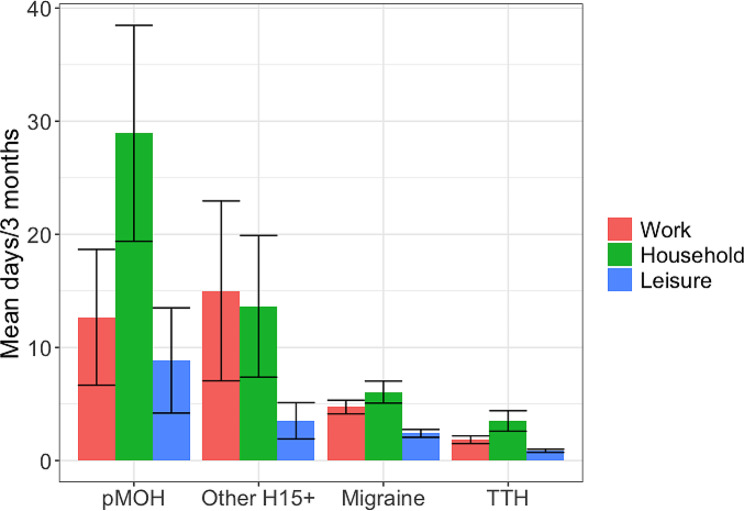
For all headache, mean frequency was 4.3 days/month, mean duration 8.4 h, mean intensity 2.3 (moderate). Mean pTIS was 3.6%. Mean lost days from work were 3.9, from household chores 6.6, from social/leisure activities 2.0. Of participants reporting HY, 37.3% could do less than half their expected activity, 19.8% could do nothing. At population-level (i.e., for every adult), 2.5 workdays (potentially translating into lost GDP), 3.6 household days and 1.3 social/leisure days were lost to headache. According to HY data, mean total impaired participation (not distinguishing between work, household and social/leisure) was 6.8%. A total of 830 individuals (35.8%) fulfilled one or more of our needs assessment criteria.
A very high symptom burden is associated with a commensurately high burden of impaired participation. The economic cost appears to be enormous. Over a third of the adult population are revealed to require headache-related health care on the basis of being likely to benefit, demanding highly efficient organization of care.
我们之前已经表明,头痛在沙特阿拉伯的成年人中非常普遍。在这里,我们估计相关的症状负担和受损的参与(时间使用受损、生产力损失和脱离社会活动),并使用这些估计来评估沙特阿拉伯与头痛相关的医疗保健需求。
一项随机横断面调查包括来自该国 13 个地区的 2316 名成年人(18-65 岁)。它使用全球头痛运动的标准化方法,并进行了文化要求的修改:使用随机数字拨号通过手机进行参与,而不是挨家挨户访问。查询使用 HARDSHIP 问卷,基于 ICHD-3 beta 的诊断问题,关于症状负担的问题,使用 HALT 指数评估受损的参与情况,以及询问昨天报告头痛的人昨天的活动情况(HY)。医疗保健“需求”是根据受益的可能性来定义的。我们计算了所有每月头痛发作≥15 天、每月偏头痛发作≥3 天、偏头痛或 TTH 发作且满足以下两个标准之一的患者:a)发作状态中的时间比例(pTIS)>3.3%且强度≥2(中度-重度);b)在 3 个月内,因头痛丧失≥3 天的带薪工作和/或家务劳动。
对于所有头痛,平均发作频率为 4.3 天/月,平均持续时间为 8.4 小时,平均强度为 2.3(中度)。平均 pTIS 为 3.6%。平均因工作丧失的天数为 3.9 天,因家务丧失的天数为 6.6 天,因社会/休闲活动丧失的天数为 2.0 天。在报告 HY 的参与者中,37.3%的人无法完成一半的预期活动,19.8%的人无法完成任何活动。在人群层面(即每个成年人),由于头痛,有 2.5 个工作日(可能导致 GDP 损失)、3.6 个家务日和 1.3 个社会/休闲日被浪费。根据 HY 数据,平均总受损参与度(不区分工作、家务和社会/休闲)为 6.8%。共有 830 人(35.8%)符合我们的需求评估标准之一或更多。
非常高的症状负担与相应的受损参与负担相关。经济成本似乎非常巨大。超过三分之一的成年人口根据可能受益的情况需要与头痛相关的医疗保健,这需要高度有效的医疗保健组织。