Center for Vaccine Development and Global Health, University of Maryland School of Medicine, Baltimore, Maryland, USA.
Department of Medicine, University of Maryland School of Medicine, Baltimore, Maryland, USA.
mSphere. 2018 Nov 28;3(6):e00474-18. doi: 10.1128/mSphere.00474-18.
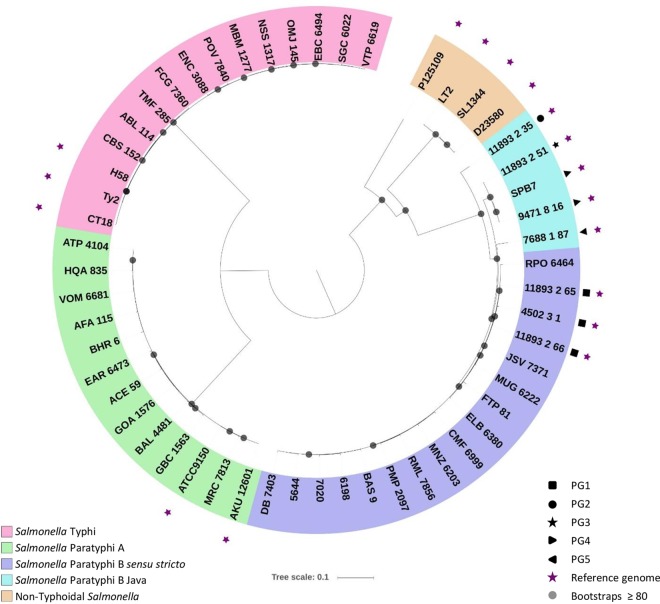
Enteric fever is caused by three serovars: Typhi, Paratyphi A, and Paratyphi B Although vaccines against two of these serovars are licensed (Typhi) or in clinical development (Paratyphi A), as yet there are no candidates for Paratyphi B. To gain genomic insight into these serovars, we sequenced 38 enteric fever-associated strains from Chile and compared these with reference genomes. Each of the serovars was separated genomically based on the core genome. Genomic comparisons identified loci that were aberrant between serovars Paratyphi B and Paratyphi B Java, which is typically associated with gastroenteritis; however, the majority of these were annotated as hypothetical or phage related and thus were not ideal vaccine candidates. With the genomic information in hand, we engineered a live attenuated Paratyphi B vaccine strain, CVD 2005, which was capable of protecting mice from both homologous challenge and heterologous challenge with Paratyphi B Java. These findings extend our understanding of Paratyphi B and provide a viable vaccine option for inclusion in a trivalent live attenuated enteric fever vaccine formulation. We developed a live attenuated serovar Paratyphi B vaccine that conferred protection in mice against challenge with Paratyphi B and Paratyphi B Java, which are the causes of enteric fever and gastroenteritis, respectively. Currently, the incidence of invasive Paratyphi B infections is low; however, the development of new conjugate vaccines against other enteric fever serovars could lead to the emergence of Paratyphi B to fill the niche left by these other pathogens. As such, an effective Paratyphi B vaccine would be a useful tool in the armamentarium against infections. Comparative genomics confirmed the serovar-specific groupings of these isolates and revealed that there are a limited number of genetic differences between the and Java strains, which are mostly hypothetical and phage-encoded proteins. The observed level of genomic similarity likely explains why we observe some cross-protection.
伤寒、甲型副伤寒和乙型副伤寒。尽管有两种血清型的疫苗(伤寒)或在临床开发中(甲型副伤寒),但目前还没有乙型副伤寒的候选疫苗。为了从基因组角度了解这些血清型,我们对来自智利的 38 株肠热病相关菌株进行了测序,并将这些菌株与参考基因组进行了比较。根据核心基因组,每个血清型在基因组上都是分开的。基因组比较确定了甲型副伤寒和甲型副伤寒乙型之间异常的基因座,甲型副伤寒乙型通常与肠胃炎有关;然而,这些基因座的大多数被注释为假设或噬菌体相关,因此不是理想的疫苗候选物。有了基因组信息,我们设计了一种活的减毒乙型副伤寒疫苗株 CVD 2005,该疫苗株能够保护小鼠免受同源性挑战和异源性挑战的侵袭。这些发现扩展了我们对乙型副伤寒的认识,并为在三联活减毒肠热病疫苗配方中加入一种可行的疫苗选择提供了依据。我们开发了一种活的减毒乙型副伤寒疫苗,该疫苗能够在小鼠中提供针对乙型副伤寒和乙型副伤寒甲型的保护,分别是肠热病和肠胃炎的病因。目前,侵袭性乙型副伤寒感染的发病率较低;然而,针对其他肠热病血清型的新结合疫苗的开发可能导致乙型副伤寒的出现,以填补这些其他病原体留下的空白。因此,有效的乙型副伤寒疫苗将是对抗感染的有用工具。比较基因组学证实了这些分离株的血清型特异性分组,并揭示了和 Java 株之间存在有限数量的遗传差异,这些差异主要是假设和噬菌体编码的蛋白质。观察到的基因组相似性水平可能解释了为什么我们观察到一些交叉保护。