Faculty of Pharmaceutical Sciences, Suzuka University of Medical Sciences, Suzuka, Mie, 513-8670, Japan.
RNA. 2019 Feb;25(2):264-276. doi: 10.1261/rna.068106.118. Epub 2018 Nov 28.
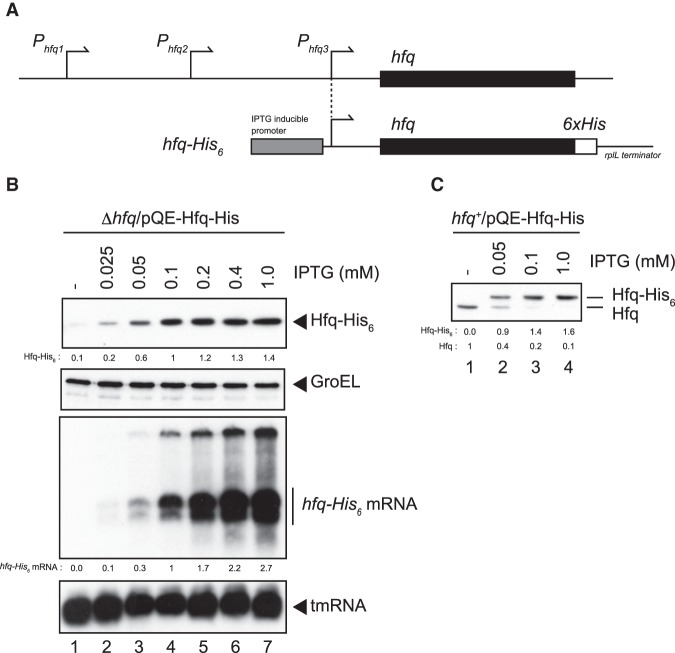
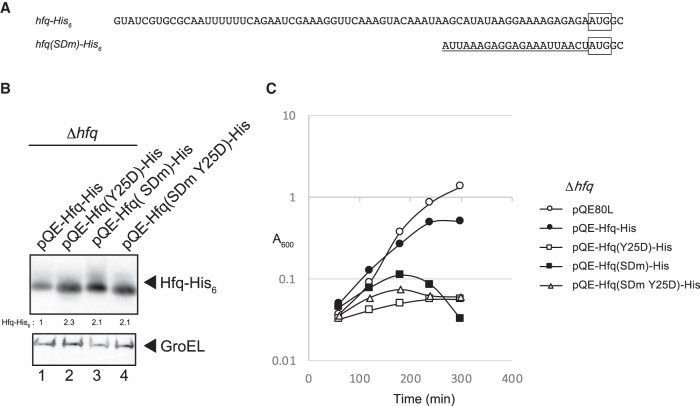
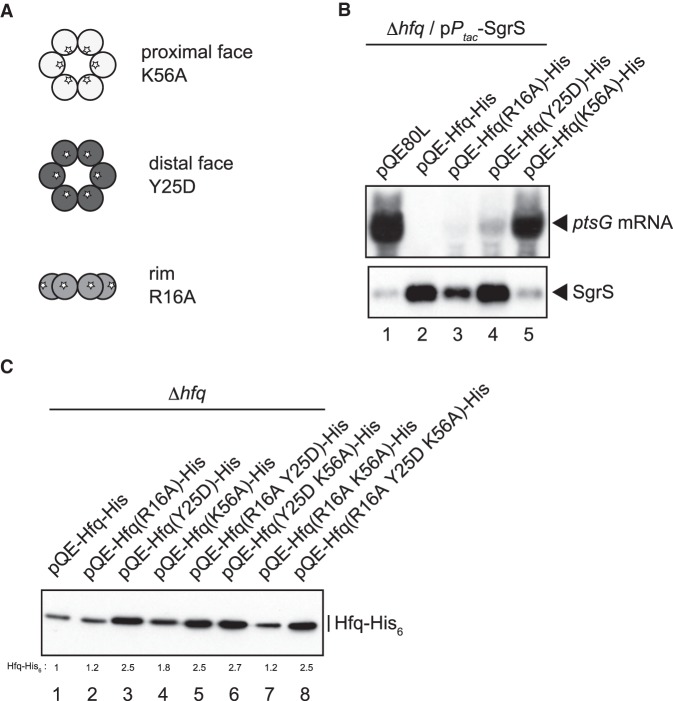
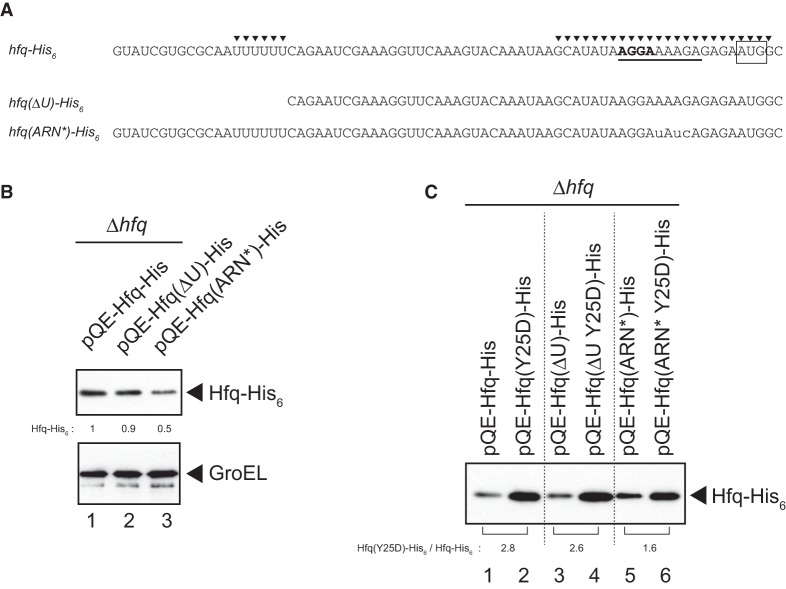
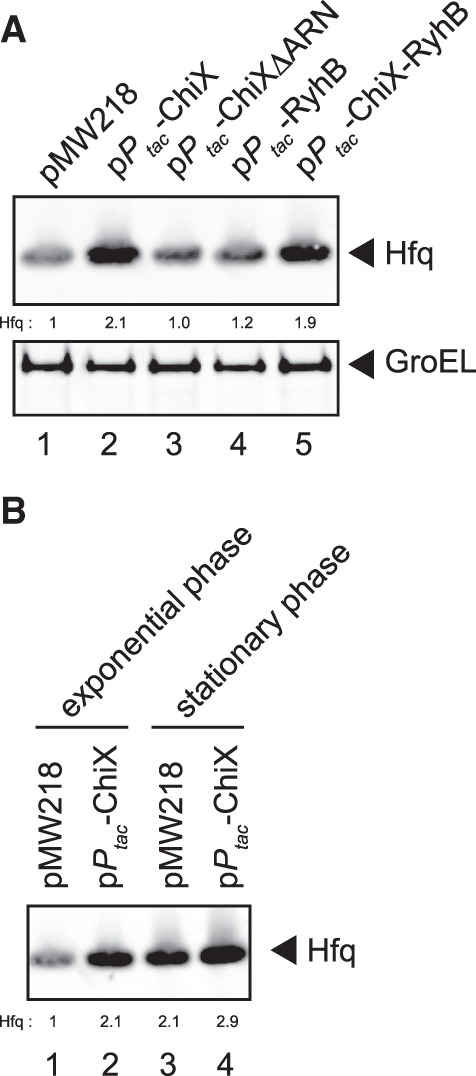
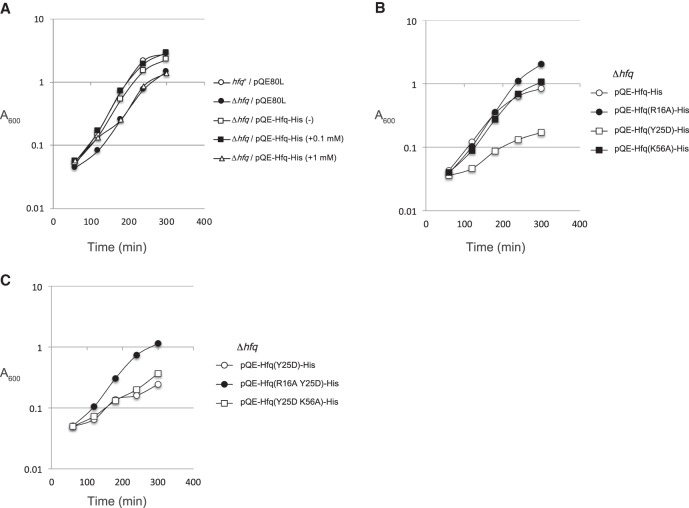
The RNA chaperone Hfq plays a critical role in sRNA-mediated gene regulation in enteric bacteria. The major role of Hfq is to stimulate base-pairing between sRNAs and target mRNAs by binding both RNAs through three RNA-binding surfaces. To understand the post-transcriptional network exerted by Hfq and its associated sRNAs, it is important to know how the cellular concentration of Hfq is regulated. While an early study showed that translation is repressed by Hfq, the detailed mechanism and biological significance of the autoregulation remain to be studied. Here, we show that the synthesis of Hfq is strictly autoregulated to maintain the cellular concentration of Hfq within a limited range even when the mRNA is overexpressed from a plasmid-borne gene. Mutational and biochemical studies demonstrate that Hfq represses its own translation primarily by binding to the mRNA through the distal face. The growth of cells harboring the plasmid is markedly inhibited due to an increased Hfq level when the distal face of Hfq is mutated or the 5'-UTR of is mutated. A mutation in the rim suppresses the growth inhibition caused by the distal face mutation, suggesting that the interaction of Hfq with undefined RNAs through the rim is responsible for the growth inhibition by the increased Hfq level. In addition, the data suggest that the autoregulation operates not only in cells harboring a multicopy gene but also in the wild-type cells.
RNA 伴侣蛋白 Hfq 在肠道细菌的 sRNA 介导的基因调控中起着关键作用。Hfq 的主要作用是通过三个 RNA 结合表面结合 RNA,从而刺激 sRNA 和靶 mRNA 之间的碱基配对。为了了解 Hfq 及其相关 sRNA 发挥的转录后网络,了解细胞内 Hfq 的浓度是如何调节的非常重要。虽然早期的研究表明 Hfq 抑制翻译,但 Hfq 自身调控的详细机制和生物学意义仍有待研究。在这里,我们表明,即使从质粒携带的基因过表达 mRNA,Hfq 的合成也受到严格的自身调控,以将细胞内 Hfq 的浓度维持在有限的范围内。突变和生化研究表明,Hfq 主要通过与远端面的 mRNA 结合来抑制自身翻译。当 Hfq 的远端面发生突变或 5'-UTR 发生突变时,由于 Hfq 水平升高,携带质粒的细胞的生长明显受到抑制。边缘突变抑制了远端面突变引起的生长抑制,这表明通过边缘与未定义的 RNA 相互作用导致了高水平 Hfq 引起的生长抑制。此外,数据表明,这种自身调控不仅在携带多拷贝 基因的细胞中起作用,而且在野生型细胞中也起作用。