Cell Biology and Metabolism Program, Eunice Kennedy Shriver National Institute of Child Health and Human Development, Bethesda, MD 20892-5430, USA.
J Mol Biol. 2013 Oct 9;425(19):3678-97. doi: 10.1016/j.jmb.2013.01.006. Epub 2013 Jan 11.
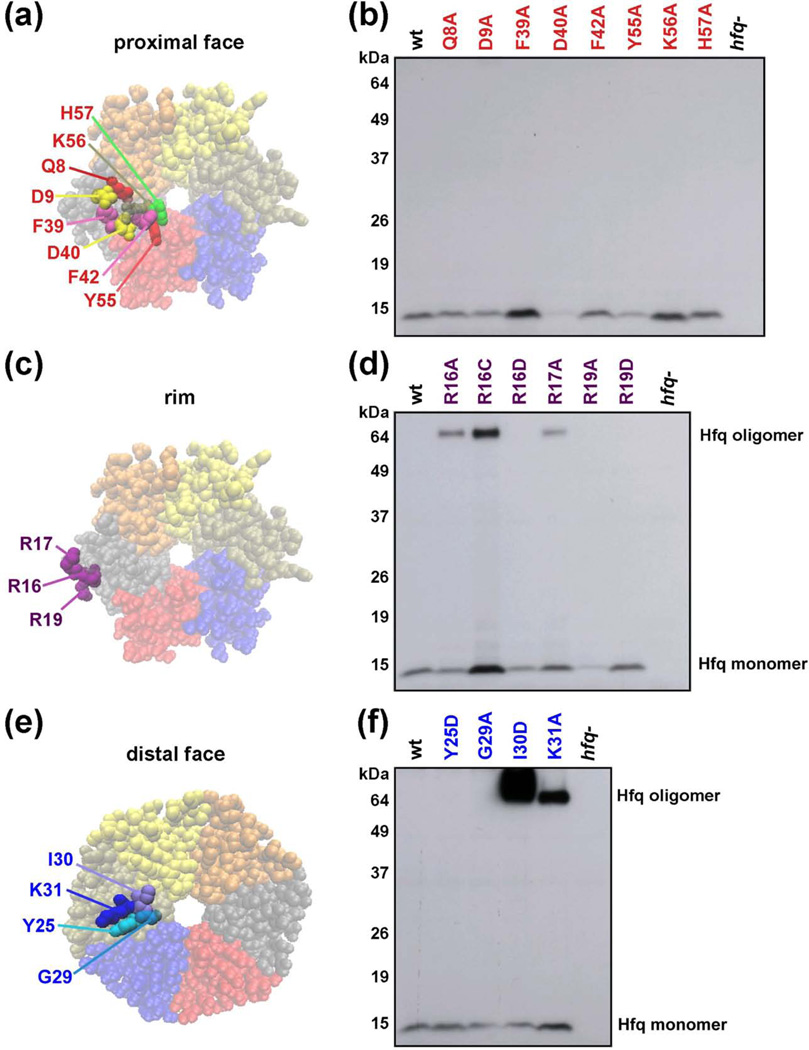
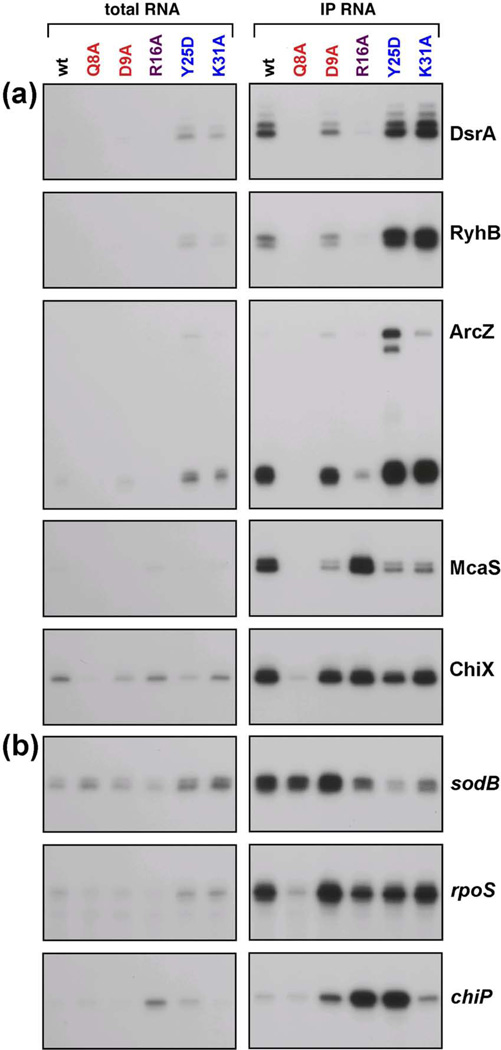
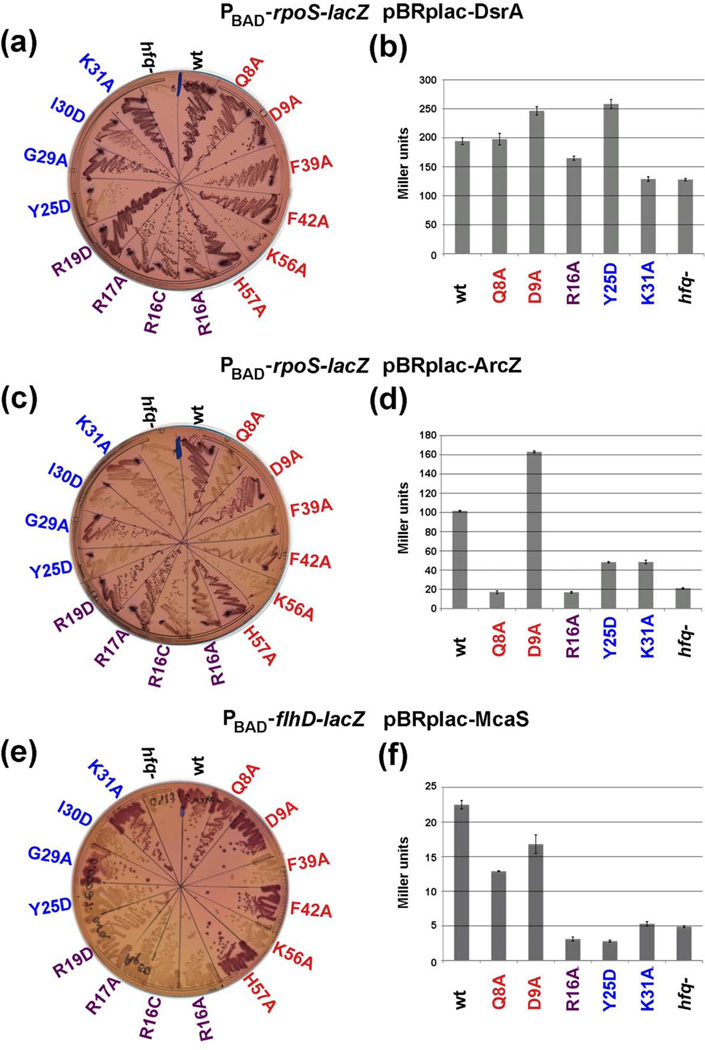
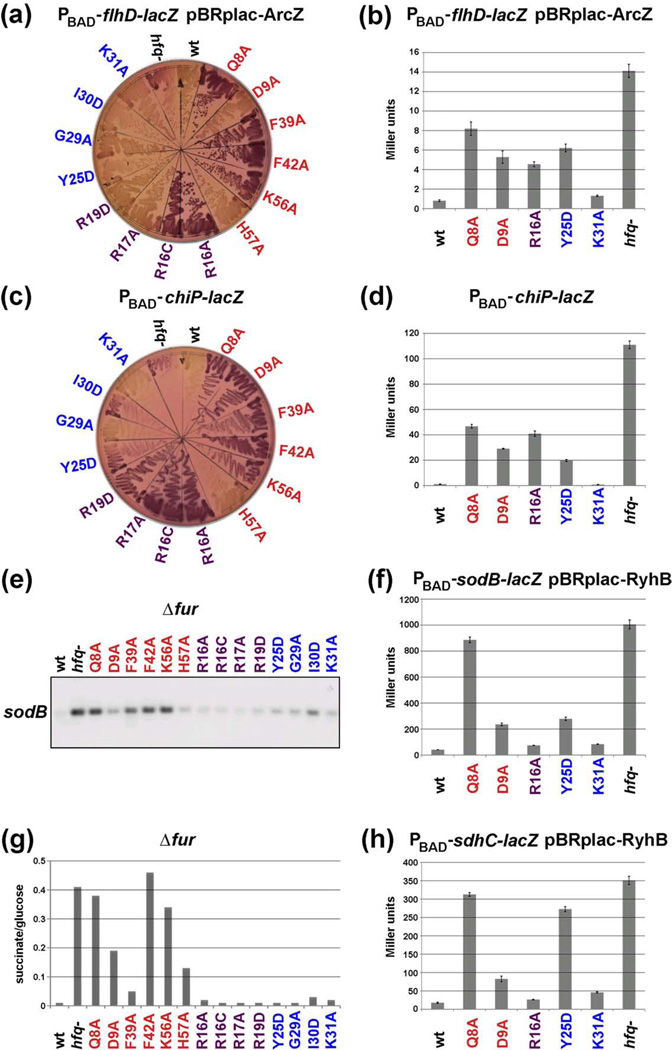
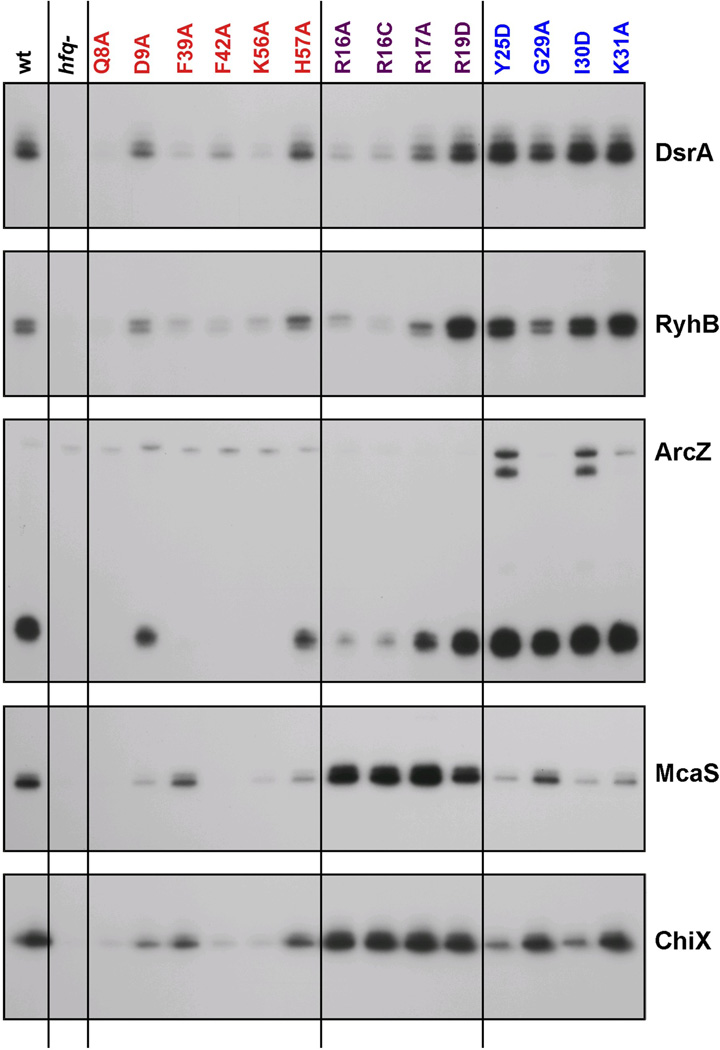
The RNA chaperone protein Hfq is required for the function of all small RNAs (sRNAs) that regulate mRNA stability or translation by limited base pairing in Escherichia coli. While there have been numerous in vitro studies to characterize Hfq activity and the importance of specific residues, there has been only limited characterization of Hfq mutants in vivo. Here, we use a set of reporters as well as co-immunoprecipitation to examine 14 Hfq mutants expressed from the E. coli chromosome. The majority of the proximal face residues, as expected, were important for the function of sRNAs. The failure of sRNAs to regulate target mRNAs in these mutants can be explained by reduced sRNA accumulation. Two of the proximal mutants, D9A and F39A, acted differently from the others in that they had mixed effects on different sRNA/mRNA pairs and, in the case of F39A, showed differential sRNA accumulation. Mutations of charged residues at the rim of Hfq interfered with positive regulation and gave mixed effects for negative regulation. Some, but not all, sRNAs accumulated to lower levels in rim mutants, suggesting qualitative differences in how individual sRNAs are affected by Hfq. The distal face mutants were expected to disrupt binding of ARN motifs found in mRNAs. They were more defective for positive regulation than negative regulation at low mRNA expression, but the defects could be suppressed by higher levels of mRNA expression. We discuss the implications of these observations for Hfq binding to RNA and mechanisms of action.
RNA 伴侣蛋白 Hfq 是所有通过在大肠杆菌中有限碱基配对调节 mRNA 稳定性或翻译的小 RNA(sRNA)功能所必需的。虽然已经有许多体外研究来表征 Hfq 的活性和特定残基的重要性,但在体内对 Hfq 突变体的表征却很有限。在这里,我们使用一组报告基因和共免疫沉淀来研究从大肠杆菌染色体表达的 14 种 Hfq 突变体。正如预期的那样,大多数近端表面残基对于 sRNA 的功能很重要。这些突变体中 sRNA 不能调节靶 mRNA,可以用 sRNA 积累减少来解释。两个近端突变体 D9A 和 F39A 的行为与其他突变体不同,它们对不同的 sRNA/mRNA 对具有混合效应,并且在 F39A 的情况下,显示出不同的 sRNA 积累。Hfq 边缘带电荷残基的突变干扰了正调控,并对负调控产生了混合效应。边缘突变体中的一些(但不是全部)sRNA 积累到较低水平,这表明单个 sRNA 受到 Hfq 影响的方式存在定性差异。预计远端突变体将破坏在 mRNA 中发现的 ARN 基序的结合。在低 mRNA 表达时,它们对正调控的缺陷比对负调控的缺陷更大,但缺陷可以通过更高水平的 mRNA 表达来抑制。我们讨论了这些观察结果对 Hfq 与 RNA 结合和作用机制的影响。