Molina H A, Kierszenbaum F
Department of Microbiology and Public Health, Michigan State University, East Lansing 48824.
Immunology. 1988 Aug;64(4):725-31.
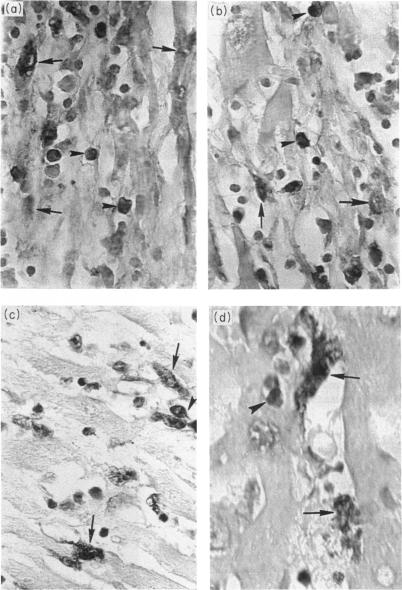
An immunohistochemical study of eosinophil distribution in the inflammatory cell infiltrates of four different types of myocardial lesions associated with Chagas' disease--caused by Trypanosoma cruzi--showed larger numbers of these cells in areas presenting tissue necrosis and degeneration, most notably in patients with the most severe myocarditis from a histopathological stand-point. Using antisera specific for human eosinophil-derived neurotoxin or eosinophil peroxidase, we detected deposits of these secretion products on myofibres and in the interstitium of chagasic myocardium displaying necrosis and degeneration but rarely in other types of lesions. These deposits were not detectable in the myocardium of non-chagasic patients who had died from myocardial infarction (acute or in the scarring stage) or myocarditis secondary to bacterial endocarditis. When human eosinophil-derived neurotoxin was incubated with myoblast monolayers there was a significant cell injury, detachment and lysis. These effects were abrogated by yeast RNA, added as a competitive ribonuclease substrate, and inhibited by the ribonuclease inhibitor RNasin, suggesting that the ribonuclease activity of the eosinophil-derived neurotoxin was involved in the effect. These results suggest a link between eosinophil infiltration and necrosis in chagasic myocardial lesions and point to EDN, and perhaps other toxic eosinophil secretion products, as possible mediators of tissue damage.
一项免疫组化研究对与恰加斯病(由克氏锥虫引起)相关的四种不同类型心肌病变的炎症细胞浸润中的嗜酸性粒细胞分布进行了观察。结果显示,在出现组织坏死和变性的区域,这些细胞数量较多,从组织病理学角度来看,在患有最严重心肌炎的患者中最为明显。使用针对人嗜酸性粒细胞衍生神经毒素或嗜酸性粒细胞过氧化物酶的抗血清,我们在显示坏死和变性的恰加斯心肌病心肌纤维和间质中检测到了这些分泌产物的沉积,但在其他类型病变中很少见。在因心肌梗死(急性或瘢痕形成期)或细菌性心内膜炎继发的心肌炎而死亡的非恰加斯病患者的心肌中未检测到这些沉积物。当将人嗜酸性粒细胞衍生神经毒素与成肌细胞单层一起孵育时,出现了明显的细胞损伤、脱离和裂解。作为竞争性核糖核酸酶底物添加的酵母RNA消除了这些作用,核糖核酸酶抑制剂RNasin抑制了这些作用,这表明嗜酸性粒细胞衍生神经毒素的核糖核酸酶活性参与了这一效应。这些结果表明恰加斯病心肌病变中嗜酸性粒细胞浸润与坏死之间存在联系,并指出嗜酸性粒细胞衍生神经毒素以及可能的其他有毒嗜酸性粒细胞分泌产物可能是组织损伤的介质。