Nutrition Program, School of Biological and Population Health Sciences, College of Public Health and Human Sciences, Oregon State University, Corvallis, OR, United States of America.
Department of Pediatrics, University of California, Davis, Sacramento, CA, United States of America.
PLoS One. 2018 Nov 29;13(11):e0208204. doi: 10.1371/journal.pone.0208204. eCollection 2018.
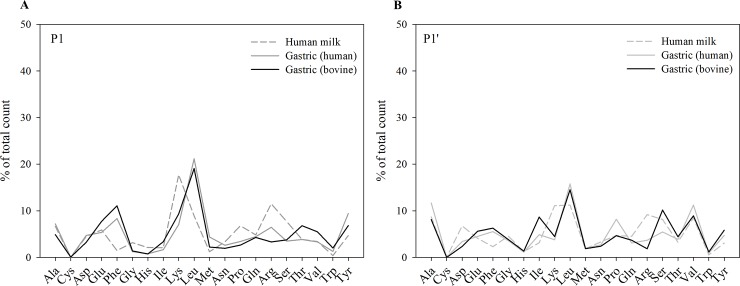
Digestion of milk proteins in the premature infant stomach releases functional peptides; however, which peptides are present has not been reported. Premature infants are often fed a combination of human milk and bovine milk fortifiers, but the variety of functional peptides released from both human and bovine milk proteins remains uncharacterized. This study applied peptidomics to investigate the peptides released in gastric digestion of mother's milk proteins and supplemental bovine milk proteins in premature infants. Peptides were assessed for homology against a database of known functional peptides-Milk Bioactive Peptide Database. The peptidomic data were analyzed to interpret which proteases most likely released them from the parent protein. We identified 5,264 unique peptides from bovine and human milk proteins within human milk, fortifier or infant gastric samples. Plasmin was predicted to be the most active protease in milk, while pepsin or cathepsin D were predicted to be most active in the stomach. Alignment of the peptide distribution showed a different digestion pattern between human and bovine proteins. The number of peptides with high homology to known functional peptides (antimicrobial, angiotensin-converting enzyme-inhibitory, antioxidant, immunomodulatory, etc.) increased from milk to the premature infant stomach and was greater from bovine milk proteins than human milk proteins. The differential release of bioactive peptides from human and bovine milk proteins may impact overall health outcomes in premature infants.
在早产儿的胃中,消化牛奶蛋白会释放出具有功能的肽;然而,目前尚未报道哪些肽存在。早产儿通常同时喂食人乳和牛乳制品强化剂,但从人乳和牛乳蛋白中释放的各种具有功能的肽尚未得到描述。本研究应用肽组学方法研究了早产儿母乳蛋白和补充牛乳蛋白在胃消化过程中释放的肽。对这些肽进行了与已知功能肽数据库(乳生物活性肽数据库)的同源性评估。对肽组学数据进行了分析,以解释哪种蛋白酶最有可能从母体蛋白中释放出这些肽。我们从人乳、强化剂或婴儿胃样本中的牛乳和人乳蛋白中鉴定出 5264 个独特的肽。预测乳中最活跃的蛋白酶是纤溶酶,而胃中最活跃的蛋白酶是胃蛋白酶或组织蛋白酶 D。肽分布的比对显示,人乳和牛乳蛋白的消化模式不同。与人乳相比,与已知功能肽(抗菌肽、血管紧张素转化酶抑制剂、抗氧化肽、免疫调节肽等)具有高度同源性的肽数量从人乳增加到早产儿的胃中,并且牛乳蛋白的数量多于人乳蛋白。人乳和牛乳蛋白中生物活性肽的差异释放可能会影响早产儿的整体健康状况。