Instituto de Investigaciones Biotecnológicas (UNSAM-CONICET), Universidad Nacional de San Martín, Buenos Aires, Argentina.
Instituto de Investigaciones Biotecnológicas (UNSAM-CONICET), Universidad Nacional de San Martín, Buenos Aires, Argentina.
J Control Release. 2019 Jan 10;293:158-171. doi: 10.1016/j.jconrel.2018.11.025. Epub 2018 Nov 27.
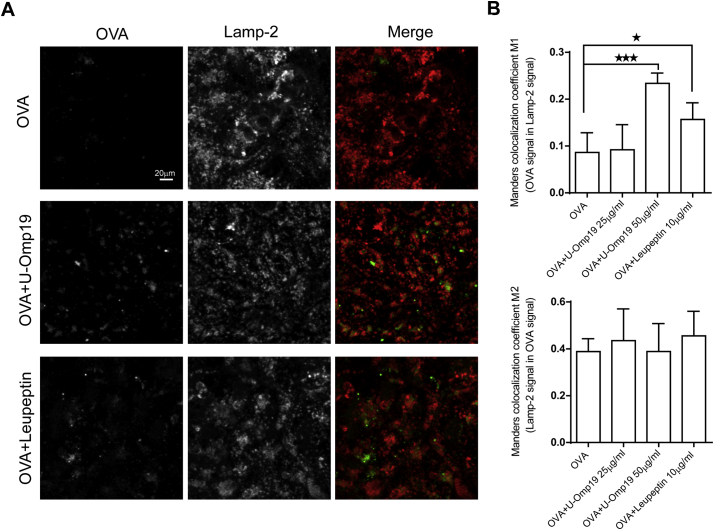
The study of capture and processing of antigens (Ags) by intestinal epithelial cells is very important for development of new oral administration systems. Efficient oral Ag delivery systems must resist enzymatic degradation by gastric and intestinal proteases and deliver the Ag across biological barriers. The recombinant unlipidated outer membrane protein from Brucella spp. (U-Omp19) is a protease inhibitor with immunostimulatory properties used as adjuvant in oral vaccine formulations. In the present work we further characterized its mechanism of action and studied the interaction and effect of U-Omp19 on the intestinal epithelium. We found that U-Omp19 inhibited protease activity from murine intestinal brush-border membranes and cysteine proteases from human intestinal epithelial cells (IECs) promoting co-administered Ag accumulation within lysosomal compartments of IECs. In addition, we have shown that co-administration of U-Omp19 facilitated the transcellular passage of Ag through epithelial cell monolayers in vitro and in vivo while did not affect epithelial cell barrier permeability. Finally, oral co-delivery of U-Omp19 in mice induced the production of Ag-specific IgA in feces and the increment of CD103 CD11b CD8α dendritic cells subset at Peyer's patches. Taken together, these data describe a new mechanism of action of a mucosal adjuvant and support the use of this rationale/strategy in new oral delivery systems for vaccines.
研究肠道上皮细胞对抗原(Ags)的捕获和处理对于开发新的口服给药系统非常重要。有效的口服 Ag 递送系统必须抵抗胃和肠道蛋白酶的酶解,并将 Ag 递送到生物屏障中。来自布鲁氏菌属的重组非脂化外膜蛋白(U-Omp19)是一种具有免疫刺激特性的蛋白酶抑制剂,用作口服疫苗制剂的佐剂。在本工作中,我们进一步表征了其作用机制,并研究了 U-Omp19 与肠道上皮的相互作用和影响。我们发现 U-Omp19 抑制了来自鼠肠刷状缘膜的蛋白酶活性和人肠上皮细胞(IECs)中的半胱氨酸蛋白酶,促进共给药 Ag 在 IEC 的溶酶体隔室中积累。此外,我们还表明,U-Omp19 的共给药促进了 Ag 穿过体外和体内上皮细胞单层的跨细胞传递,而不影响上皮细胞屏障通透性。最后,在小鼠中口服共递送 U-Omp19 诱导粪便中 Ag 特异性 IgA 的产生,并在派尔集合淋巴结中增加 CD103 CD11b CD8α 树突状细胞亚群。总之,这些数据描述了一种粘膜佐剂的新作用机制,并支持在新型口服疫苗递送系统中使用该原理/策略。