School of Exercise and Nutritional Sciences, San Diego State University, San Diego, CA 92182, USA.
Molecules. 2018 Nov 29;23(12):3126. doi: 10.3390/molecules23123126.
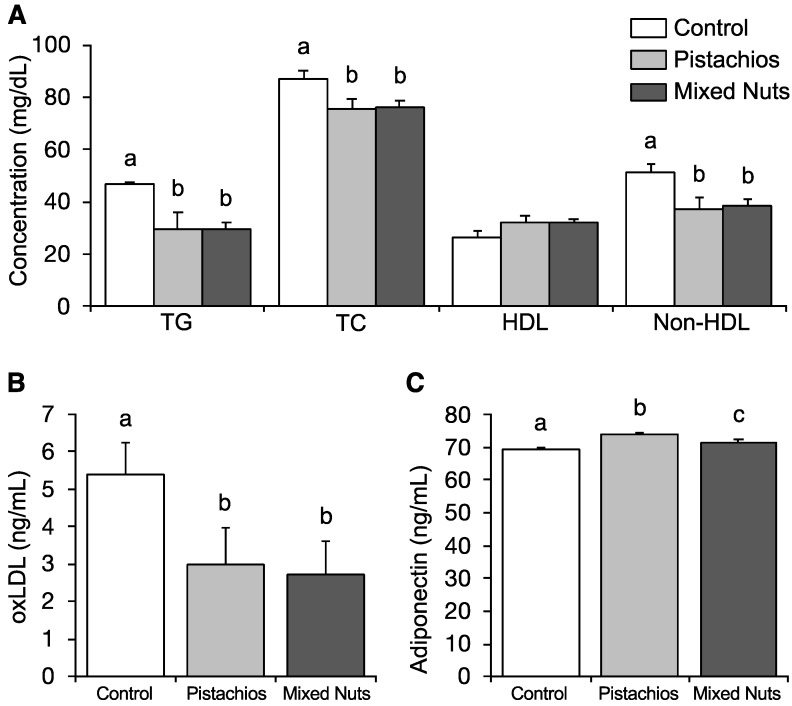
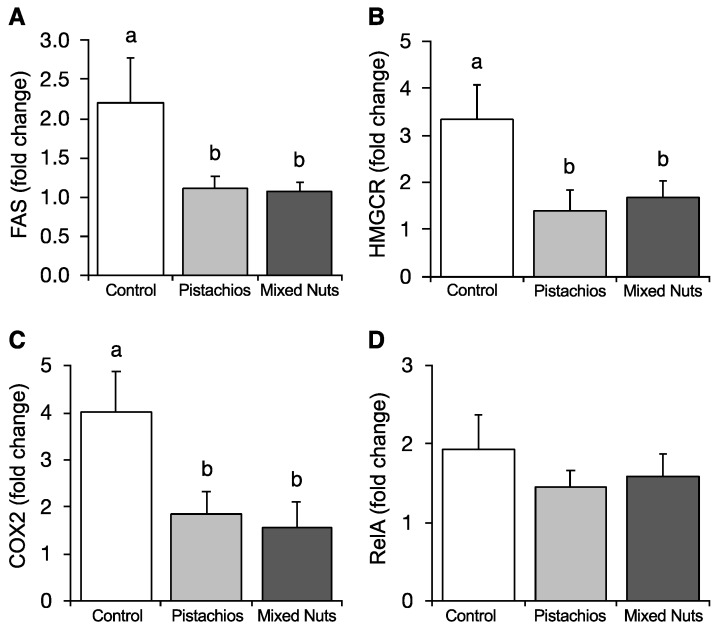
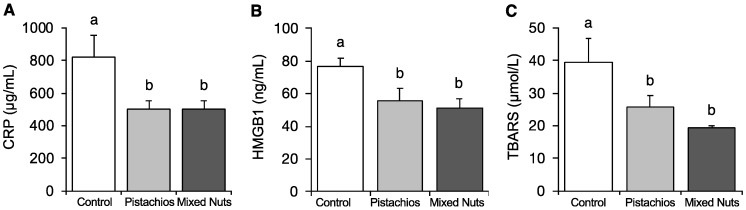
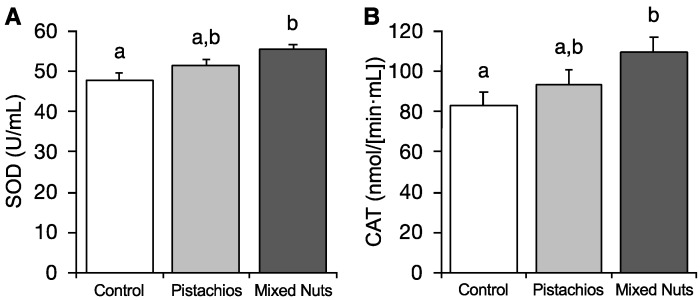
Nut consumption is associated with reduced risk of cardiovascular disease (CVD). Because most studies have administered single nut varieties, it is unknown whether mixed nuts will also reduce CVD risk. The objective of this study was to compare the effects of mixed nut and pistachio consumption on lipid profiles, glucose, inflammation, oxidative stress, and antioxidant capacity in rats fed an atherogenic diet. Thirty male Sprague-Dawley rats (21 days old) were assigned into three groups ( = 10) based on initial body weight and fed either an isocaloric control diet (no nuts), 8.1% pistachio diet (single nut), or 7.5% mixed nut diet (almonds, brazil nuts, cashews, macadamia nuts, peanuts, pecans, pistachios, and walnuts) for 8 weeks. Both pistachios and mixed nuts significantly decreased triglycerides, total cholesterol, and LDL-cholesterol ( < 0.05) compared with controls. Both nut groups exhibited reductions in C-reactive protein ( = 0.045) and oxidative stress ( = 0.004). The mixed nut group had greater superoxide dismutase ( = 0.004) and catalase ( = 0.044) and lower aspartate aminotransferase ( = 0.048) activities. Gene expression for , and was downregulated for both nut groups compared to controls ( < 0.05). In conclusion, mixed nuts and individual nut varieties have comparable effects on CVD risk factors in rats.
坚果的摄入与心血管疾病(CVD)风险的降低有关。由于大多数研究只给单一品种的坚果,因此尚不清楚混合坚果是否也能降低 CVD 风险。本研究的目的是比较混合坚果和开心果的摄入对给予动脉粥样硬化饮食的大鼠的血脂谱、血糖、炎症、氧化应激和抗氧化能力的影响。30 只雄性 Sprague-Dawley 大鼠(21 天大)根据初始体重分为三组(每组 10 只),分别喂食等热量对照饮食(无坚果)、8.1%的开心果饮食(单一坚果)或 7.5%的混合坚果饮食(杏仁、巴西坚果、腰果、澳洲坚果、花生、山核桃、开心果和核桃),持续 8 周。与对照组相比,开心果和混合坚果均显著降低了甘油三酯、总胆固醇和 LDL 胆固醇(<0.05)。两组坚果均降低了 C 反应蛋白(=0.045)和氧化应激(=0.004)。混合坚果组的超氧化物歧化酶(=0.004)和过氧化氢酶(=0.044)活性更高,天冬氨酸转氨酶(=0.048)活性更低。与对照组相比,两组坚果的基因表达均下调(<0.05)。总之,混合坚果和单一坚果品种对大鼠 CVD 风险因素具有相当的影响。