Guttmacher Institute, New York, NY, USA.
Guttmacher Institute, New York, NY, USA.
Lancet Glob Health. 2019 Jan;7(1):e110-e118. doi: 10.1016/S2214-109X(18)30404-2. Epub 2018 Nov 29.
Abortion-related mortality is one of the main causes of maternal mortality worldwide. Laws often restrict the provision of safe abortion care, yet post-abortion care is a service that all countries have committed to provide to manage abortion complications. There is minimal evidence on the capacity of national health systems to provide post-abortion care.
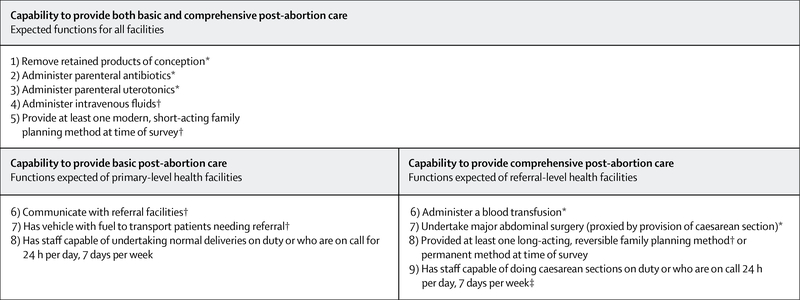
We did a multicountry analysis of data from nationally representative Service Provision Assessment surveys done between 2007 to 2017 in ten countries across three regions (Bangladesh, Haiti, Kenya, Malawi, Namibia, Nepal, Rwanda, Senegal, Tanzania, and Uganda). Data were available for all ten countries from 2007 to 2015. We included facilities offering childbirth delivery services and classified facilities as primary or referral level. We measured signal functions for post-abortion care (the availability of key equipment and ability to perform services) to assess the proportion of primary-level and referral-level facilities in each country with the capacity to provide basic and comprehensive post-abortion care, respectively. We calculated the proportion of facilities providing each post-abortion care signal function to examine specific gaps in service provision.
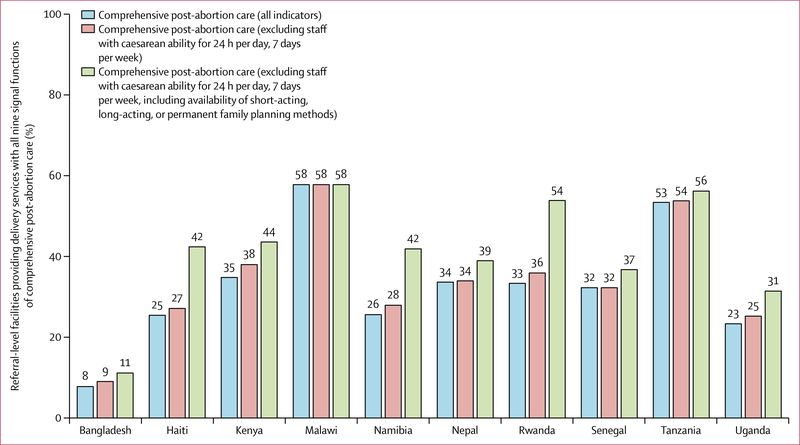
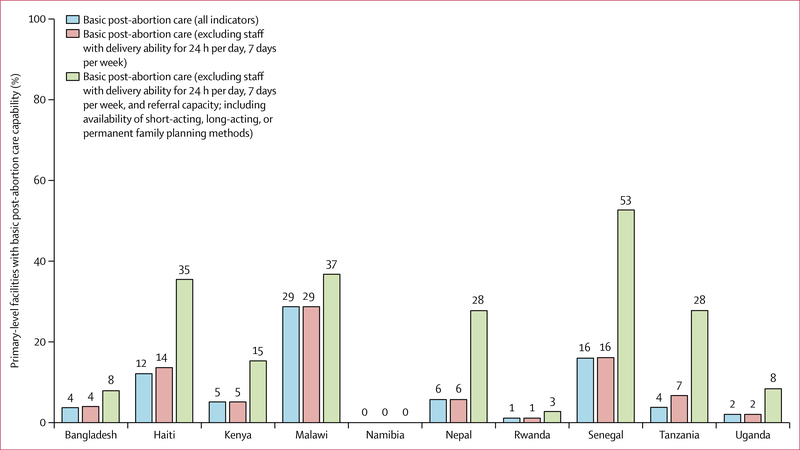
There are critical gaps in the provision of post-abortion care at all facilities that offer delivery services. In seven (70%) of ten countries, less than 10% of primary-level facilities could provide basic post-abortion care, and in eight (80%) of ten countries less than 40% of referral-level facilities could provide comprehensive post-abortion care. In no country could all referral facilities provide all the essential services that need to be included in basic post-abortion care.
The capacity of primary-level and referral-level health facilities to provide basic and comprehensive post-abortion care, respectively, is low. The results highlight the gap between political commitments to address the consequences of unsafe abortion and the capacity of health systems to provide post-abortion care. Increasing the provision of good-quality post-abortion care is essential to reduce the level of abortion-related morbidity and mortality.
UK Aid from the UK Government.
与堕胎相关的死亡是全球孕产妇死亡的主要原因之一。法律通常限制提供安全的堕胎护理,但流产后护理是所有国家都承诺提供的服务,用于处理堕胎并发症。关于国家卫生系统提供流产后护理的能力,证据很少。
我们对 2007 年至 2017 年期间在三个地区(孟加拉国、海地、肯尼亚、马拉维、纳米比亚、尼泊尔、卢旺达、塞内加尔、坦桑尼亚和乌干达)的十个国家进行的具有代表性的服务提供评估调查数据进行了多国分析。从 2007 年到 2015 年,所有十个国家都有数据可用。我们包括提供分娩服务的设施,并将设施分类为初级或转诊级别。我们衡量了流产后护理的信号功能(关键设备的可用性和提供服务的能力),以评估每个国家中具有提供基本和全面流产后护理能力的初级和转诊级别设施的比例。我们计算了提供每个流产后护理信号功能的设施比例,以检查服务提供方面的具体差距。
所有提供分娩服务的设施在提供流产后护理方面都存在严重差距。在十个国家中的七个(70%)中,不到 10%的初级设施能够提供基本的流产后护理,在十个国家中的八个(80%)中,不到 40%的转诊设施能够提供全面的流产后护理。在没有一个国家,所有转诊设施都能提供基本流产后护理中所需的所有基本服务。
初级和转诊级别的卫生设施分别提供基本和全面流产后护理的能力较低。结果突出了政治承诺解决不安全堕胎后果与卫生系统提供流产后护理能力之间的差距。增加优质流产后护理的提供对于降低与堕胎相关的发病率和死亡率至关重要。
英国政府的英国援助。