School of Public Health, SUN Yat-sen University, No. 74, Zhongshan 2nd Road, Yuexiu District, Guangzhou 510080, China.
Shenzhen Luohu Hospital Group, Shenzhen, China.
Bull World Health Organ. 2018 Dec 1;96(12):843-852. doi: 10.2471/BLT.18.214908. Epub 2018 Oct 1.
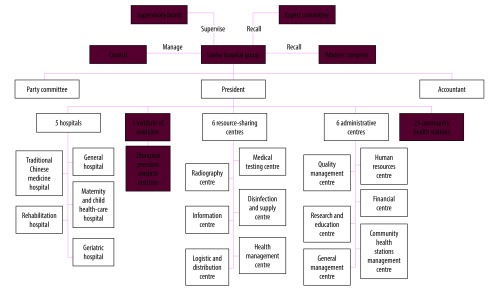
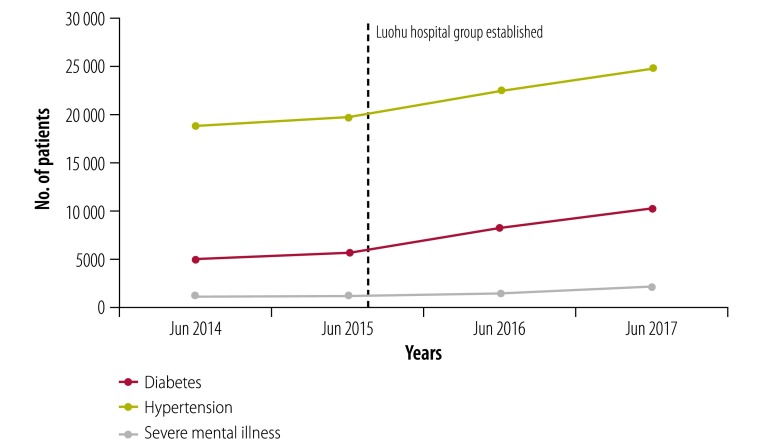
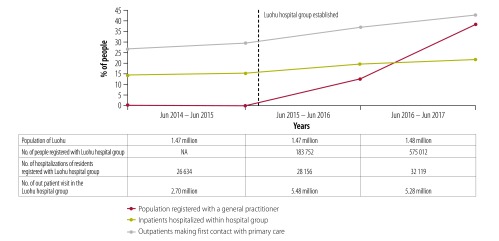
In most countries, the demand for integrated care for people with chronic diseases is increasing as the population ages. This demand requires a fundamental shift of health-care systems towards more integrated service delivery models. To achieve this shift in China, the World Health Organization, the World Bank and the Chinese government proposed a tiered health-care delivery system in accordance with a people-centred integrated care model. The approach was pioneered in Luohu district of Shenzhen city from 2015 to 2017 as a template for practice. In September 2017, China's health ministry introduced this approach to people-centred integrated care to the entire country. We describe the features of the Luohu model in relation to the core action areas and implementation strategies proposed and we summarize data from an evaluation of the first two years of the programme. We discuss the challenges faced during implementation and the lessons learnt from it for other health-care systems. We consider how to improve collaboration between institutions, how to change the population's behaviour about using community health services as the first point of contact and how to manage resources effectively to avoid budget deficits. Finally, we outline next steps of the Luohu model and its potential application to strengthen health care in other urban health-care systems.
在大多数国家,随着人口老龄化,人们对慢性病综合护理的需求正在增加。这种需求要求医疗保健系统向更整合的服务提供模式进行根本性转变。为了在中国实现这一转变,世界卫生组织、世界银行和中国政府根据以人为本的综合护理模式,提出了分层医疗保健提供系统。该方法于 2015 年至 2017 年在深圳市罗湖区率先试行,作为实践模板。2017 年 9 月,中国卫生部向全国推广以人为本的综合护理方法。我们描述了罗湖模式与所提出的核心行动领域和实施策略相关的特点,并总结了该方案头两年的评估数据。我们讨论了实施过程中面临的挑战以及从中吸取的对其他医疗保健系统的经验教训。我们考虑如何改进机构间的协作,如何改变民众对使用社区卫生服务作为第一联系点的行为,以及如何有效管理资源以避免预算赤字。最后,我们概述了罗湖模式的下一步以及其在加强其他城市医疗保健系统的应用潜力。