Division of Hepatology, Department of Medicine II, University Hospital Würzburg, Würzburg, Germany.
Division of Hepatology, Department of Gastroenterology and Rheumatology, University Hospital Leipzig, Leipzig, Germany.
PLoS One. 2018 Dec 3;13(12):e0208225. doi: 10.1371/journal.pone.0208225. eCollection 2018.
BACKGROUND & AIMS: Serum interferon-gamma-inducible protein-10 (IP-10) is elevated in cholestatic liver diseases and predicts response to antiviral therapy in patients with chronic hepatitis C virus (HCV) infection. Dipeptidylpeptidase 4 (DPPIV) cleaves active IP-10 into an inactive form, which inhibits recruitment of CXCR3+ T cells to the liver. In this study the link between IP-10 levels, DPPIV activity in serum and CXCR3+ T cells is analysed in cholestatic and non-cholestatic liver patients.
In serum DPPIV activity (by enzymatic assay), IP-10 (by ELISA) and bile acids (BA) (by enzymatic assay) were analysed in 229 naive HCV genotype (GT) 1 patients and in 16 patients with cholestatic liver disease. In a prospective follow-up (FU) cohort of 27 HCV GT 1 patients peripheral CD3+CXCR3+, CD4+CXCR3+ and CD8+CXCR3+ cells were measured by FACS.
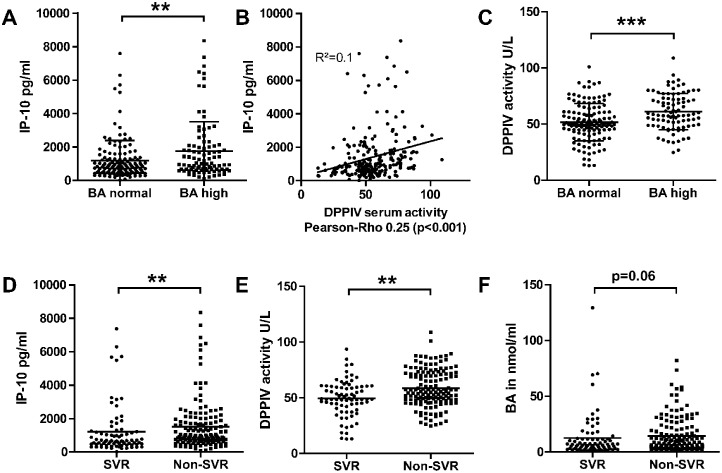
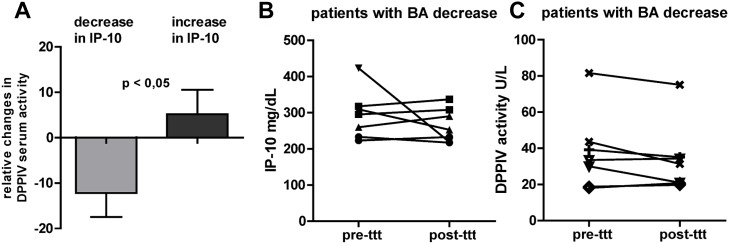
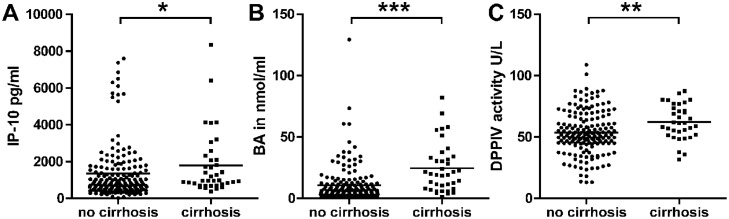
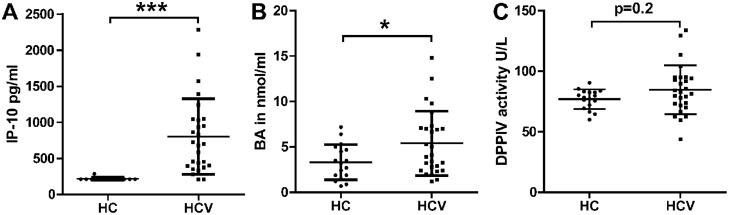
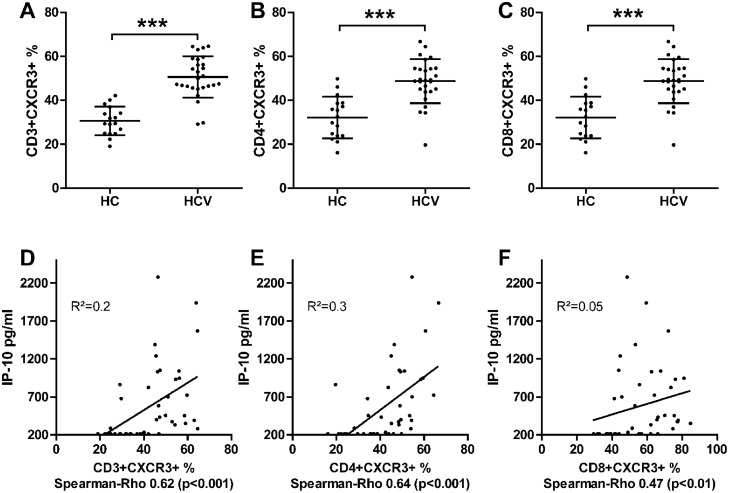
In 229 HCV patients serum IP-10 levels correlated positively to DPPIV serum activity. Higher IP-10 levels and DPPIV activity were detected in cholestatic and in cirrhotic HCV patients. Increased IP-10 serum levels were associated with therapeutic non-response to antiviral treatment with pegylated-interferon and ribavirin. In the HCV FU cohort elevated IP-10 serum levels and increased BA were associated with higher frequencies of peripheral CD3+CXCR3+, CD4+CXCR3+ and CD8+CXCR3+ T cells. Positive correlation between serum IP-10 levels and DPPIV activity was likewise validated in patients with cholestatic liver diseases.
A strong correlation between elevated serum levels of IP-10 and DPPIV activity was seen in different cholestatic patient groups. Furthermore, in cholestatic HCV patients a functional link to increased numbers of peripheral CXCR3+ immune cells could be observed. The source of DPPIV release in cholestatic patients remains open.
血清干扰素-γ诱导蛋白-10(IP-10)在胆汁淤积性肝病中升高,并可预测慢性丙型肝炎病毒(HCV)感染患者对抗病毒治疗的反应。二肽基肽酶 4(DPPIV)将活性 IP-10 切割成无活性形式,从而抑制 CXCR3+T 细胞向肝脏的募集。在这项研究中,分析了胆汁淤积和非胆汁淤积性肝病患者血清中 IP-10 水平、DPPIV 活性与 CXCR3+T 细胞之间的联系。
在 229 例初治 HCV 基因型(GT)1 患者和 16 例胆汁淤积性肝病患者的血清中,通过酶联免疫吸附试验(ELISA)分析了 DPPIV 活性(通过酶法测定)、IP-10(通过 ELISA 测定)和胆汁酸(BA)(通过酶法测定)。在 27 例 HCV GT 1 患者的前瞻性随访(FU)队列中,通过 FACS 测量外周血 CD3+CXCR3+、CD4+CXCR3+和 CD8+CXCR3+细胞。
在 229 例 HCV 患者中,血清 IP-10 水平与 DPPIV 血清活性呈正相关。在胆汁淤积性和肝硬化 HCV 患者中,检测到更高的 IP-10 水平和 DPPIV 活性。血清 IP-10 水平升高与聚乙二醇干扰素和利巴韦林抗病毒治疗的无反应相关。在 HCV FU 队列中,升高的血清 IP-10 水平和增加的 BA 与外周血 CD3+CXCR3+、CD4+CXCR3+和 CD8+CXCR3+T 细胞频率升高相关。在胆汁淤积性肝病患者中,同样验证了血清 IP-10 水平与 DPPIV 活性之间的正相关。
在不同的胆汁淤积性患者群体中,观察到升高的血清 IP-10 水平与 DPPIV 活性之间存在强烈的相关性。此外,在胆汁淤积性 HCV 患者中,可以观察到与外周 CXCR3+免疫细胞数量增加的功能联系。胆汁淤积患者中 DPPIV 释放的来源尚不清楚。