Institute of Public Health, Department of Epidemiology and Biostatistics, Kilimanjaro Christian Medical University College (KCMUCo), P.O. Box 2240, Moshi, Tanzania.
Department of Community Medicine, Kilimanjaro Christian Medical Centre (KCMC), Moshi, Tanzania.
BMC Pregnancy Childbirth. 2018 Dec 4;18(1):471. doi: 10.1186/s12884-018-2104-7.
The World Health Organization has recommended that all infants under 6 months should be exclusively breastfed. An understanding of the trend of exclusive breastfeeding (EBF) over years and over smaller geographical areas is crucial to monitor the progress made in improving the proportions of infants' EBF.
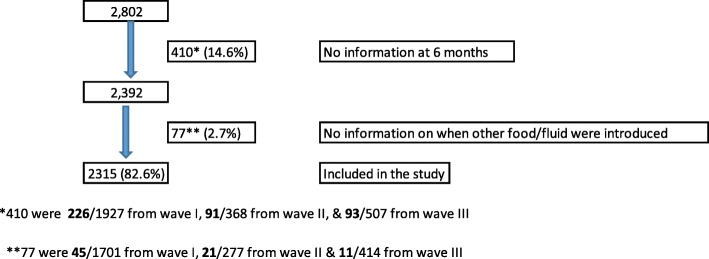
Data on infant feeding practices on 2315 mother-infant pairs from 2002 to 2014 were extracted from cohorts of women who delivered in the Moshi Municipality. Descriptive statistics were used to establish the trend of EBF up to 1, 3 and 6 months across waves (2002/2004 = wave I, 2005/2012 = wave II and 2013/2014 = wave III), to relate EBF up to 6 months to wealth quintiles and to HIV status of mothers.
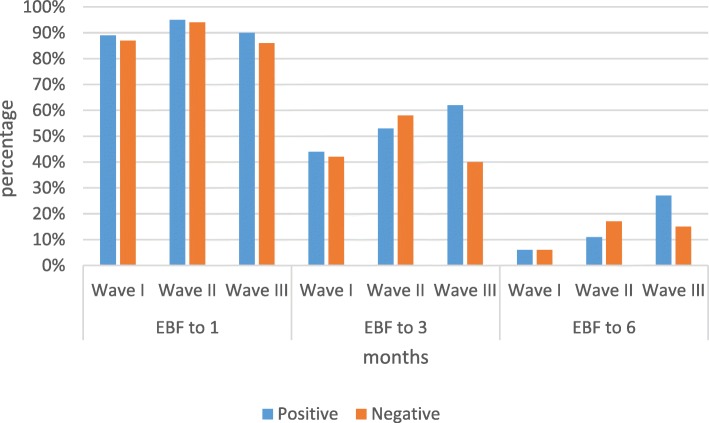
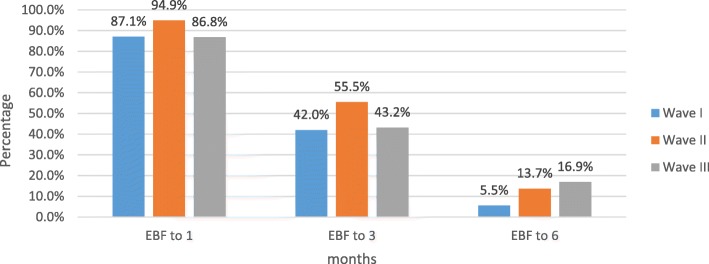
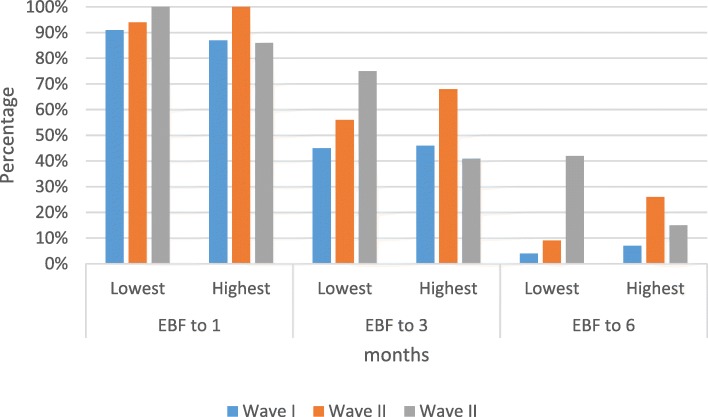
The number of mothers in waves I, II and III were 1656 (71.5%), 256 (11.1%) and 403(17.4%) respectively. The percentages of EBF up to 6 months increased from 5.5, 13.7 to 16.9% from wave I to III. Overall, across the waves, the proportion of EBF up to 6 months among the mothers in the low wealth quintile was 4, 9 and 42%, and 7, 26 and 15% for the ones in the highest wealth quintile. The proportion of EBF up to 6 months has been increasing among HIV positive mothers while fluctuating among their counterparts across the waves.
The proportion of EBF up to 6 months has been increasing in the Moshi municipality but is below the national average. While establishing trends of EBF at the national level is commendable, research to establish trends over smaller geographical areas is needed to provide a true picture that may otherwise be masked.
世界卫生组织建议所有 6 个月以下的婴儿应进行纯母乳喂养。了解多年来和较小地理区域内纯母乳喂养(EBF)的趋势,对于监测改善婴儿 EBF 比例方面取得的进展至关重要。
从莫希市分娩的妇女队列中提取了 2002 年至 2014 年 2315 对母婴的母乳喂养数据。采用描述性统计方法确定了各波次(2002/2004=波 I,2005/2012=波 II 和 2013/2014=波 III)1、3 和 6 个月 EBF 的趋势,以及将 6 个月 EBF 与财富五分位数和母亲 HIV 状况相关联。
波 I、II 和 III 的母亲人数分别为 1656 人(71.5%)、256 人(11.1%)和 403 人(17.4%)。6 个月 EBF 的百分比从波 I 到波 III 分别从 5.5%、13.7%增加到 16.9%。总体而言,各波次中,低财富五分位数的母亲 6 个月 EBF 的比例分别为 4%、9%和 42%,高财富五分位数的母亲 6 个月 EBF 的比例分别为 7%、26%和 15%。6 个月 EBF 的比例在 HIV 阳性母亲中呈上升趋势,而在其对照者中则在各波次中波动。
莫希市 6 个月 EBF 的比例一直在增加,但低于全国平均水平。在国家一级建立 EBF 趋势值得称赞,但需要进行研究以确定较小地理区域内的趋势,以提供否则可能被掩盖的真实情况。