Harris Marc Ashley
Cardiff Metropolitan University, School of Sport and Health Sciences, United Kingdom of Great Britain and Northern Ireland.
Prev Med Rep. 2018 Nov 13;13:37-40. doi: 10.1016/j.pmedr.2018.11.009. eCollection 2019 Mar.
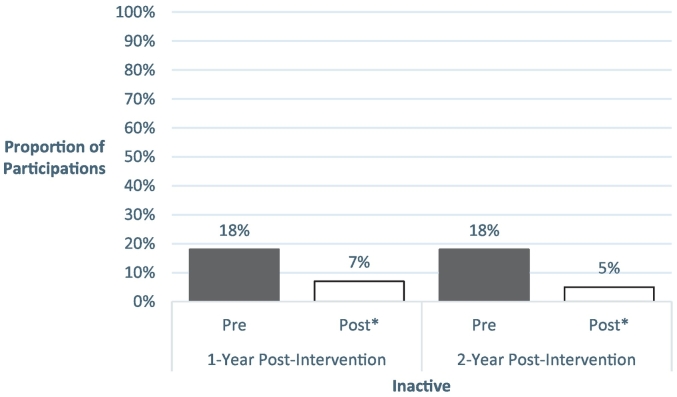
Gamification refers to the use of game mechanics (e.g. competition, point scoring, progress visualisation and task setting) to engage and motivate people to achieve an end goal. Public health programs that incorporate gamification-based approaches which aim to improve the public's health have grown in popularity, however most commonplace are individualistic, smartphone-based applications and few studies have been conducted on community-wide interventions. Furthermore, the few studies which have been conducted have relied on small sample sizes with short-term follow-up. In view of this gap in current understanding, this study explored the impact of a community-wide gamified intervention, called 'Beat the Street' (in Reading UK) on levels of physical activity at 1 and 2-years post-intervention (between 2014 and 2016). Data were available for N = 1567 participants at one-year post-intervention and N = 723 participants at 2-years post-intervention. A Pretest-Posttest analysis revealed a 11% and 13% decrease in levels of inactivity at 1 and 2-years post-intervention respectively. Furthermore, participants who were inactive at baseline reported undertaking 3.4 and 3.8 days of activity at 1 and 2-years post-intervention, respectively. These findings provide promising preliminary evidence that gamification may be effective for decreasing physical inactivity and game-design mechanisms which may support behaviour change are discussed.
游戏化是指运用游戏机制(如竞争、得分、进度可视化和任务设定)来吸引和激励人们实现最终目标。采用旨在改善公众健康的基于游戏化方法的公共卫生项目越来越受欢迎,然而最常见的是基于智能手机的个人应用程序,针对社区范围干预措施的研究很少。此外,已开展的少数研究样本量小且随访时间短。鉴于目前认知上的这一差距,本研究探讨了一项名为“击败街道”(英国雷丁市)的社区范围游戏化干预措施在干预后1年和2年(2014年至2016年)对身体活动水平的影响。干预后1年有N = 1567名参与者的数据,干预后2年有N = 723名参与者的数据。一项前后测分析显示,干预后1年和2年不活动水平分别下降了11%和13%。此外,基线时不活动的参与者在干预后1年和2年分别报告进行了3.4天和3.8天的活动。这些发现提供了有前景的初步证据,表明游戏化可能对减少身体不活动有效,并讨论了可能支持行为改变的游戏设计机制。