Department of Psychology, Education and Child Studies, Erasmus School of Social and Behavioural Sciences, Erasmus University Rotterdam, Rotterdam, Netherlands.
Erasmus University College, Erasmus School of Social and Behavioural Sciences, Erasmus University Rotterdam, Rotterdam, Netherlands.
J Med Internet Res. 2021 Apr 12;23(4):e19875. doi: 10.2196/19875.
Sedentary behavior (SB) and lack of physical activity (PA) have been associated with poorer health outcomes and are increasingly prevalent in individuals working in sedentary occupations such as office jobs. Gamification and nudges have attracted attention as promising strategies to promote changes in health behavior. However, most effectiveness studies thus far lacked active controls, and few studies have tested interventions combining these strategies.
This study investigates the effectiveness of combining a gamified digital app with physical nudges to increase PA and reduce SB in Dutch office workers.
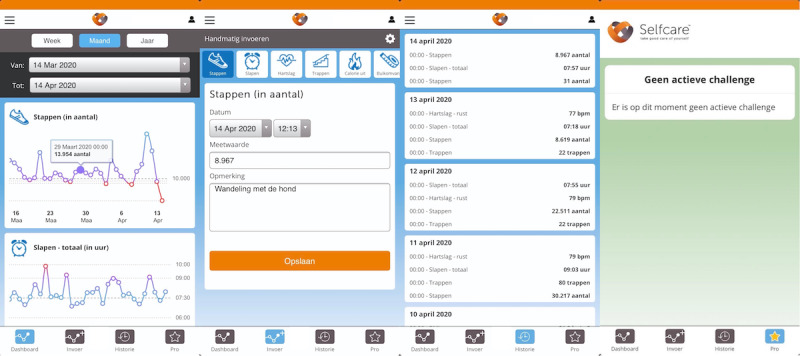
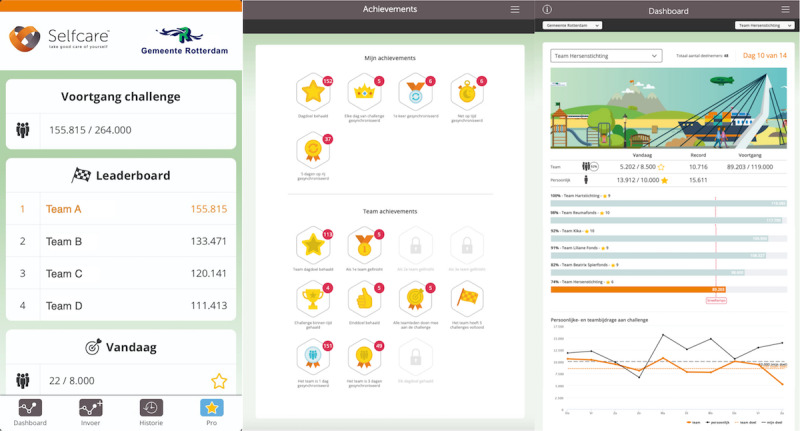
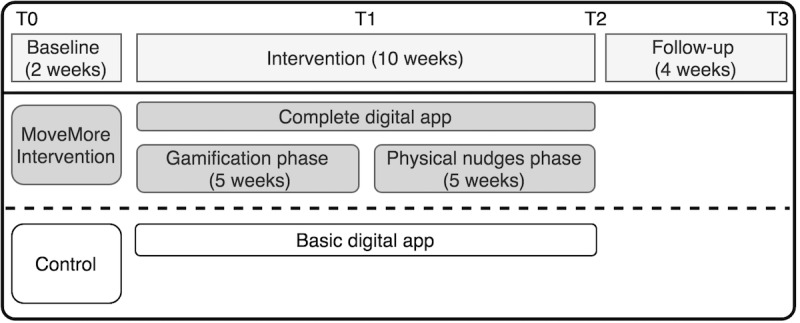
Employees in the municipality of Rotterdam (N=298) from two office locations were randomized at the location level to either a 10-week intervention, combining a 5-week gamification phase encompassing a gamified digital app with social support features and a 5-week physical nudges phase, or to an active control (ie, basic digital app with self-monitoring and goal setting). The primary outcome was the daily step count, objectively measured via accelerometers. Secondary outcomes were self-reported PA and SB measured at baseline and at 5, 10, and 14 weeks. Mixed effects models were used to analyze the effects of the intervention on the outcome measures.
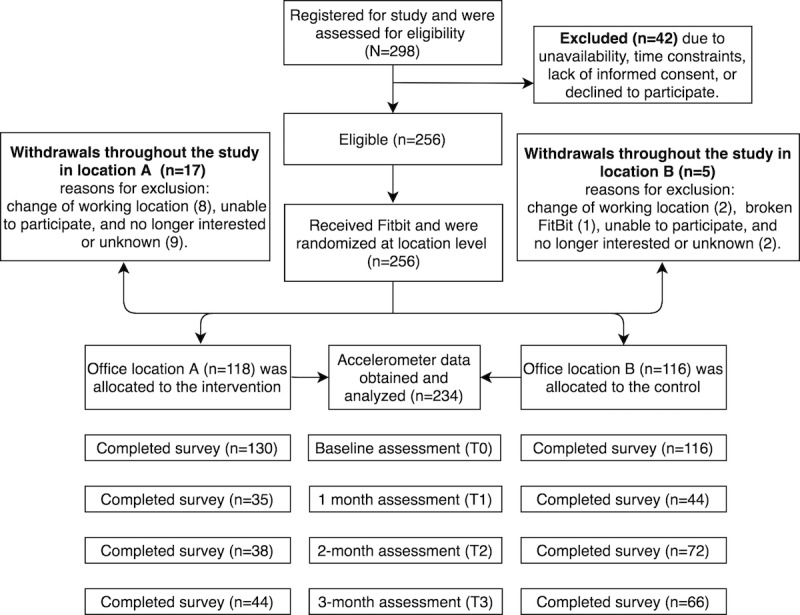
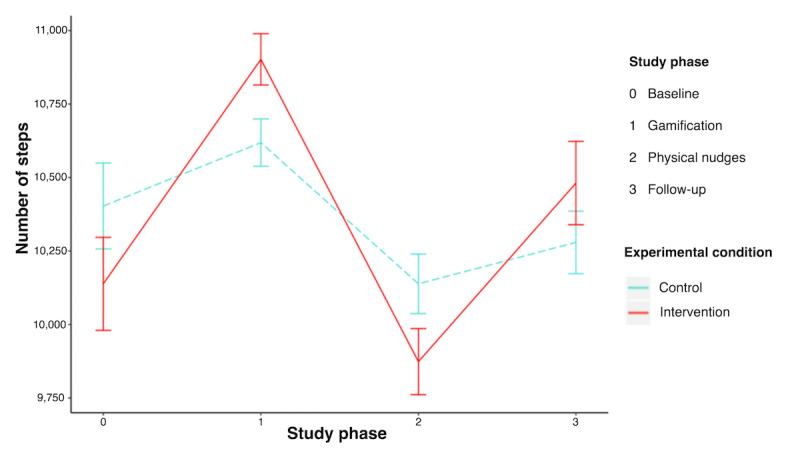
A total of 78.5% (234/298) of participants completed the study and provided accelerometer data, whereas 36.9% (110/298) participants completed the self-report measures at 14 weeks. In the gamification phase, step count data were missing for 13.5% (473/3492) of observations in the control and 11.4% (445/3888) in the intervention condition; however, these percentages increased to 39.6% (1154/2910) and 59.6% (1932/3492) at follow-up, respectively. During the gamification phase, intervention participants increased their number of daily steps by 634 (95% CI 154.2-1113.8; P=.01) more than participants in the control group, after controlling for relevant factors. Improvements were not sustained during the physical nudges phase (P=.76) or follow-up (P=.88).
A digital intervention with gamification and social support features significantly increased the step count of office workers compared with an active control. Physical nudges in the workplace were insufficient to promote the maintenance of behavioral changes achieved in the gamification phase. Future research should explore the long-term effectiveness of similar gamified digital interventions.
International Standard Randomized Controlled Trial Number (ISRCTN) 49129401; https://www.isrctn.com/ISRCTN14881571.
久坐行为(SB)和缺乏身体活动(PA)与较差的健康结果相关联,并且在从事久坐职业(如办公室工作)的个体中越来越普遍。游戏化和推动因素已引起关注,成为促进健康行为改变的有希望的策略。然而,迄今为止,大多数有效性研究都缺乏主动对照,而且很少有研究测试结合这些策略的干预措施。
本研究调查了在荷兰办公室工作人员中,结合使用游戏化数字应用程序和物理推动因素来增加 PA 和减少 SB 的有效性。
鹿特丹市(N=298)的两个办公地点的员工在办公地点层面上随机分配到 10 周的干预组,该干预组结合了 5 周的游戏化阶段,其中包括具有社交支持功能的游戏化数字应用程序和 5 周的物理推动因素阶段,或到主动对照组(即具有自我监测和目标设定功能的基本数字应用程序)。主要结局是通过加速度计客观测量的每日步数。次要结局是在基线和 5、10 和 14 周时自我报告的 PA 和 SB。使用混合效应模型分析干预对结局测量的影响。
共有 78.5%(234/298)的参与者完成了研究并提供了加速度计数据,而 36.9%(110/298)的参与者在 14 周时完成了自我报告测量。在游戏化阶段,控制组中观察到 13.5%(473/3492)的观测值和干预组中 11.4%(445/3888)的数据缺失;然而,在随访时,这些百分比分别增加到 39.6%(1154/2910)和 59.6%(1932/3492)。在游戏化阶段,干预组参与者比对照组参与者每天多走 634 步(95%CI 154.2-1113.8;P=.01),在控制了相关因素后。在物理推动阶段(P=.76)或随访阶段(P=.88),没有维持改善。
与主动对照组相比,具有游戏化和社交支持功能的数字干预显著增加了上班族的步数。工作场所的物理推动因素不足以促进在游戏化阶段实现的行为改变的维持。未来的研究应该探索类似游戏化数字干预的长期有效性。
国际标准随机对照试验编号(ISRCTN)49129401;https://www.isrctn.com/ISRCTN4881571。