Department of Sports Medicine, Norwegian School of Sport Sciences; Sognsvegen 220, 0806 Oslo, Norway.
Department of Psychology, Faculty of Health Sciences, UiT- the Arctic University of Norway, N-9037 Tromsø, Norway.
Nutrients. 2018 Dec 3;10(12):1887. doi: 10.3390/nu10121887.
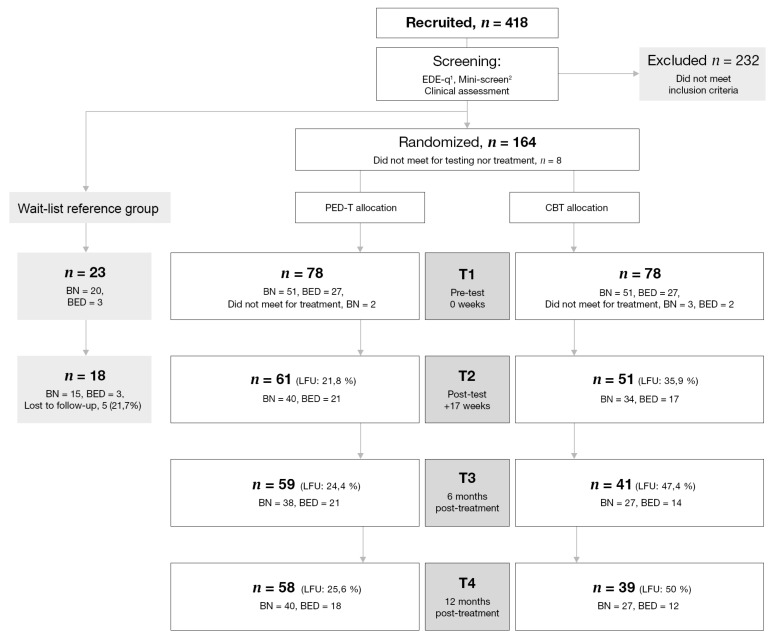
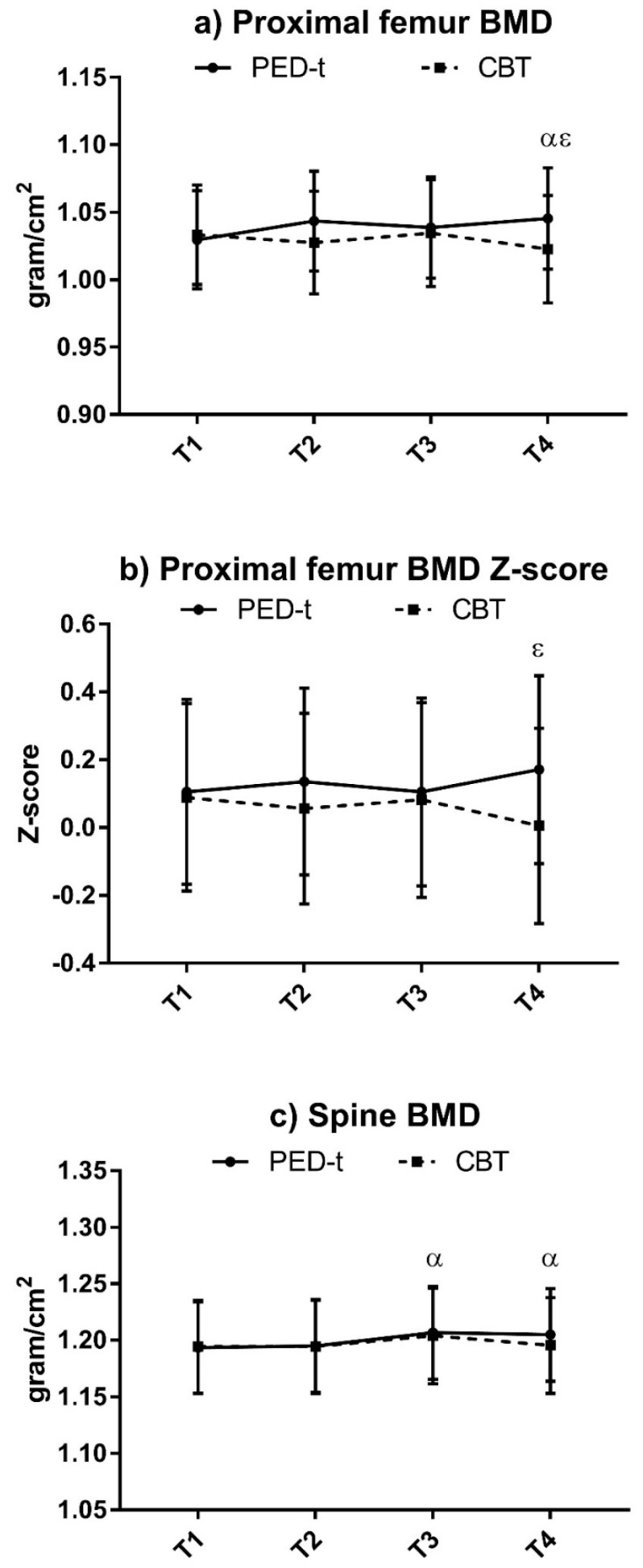
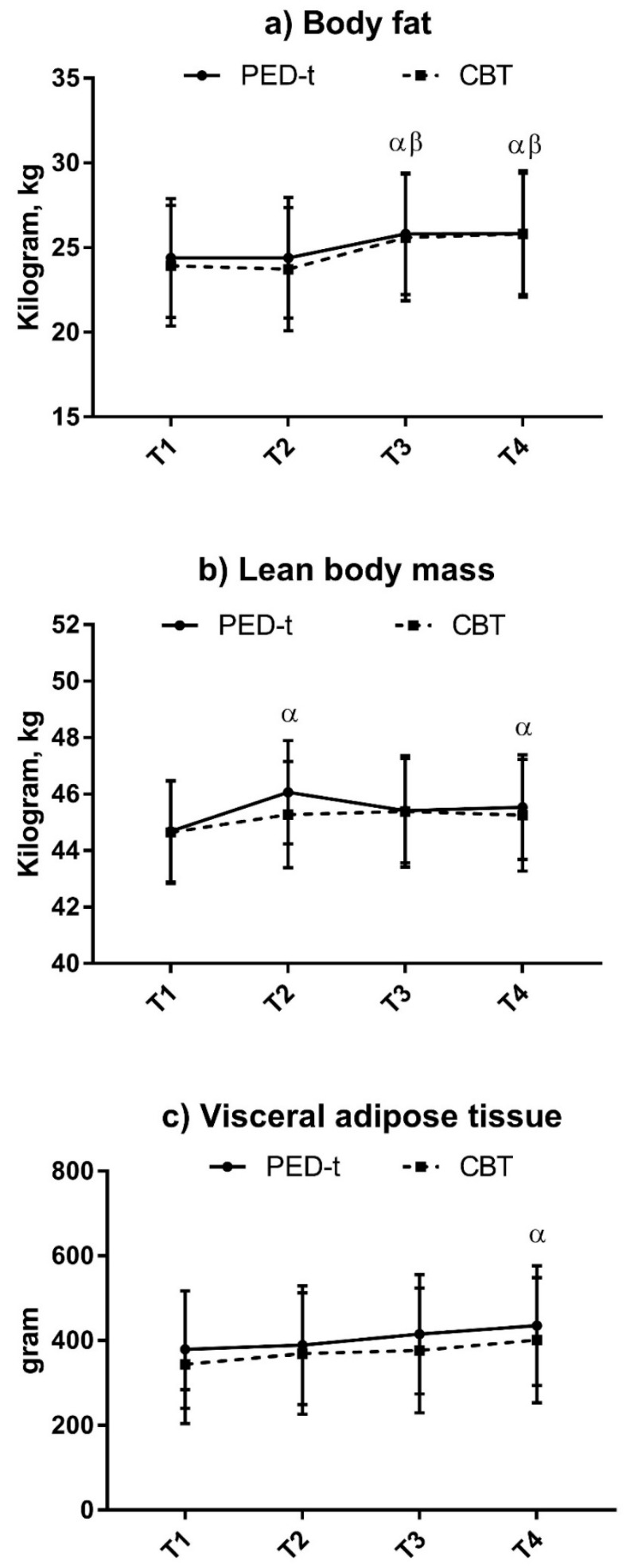
Persons with bulimia nervosa (BN) or binge eating disorder (BED) have an elevated risk of non-communicable diseases (NCDs). However, lowering this risk is rarely addressed in standard cognitive-behavioral treatment (CBT). We aimed to compare CBT with an intervention combining physical exercise and dietary therapy (PED-t), and hypothesized that the PED-t would do better than CBT in lowering the risk of NCD both initially and longitudinally. In this study, 164 women with bulimia nervosa or binge eating disorder were randomly assigned to 16-weeks of outpatient group therapy with either PED-t or CBT. Body composition (BC) was measured by dual-energy X-ray absorptiometry. Measures of physical fitness (VO₂peak and one repetition maximum (1RM) in squats, bench press, and seated row) were also recorded. All measurements were completed baseline, post-treatment, and at 6- and 12-month follow-ups, respectively. Our results showed that PED-t improved more than CBT on mean (99% CI) absolute Vo2peak; 57,2 (84.4, 198.8) mL ( = 0.22, < 0.001) post-treatment. There were small to medium long-term differences in 1RM after PED-t compared to CBT. BC deteriorated in both groups during follow-up. Neither the PED-t nor the CBT lowered the risk for NCDs. Clearly, other approaches need to be considered to promote physical fitness and lower the risk of NCDs among individuals with BN and BED.
神经性贪食症(BN)或暴食障碍(BED)患者发生非传染性疾病(NCD)的风险增加。然而,在标准的认知行为治疗(CBT)中很少解决降低这种风险的问题。我们旨在比较 CBT 与结合体育锻炼和饮食治疗的干预措施(PED-t),并假设 PED-t 在降低 NCD 风险方面最初和纵向都优于 CBT。在这项研究中,164 名患有神经性贪食症或暴食障碍的女性被随机分配到为期 16 周的门诊小组治疗,分别接受 PED-t 或 CBT。通过双能 X 射线吸收法测量身体成分(BC)。还记录了体能测量值(VO₂peak 和深蹲、卧推和坐姿划船的 1 次重复最大值(1RM))。所有测量均在基线、治疗后以及 6 个月和 12 个月随访时完成。我们的结果表明,PED-t 在平均(99%CI)绝对 Vo2peak 方面的改善明显优于 CBT;治疗后为 57.2(84.4,198.8)mL( = 0.22, < 0.001)。与 CBT 相比,PED-t 在 1RM 方面有小到中等的长期差异。在随访期间,两组的 BC 都恶化了。PED-t 和 CBT 均未降低 BN 和 BED 个体发生 NCD 的风险。显然,需要考虑其他方法来促进身体健康并降低 BN 和 BED 个体发生 NCD 的风险。