Division of Network Services, Department of Medicine, Memorial Sloan Kettering Cancer Center, West Harrison, New York.
Department of Psychiatry and Behavioral Sciences, Memorial Sloan Kettering Cancer Center, New York, New York.
Cancer. 2019 Mar 1;125(5):779-787. doi: 10.1002/cncr.31859. Epub 2018 Dec 6.
Depression is highly prevalent in lung cancer. Although there is a known association between inflammation and depression, this relationship has not been examined in patients with lung cancer who undergo treatment with immune and other targeted drug therapies. Peripheral blood C-reactive protein (CRP), a marker of systemic inflammation, may help identify metastatic lung cancer patients with inflammation-associated depression.
Patients with metastatic lung cancer undergoing treatment were evaluated for depression using the Hospital Anxiety and Depression Scale (HADS). Inflammation (CRP and CRP cutoffs ≥1 and ≥3 mg/mL) and demographic and treatment variables were analyzed for association with depression.
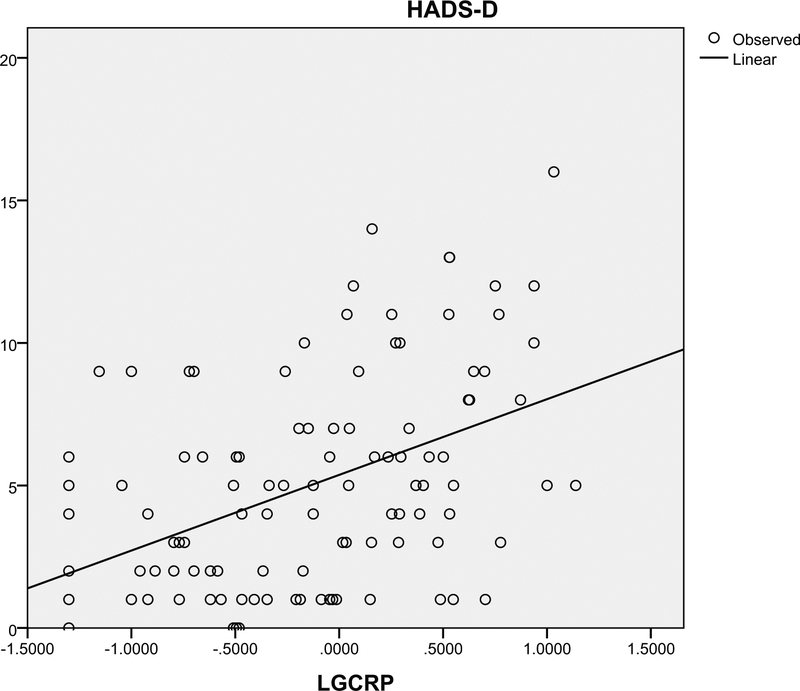
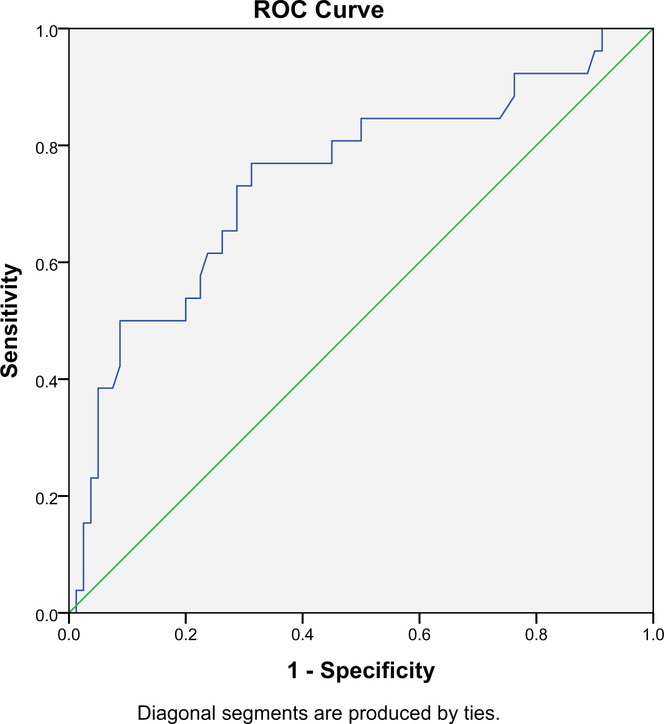
One hundred nine consecutive participants exhibited an average plasma CRP concentration of 1.79 mg/mL (median, 0.75 mg/mL [standard deviation, 2.5 mg/mL), and 20.7% had a CRP concentration of ≥3.0 mg/mL; 23.9% met depression screening criteria (HADS ≥8). A log transformation of CRP was significantly correlated with depression severity (r = 0.47, P < .001). CRP was the only covariate to predict depression severity (P = .008) in a multivariate model including lung cancer disease subtype and type of systemic treatment. Receiver operating characteristic analysis indicated that CRP had moderate predictive accuracy in identifying elevated depression (area under the curve = 0.74). A cutoff of CRP ≥3.0 generated high specificity (88%) but identified only 50% of those with elevated depression.
Elevated CRP is associated with depression in patients with metastatic lung cancer. Thus, CRP may identify a subset of lung cancer patients with inflammation-induced depression and may be useful in predicting response to treatments that target inflammation or its downstream mediators on the brain.
肺癌患者中抑郁症的发病率很高。尽管已经知道炎症与抑郁症之间存在关联,但尚未在接受免疫和其他靶向药物治疗的肺癌患者中对此进行研究。外周血 C 反应蛋白(CRP),一种全身性炎症的标志物,可能有助于识别与炎症相关的患有抑郁症的转移性肺癌患者。
对接受治疗的转移性肺癌患者使用医院焦虑和抑郁量表(HADS)进行抑郁评估。分析炎症(CRP 和 CRP 切点≥1 和≥3mg/mL)和人口统计学及治疗变量与抑郁的相关性。
109 例连续参与者的平均血浆 CRP 浓度为 1.79mg/mL(中位数,0.75mg/mL[标准差,2.5mg/mL]),20.7%的 CRP 浓度≥3.0mg/mL;23.9%的患者符合抑郁筛查标准(HADS≥8)。CRP 的对数转换与抑郁严重程度显著相关(r=0.47,P<.001)。在包括肺癌疾病亚型和全身治疗类型的多变量模型中,CRP 是唯一可预测抑郁严重程度的协变量(P=0.008)。受试者工作特征分析表明,CRP 对识别升高的抑郁具有中等预测准确性(曲线下面积=0.74)。CRP 切点≥3.0 具有较高的特异性(88%),但仅能识别 50%的抑郁升高患者。
在转移性肺癌患者中,CRP 升高与抑郁有关。因此,CRP 可能识别出患有炎症引起的抑郁症的肺癌患者亚群,并且可能有助于预测针对炎症或其对大脑的下游介质的治疗反应。