a Baruch Ivcher School of Psychology , Interdisciplinary Center Herzliya , Herzliya , Israel.
b MRC Cognition and Brain Sciences Unit , University of Cambridge , Cambridge , United Kingdom.
Memory. 2019 May;27(5):686-697. doi: 10.1080/09658211.2018.1554079. Epub 2018 Dec 7.
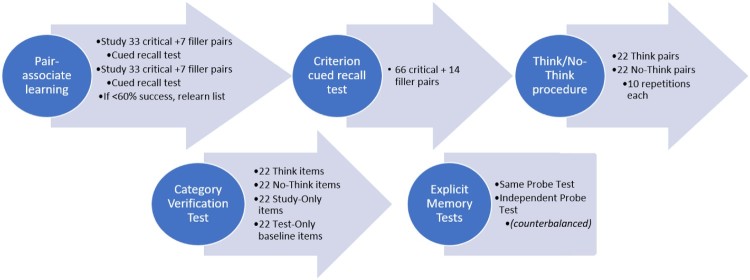
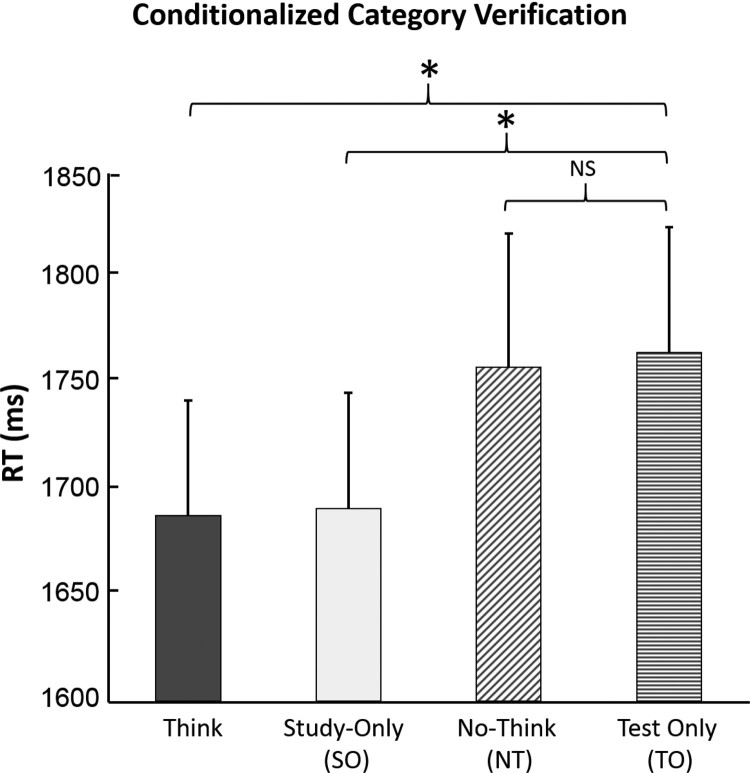
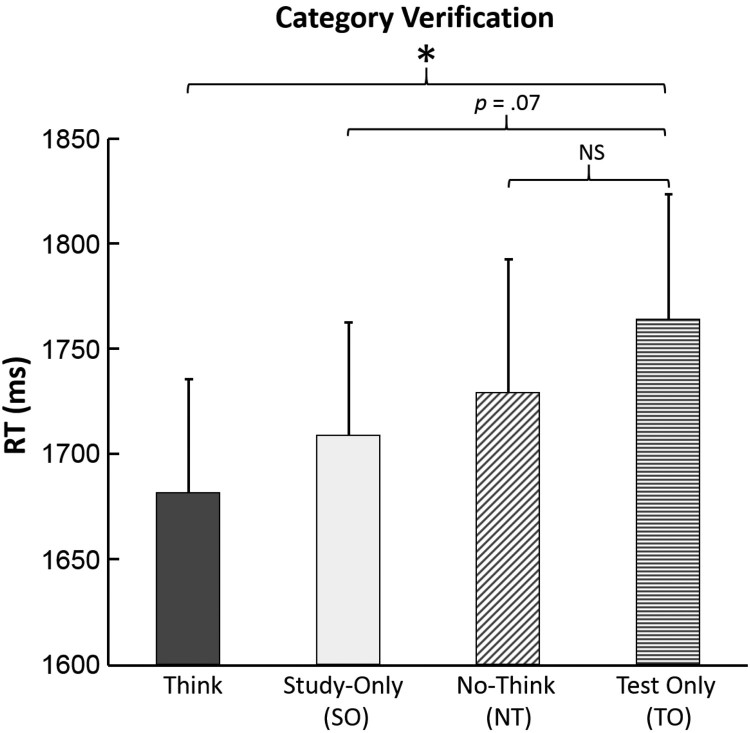
When people suppress retrieval of episodic memories, it can induce forgetting on later direct tests of memory for those events. Recent reports indicate that suppressing retrieval affects less conscious, unintentional retrieval of unwanted memories as well, at least on perceptually-oriented indirect tests. In the current study we examined how suppressing retrieval affects conceptual implicit memory for the suppressed content, using a category verification task. Participants studied cue-target words pairs in which the targets were exemplars of 22 semantic categories, such as vegetables or occupations. They then repeatedly retrieved or suppressed the targets in response to the cues for some of those pairs. Afterwards, they were exposed to the targets intermixed with novel items, one at a time, and asked to verify the membership of each of the words in a semantic category, as quickly as possible. Judgment response times to studied words were faster than to unstudied exemplars, reflecting repetition priming, as has been previously observed. Strikingly, the beneficial effects of prior exposure on response time were eliminated for targets that had been suppressed. Follow-up explicit memory tests also demonstrated that retrieval suppression continued to disrupt episodic recall for the items that had been just been re-exposed on the category verification test. These findings support the contention that the effects of retrieval suppression are not limited to episodic memory, but also affect indirect expressions of those memories on conceptually oriented tests, raising the possibility that underlying semantic representations of suppressed content are affected.
当人们抑制情节记忆的提取时,它会导致在随后对这些事件的直接记忆测试中遗忘。最近的报告表明,抑制提取不仅会影响对不需要的记忆的无意识、非故意提取,至少在感知导向的间接测试中是这样。在当前的研究中,我们使用类别验证任务来研究抑制提取如何影响对被抑制内容的概念性内隐记忆。参与者学习提示-目标词对,其中目标是 22 个语义类别(如蔬菜或职业)的示例。然后,他们根据提示多次提取或抑制这些对中的目标。之后,他们将目标与新的项目混合在一起,逐个展示,并要求他们尽快验证每个单词是否属于某个语义类别。对已学习单词的判断反应时间快于对未学习示例的反应时间,这反映了重复启动,如前所述。引人注目的是,对于那些被抑制的目标,先前暴露对反应时间的有益影响被消除了。后续的显性记忆测试也表明,检索抑制继续破坏在类别验证测试中刚刚重新暴露的项目的情节回忆。这些发现支持了这样一种观点,即检索抑制的影响不仅限于情节记忆,还会影响概念性测试中对这些记忆的间接表达,这增加了被抑制内容的潜在语义表示受到影响的可能性。