Unidad de Infección Viral e Inmunidad, Centro Nacional de Microbiología, Instituto de Salud Carlos III, Carretera Majadahonda-Pozuelo, Km 2.2, 28220, Majadahonda, Madrid, Spain.
Institut de Recerca de la Sida IrsiCaixa-HIVACAT, Badalona, Barcelona, Spain.
J Transl Med. 2018 Dec 6;16(1):343. doi: 10.1186/s12967-018-1717-y.
The mitochondrial DNA (mtDNA) seems to influence in a large number of diseases, including HIV infection. Moreover, there is a substantial inter-individual variability in the CD4+ recovery in HIV-infected patients on combination antiretroviral therapy (cART). Our study aimed to analyze the association between mtDNA haplogroups and CD4+ recovery in HIV-infected patients on cART.
This is a retrospective study of 324 naïve cART patients with CD4+ < 200 cells/mm, who were followed-up during 24 months after initiating cART. All patients had undetectable HIV viral load during the follow-up. Besides, we included 141 healthy controls. MtDNA genotyping was performed by using Sequenom's MassARRAY platform. The primary outcome variable was the slope of CD4+ recovery. Patients were stratified into two groups by the median slope value of CD4+ (9.65 CD4+ cells/mm/month). Logistic regression analyses were performed to calculate the odds of CD4+ recovery according to mtDNA haplogroups.
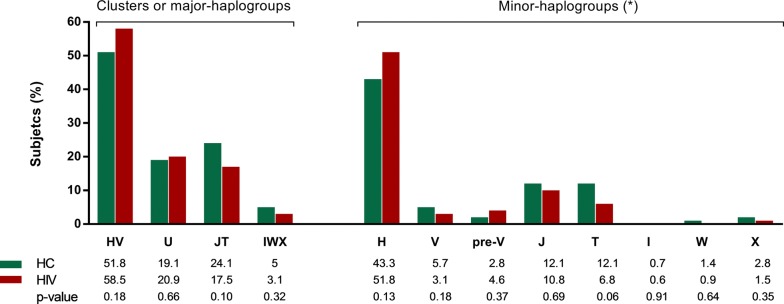
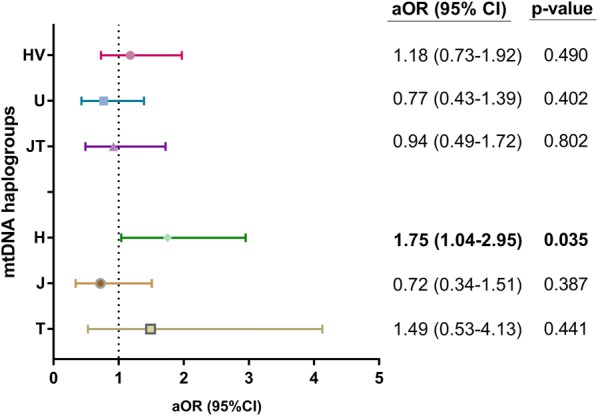
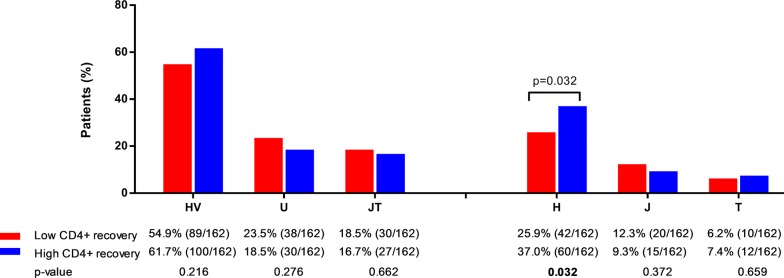
Our study included European HIV-infected patients within the N macro-cluster. The baseline values of CD4+ T-cells were similar between groups of patients stratified by the P50th of the slope of CD4+ T-cells recovery. Patients in the low CD4+ T-cells recovery group were older (p = 0.001), but this variable was included in the multivariate models. When we analyzed the frequencies of mtDNA haplogroups, no significant differences between HIV-infected individuals and healthy controls were found. We did not find any significant association between mtDNA haplogroups and the slope of CD4+ T-cells recovery by linear regression analysis. However, Patients carrying haplogroup H had a higher odds of having a better CD4+ recovery (> 9.65 CD4+ cells/mm/month) than patients without haplogroup H (p = 0.032). The adjusted logistic regression showed that patients carrying haplogroup H had a higher likelihood of achieving a CD4+ recovery > 9.65 CD4+ cells/mm/month [adjusted odds ratio (aOR) = 1.75 (95% CI = 1.04; 2.95); p = 0.035].
European mitochondrial haplogroup H was associated with the improved CD4+ recovery in HIV-infected patients starting cART with CD4+ < 200 cells/mm.
线粒体 DNA(mtDNA)似乎会影响许多疾病,包括 HIV 感染。此外,在接受联合抗逆转录病毒治疗(cART)的 HIV 感染患者中,CD4+的恢复存在很大的个体间差异。我们的研究旨在分析 mtDNA 单倍群与 HIV 感染患者 cART 后 CD4+恢复之间的关系。
这是一项回顾性研究,纳入了 324 名 CD4+<200 个细胞/mm 的初治 cART 患者,他们在开始 cART 后 24 个月内接受了随访。所有患者在随访期间均检测不到 HIV 病毒载量。此外,我们还纳入了 141 名健康对照者。使用 Sequenom 的 MassARRAY 平台进行 mtDNA 基因分型。主要结局变量是 CD4+恢复的斜率。根据 CD4+恢复的中位数斜率值(9.65 个 CD4+细胞/mm/月),将患者分为两组。采用 logistic 回归分析计算 mtDNA 单倍群与 CD4+恢复的比值比。
我们的研究纳入了 N 大聚类内的欧洲 HIV 感染患者。根据 CD4+T 细胞恢复斜率的 P50 分组,两组患者的 CD4+T 细胞的基线值相似。在 CD4+T 细胞恢复较慢的患者组中,患者年龄较大(p=0.001),但该变量被纳入多变量模型中。当我们分析 mtDNA 单倍群的频率时,在 HIV 感染个体与健康对照者之间未发现显著差异。线性回归分析未发现 mtDNA 单倍群与 CD4+T 细胞恢复斜率之间存在任何显著关联。然而,携带单倍群 H 的患者比不携带单倍群 H 的患者具有更高的获得更好 CD4+恢复的可能性(>9.65 个 CD4+细胞/mm/月)(p=0.032)。调整后的 logistic 回归显示,携带单倍群 H 的患者更有可能实现 CD4+恢复>9.65 个 CD4+细胞/mm/月[aOR=1.75(95%CI=1.04;2.95);p=0.035]。
在 CD4+<200 个细胞/mm 的开始 cART 的 HIV 感染患者中,欧洲线粒体单倍群 H 与 CD4+恢复改善相关。