Vanderbilt University School of Medicine, Nashville, Tennessee, USA.
PLoS One. 2012;7(8):e43803. doi: 10.1371/journal.pone.0043803. Epub 2012 Aug 27.
Mitochondrial function influences T cell dynamics and is affected by mitochondrial DNA (mtDNA) variation. We previously reported an association between African mtDNA haplogroup L2 and less robust CD4 cell recovery on antiretroviral therapy (ART) in non-Hispanic black ACTG 384 subjects. We explored whether additional T cell parameters in this cohort differed by mtDNA haplogroup.
ACTG 384 randomized ART-naïve subjects to two different nucleoside regimens with efavirenz, nelfinavir, or both. CD4 and CD8 memory and activation markers were available at baseline and week 48 on most subjects. mtDNA sequencing was performed on whole blood DNA, and haplogroups were determined. We studied non-Hispanic black subjects with HIV RNA <400 copies/mL at week 48. Analyses included Wilcoxon ranksum test and linear regression.
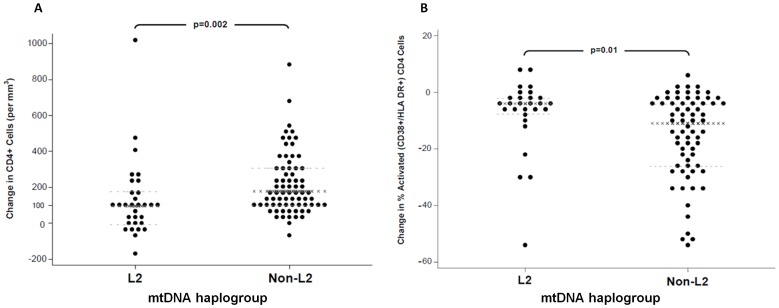
Data from 104 subjects were included. Major African mtDNA haplogroups included L1 (N=25), L2 (N=31), and L3 (N=32). Baseline age, HIV RNA, and CD4 cells did not differ between L2 and non-L2 haplogroups. Compared to non-L2 haplogroups, L2 subjects had lower baseline activated CD4 cells (median 12% vs. 17%; p=0.03) and tended toward lower activated CD8 cells (41% vs. 47%; p=0.06). At 48 weeks of ART, L2 subjects had smaller decreases in activated CD4 cells (-4% vs. -11%; p=0.01), and smaller CD4 cell increases (+95 vs. +178; p=0.002). In models adjusting for baseline age, CD4 cells, HIV RNA, and naïve-to-memory CD4 cell ratio, haplogroup L2 was associated with lower baseline (p=0.04) and 48-week change in (p=0.01) activated CD4 cells.
Among ART-naïve non-Hispanic blacks, mtDNA haplogroup L2 was associated with baseline and 48-week change in T cell activation, and poorer CD4 cell recovery. These data suggest mtDNA variation may influence CD4 T cell dynamics by modulating T cell activation. Further study is needed to replicate these associations and identify mechanisms.
线粒体功能会影响 T 细胞的动态变化,并且会受到线粒体 DNA(mtDNA)变异的影响。我们之前报道过,非裔美国人群体的线粒体 DNA 单倍群 L2 与抗逆转录病毒治疗(ART)后 CD4 细胞恢复不佳有关。我们在这个队列中探索了其他 T 细胞参数是否因 mtDNA 单倍群而不同。
ACTG 384 研究将接受 ART 治疗的初治非裔美国受试者随机分配至两种不同的核苷类逆转录酶抑制剂方案,方案中包含依非韦伦、奈韦拉平或两者均有。大多数受试者在基线和第 48 周时可获得 CD4 和 CD8 记忆性和激活标志物的数据。对全血 DNA 进行 mtDNA 测序,并确定单倍群。我们研究了第 48 周 HIV RNA<400 拷贝/mL 的非裔美国受试者。分析包括 Wilcoxon 秩和检验和线性回归。
共纳入 104 名受试者的数据。主要的非洲 mtDNA 单倍群包括 L1(N=25)、L2(N=31)和 L3(N=32)。L2 与非-L2 单倍群之间的基线年龄、HIV RNA 和 CD4 细胞无差异。与非-L2 单倍群相比,L2 受试者的基线激活的 CD4 细胞较低(中位数 12% vs. 17%;p=0.03),且激活的 CD8 细胞也较低(41% vs. 47%;p=0.06)。在接受 ART 治疗 48 周时,L2 受试者的激活 CD4 细胞下降幅度较小(-4% vs. -11%;p=0.01),CD4 细胞增加幅度也较小(+95 与 +178;p=0.002)。在调整基线年龄、CD4 细胞、HIV RNA 和幼稚 CD4 细胞与记忆性 CD4 细胞比值的模型中,单倍群 L2 与基线(p=0.04)和 48 周时(p=0.01)的激活 CD4 细胞变化有关。
在接受 ART 治疗的初治非裔美国人群体中,mtDNA 单倍群 L2 与 T 细胞激活的基线和 48 周变化以及 CD4 细胞恢复较差有关。这些数据表明,mtDNA 变异可能通过调节 T 细胞激活来影响 CD4 T 细胞的动态变化。需要进一步研究来复制这些关联并确定机制。