Department of Pharmacology and Center for Biomedical Neuroscience, UT Health San Antonio, 7703 Floyd Curl Drive, MC 7764, San Antonio, TX 78229, USA.
Department of Pharmacology and Center for Biomedical Neuroscience, UT Health San Antonio, 7703 Floyd Curl Drive, MC 7764, San Antonio, TX 78229, USA.
Schizophr Res. 2019 Apr;206:263-270. doi: 10.1016/j.schres.2018.11.006. Epub 2018 Dec 3.
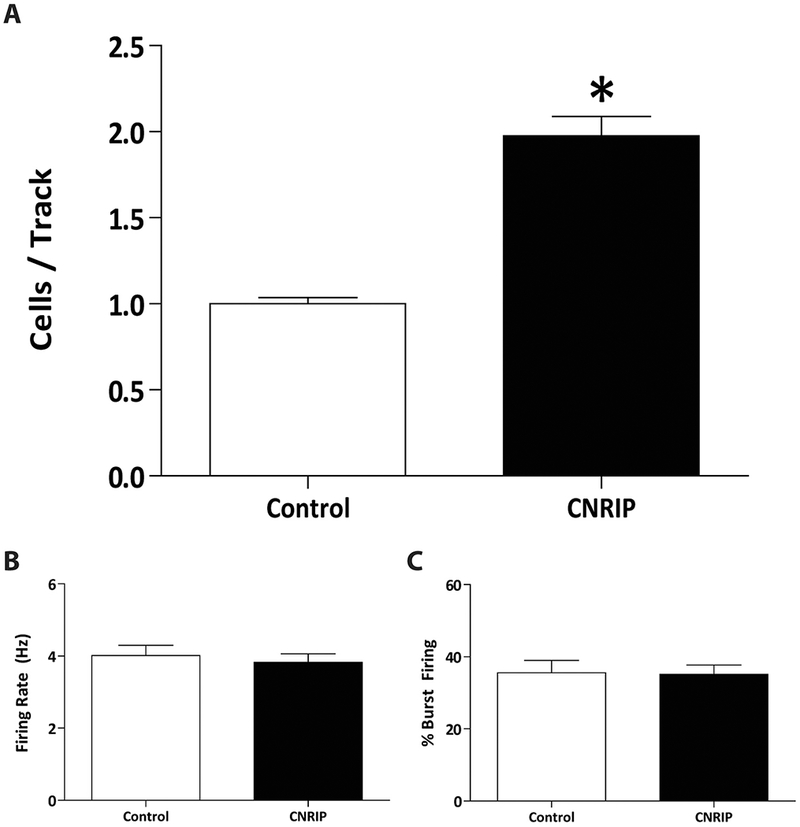
Adolescent cannabis use has been implicated as a risk factor for schizophrenia; however, it is neither necessary nor sufficient. Previous studies examining this association have focused primarily on the role of the cannabinoid receptor 1 (CB1R) with relatively little known about a key regulatory protein, the cannabinoid receptor interacting protein 1 (CNRIP1). CNRIP1 is an intracellular protein that interacts with the C-terminal tail of CB1R and regulates its intrinsic activity. Previous studies have demonstrated aberrant CNRIP1 DNA promoter methylation in post-mortem in human patients with schizophrenia, and we have recently reported decreased methylation of the CNRIP1 DNA promoter in the ventral hippocampus (vHipp) of a rodent model of schizophrenia susceptibility. To examine whether augmented CNRIP1 expression could contribute to the pathology of schizophrenia, we performed viral-mediated overexpression of CNRIP1 in the vHipp of Sprague Dawley rats. We then tested these rats for behavioral correlates of schizophrenia symptoms, followed by electrophysiology to determine the effects on the dopamine system, known to underlie psychosis. Here, we report that overexpression of vHipp CNRIP1 induces impairments in latent inhibition and social interaction, similar to those observed in individuals with schizophrenia and in rodent models of the disease. Furthermore, rats overexpressing vHipp CNRIP1 displayed a significant increase in ventral tegmental area (VTA) dopamine neuron population activity, a putative correlate of psychosis. These data provide evidence that alterations in CNRIP1 may contribute to the pathophysiology of schizophrenia, as overexpression is sufficient to produce neurophysiological and behavioral correlates consistently observed in rodent models of the disease.
青少年大麻使用被认为是精神分裂症的一个风险因素;然而,它既不是必要的,也不是充分的。以前的研究主要集中在大麻素受体 1(CB1R)的作用上,而对关键调节蛋白,即大麻素受体相互作用蛋白 1(CNRIP1)的了解相对较少。CNRIP1 是一种细胞内蛋白,与 CB1R 的 C 端尾巴相互作用,并调节其内在活性。以前的研究已经证明了精神分裂症患者死后大脑中 CNRIP1 DNA 启动子异常甲基化,我们最近报道了精神分裂症易感性啮齿动物模型腹侧海马(vHipp)中 CNRIP1 DNA 启动子的甲基化减少。为了研究增强的 CNRIP1 表达是否会导致精神分裂症的病理学改变,我们在 Sprague Dawley 大鼠的 vHipp 中进行了 CNRIP1 的病毒介导过表达。然后,我们测试了这些大鼠的精神分裂症症状的行为相关性,随后进行电生理学研究以确定对多巴胺系统的影响,多巴胺系统已知与精神病有关。在这里,我们报告说,vHipp CNRIP1 的过表达会导致潜伏抑制和社会互动受损,这与精神分裂症患者和疾病的啮齿动物模型中观察到的情况相似。此外,过表达 vHipp CNRIP1 的大鼠显示腹侧被盖区(VTA)多巴胺神经元群体活动显著增加,这可能是精神病的一个指标。这些数据提供了证据,表明 CNRIP1 的改变可能导致精神分裂症的病理生理学,因为过表达足以产生在疾病的啮齿动物模型中一致观察到的神经生理和行为相关性。