Kwon Ye Won, Bae Jae-Han, Kim Seul-Ah, Han Nam Soo
Brain Korea 21 Center for Bio-Resource Development, Division of Animal, Horticultural, and Food Sciences, Chungbuk National University, Cheongju, South Korea.
Front Microbiol. 2018 Nov 20;9:2781. doi: 10.3389/fmicb.2018.02781. eCollection 2018.
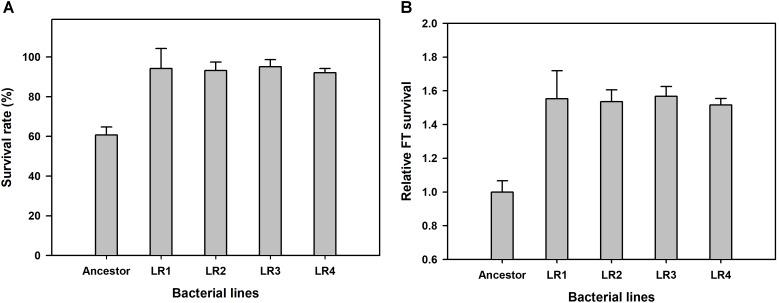
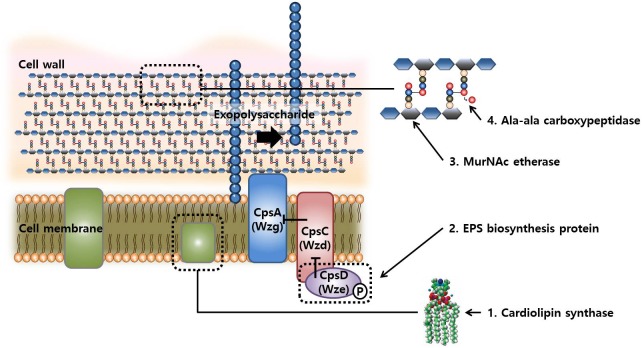
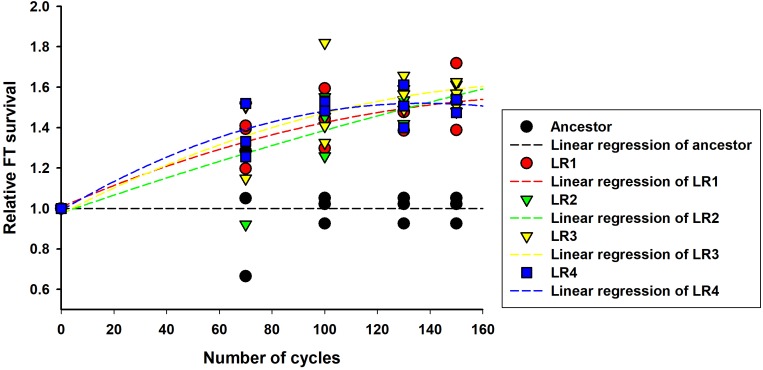
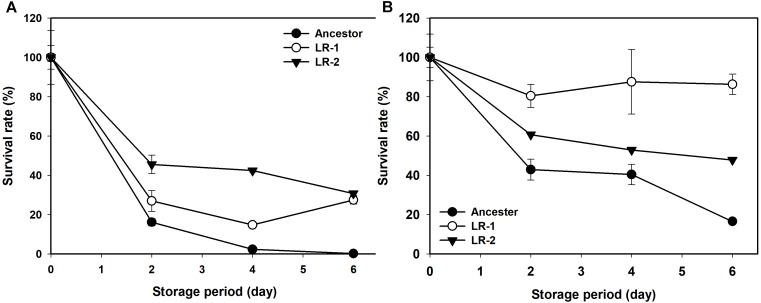
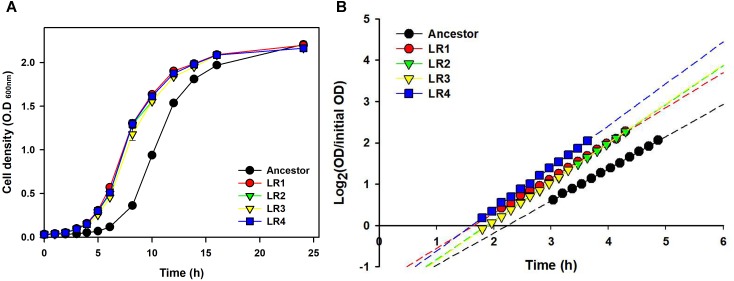
The industrial application of microorganisms as starters or probiotics requires their preservation to assure viability and metabolic activity. Freezing is routinely used for this purpose, but the cold damage caused by ice crystal formation may result in severe decrease in microbial activity. In this study, adaptive laboratory evolution (ALE) technique was applied to a lactic acid bacterium to select tolerant strains against freezing and thawing stresses. GG was subjected to freeze-thaw-growth (FTG) for 150 cycles with four replicates. After 150 cycles, FTG-evolved mutants showed improved fitness (survival rates), faster growth rate, and shortened lag phase than those of the ancestor. Genome sequencing analysis of two evolved mutants showed genetic variants at distant loci in six genes and one intergenic space. Loss-of-function mutations were thought to alter the structure of the microbial cell membrane (one insertion in ), peptidoglycan (two missense mutations in and ), and capsular polysaccharides (one missense mutation in ), resulting in an increase in cellular fluidity. Consequently, GG was successfully evolved into stress-tolerant mutants using FTG-ALE in a concerted mode at distal loci of DNA. This study reports for the first time the functioning of and in freeze-thaw sensitivity of cells and demonstrates that simple treatment of ALE designed appropriately can lead to an intelligent genetic changes at multiple target genes in the host microbial cell.
将微生物用作发酵剂或益生菌的工业应用需要对其进行保存,以确保其活力和代谢活性。为此,冷冻是常规使用的方法,但冰晶形成导致的冷损伤可能会使微生物活性严重下降。在本研究中,将适应性实验室进化(ALE)技术应用于一种乳酸菌,以筛选出耐冻融胁迫的菌株。对GG进行了150个循环的冻融生长(FTG)处理,共四个重复。150个循环后,FTG进化突变体的适应性(存活率)提高,生长速度加快,滞后期比祖先菌株缩短。对两个进化突变体的基因组测序分析显示,在六个基因和一个基因间区域的远位点存在遗传变异。功能丧失突变被认为改变了微生物细胞膜(一个插入)、肽聚糖(两个错义突变)和荚膜多糖(一个错义突变)的结构,导致细胞流动性增加。因此,利用FTG-ALE在DNA的远位点以协同模式成功地将GG进化为耐胁迫突变体。本研究首次报道了和在细胞冻融敏感性中的作用,并证明适当设计的简单ALE处理可导致宿主微生物细胞中多个靶基因发生智能遗传变化。