Adeyi Adebola A, Babalola Babafemi A
Department of Chemistry, University of Ibadan, Ibadan.
J Health Pollut. 2017 Mar 29;7(13):42-55. doi: 10.5696/2156-9614-7-13.42. eCollection 2017 Mar.
Lead and cadmium are components of paints sold in Nigeria. These heavy metals are associated with adverse neurological, cardiovascular and other human health effects.
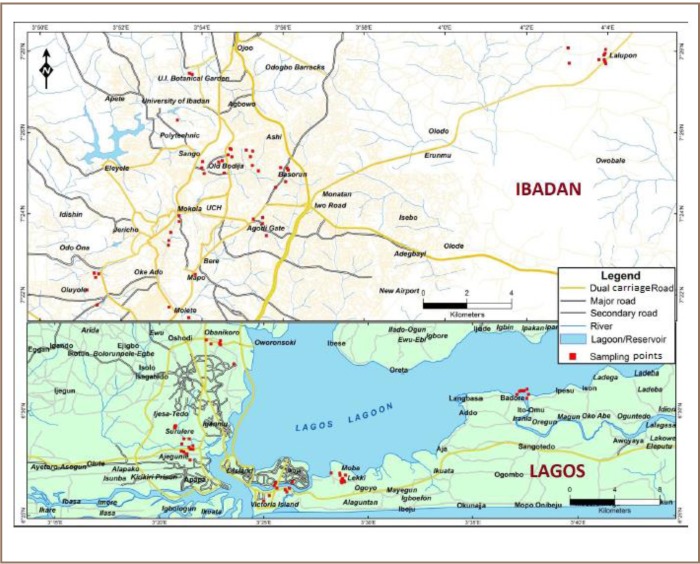
This study assesses the levels of lead and cadmium in topsoil of residential areas in Lagos and Ibadan potentially resulting from painting of buildings.
Samples were pre-treated prior to metal determination using atomic absorption spectrophotometry. Metal speciation was determined using modified Tessier sequential extraction. Soil characteristics were determined by standard methods. Soil contamination was assessed using contamination factor, geo-accumulation and pollution load indices. The United States Environmental Protection Agency integrated exposure uptake biokinetic (IEUBK) model was used to estimate and predict children's blood lead levels (BLL).
Lead and cadmium concentrations in residential areas in Lagos and Ibadan ranged from 1.56-419 mg/kg and not detected-2.8 mg/kg, respectively. Metal contamination factor and pollution load index were highest at the Lagos low income settlement. Results of IEUBK modelling showed that the Lagos low income settlement had the highest probability density for children between 1-7 years of age with an estimated BLL of >10 μg/dL. This population made up less than 0.01% of those within this age range.
Lead and cadmium concentrations in soil around the residential buildings were higher than those in the control sample. Contamination factor and pollution load index showed significant contamination in average and low income settlements. These results suggested that there was accumulation of the metals in the soil, which can persist in the environment. This may pose serious health risks, especially to vulnerable groups such as children.
铅和镉是尼日利亚销售的油漆的成分。这些重金属会对神经系统、心血管系统及其他人体健康产生不良影响。
本研究评估了拉各斯和伊巴丹居民区表层土壤中铅和镉的含量,这些含量可能是由建筑物涂漆造成的。
在使用原子吸收分光光度法测定金属含量之前,先对样品进行预处理。采用改进的 Tessier 连续提取法测定金属形态。通过标准方法测定土壤特性。使用污染因子、地累积指数和污染负荷指数评估土壤污染情况。采用美国环境保护局的综合暴露摄取生物动力学(IEUBK)模型来估计和预测儿童的血铅水平(BLL)。
拉各斯和伊巴丹居民区的铅和镉浓度分别在 1.56 - 419 毫克/千克和未检出 - 2.8 毫克/千克之间。金属污染因子和污染负荷指数在拉各斯低收入居民区最高。IEUBK 模型的结果表明,拉各斯低收入居民区 1 - 7 岁儿童血铅水平估计>10 微克/分升的概率密度最高。该人群在这个年龄范围内所占比例不到 0.01%。
居民区周围土壤中的铅和镉浓度高于对照样品。污染因子和污染负荷指数表明,在平均收入和低收入居民区存在显著污染。这些结果表明,金属在土壤中存在积累,且会在环境中持续存在。这可能会带来严重的健康风险,尤其是对儿童等弱势群体。