Cao Shuyuan, Wang Li, Zhang Zhan, Chen Feng, Wu Qian, Li Lei
Department of Hygienic Analysis and Detection and Ministry of Education Key Lab for Modern Toxicology School of Public Health Nanjing Medical University China.
Department of Epidemiology and Biostatistics and Ministry of Education Key Lab for Modern Toxicology School of Public Health Nanjing Medical University China.
FEBS Open Bio. 2018 Nov 14;8(12):2022-2034. doi: 10.1002/2211-5463.12543. eCollection 2018 Dec.
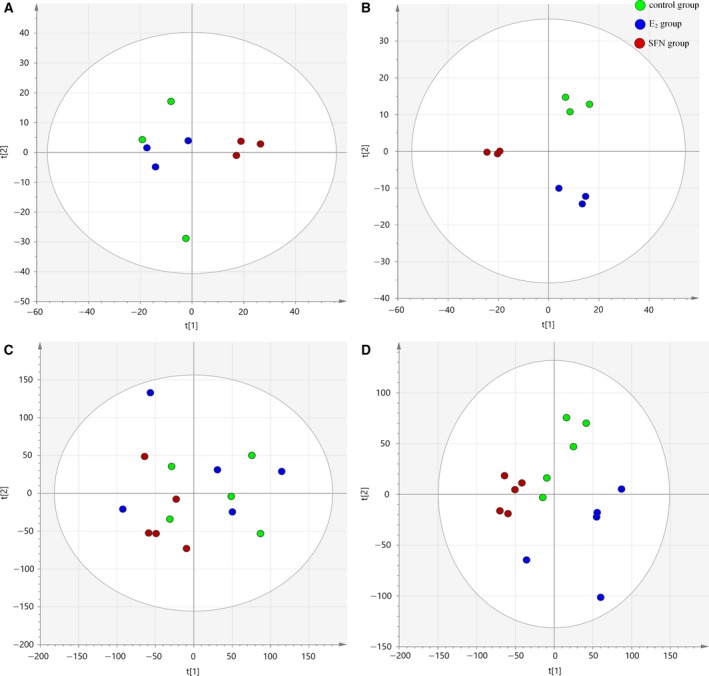
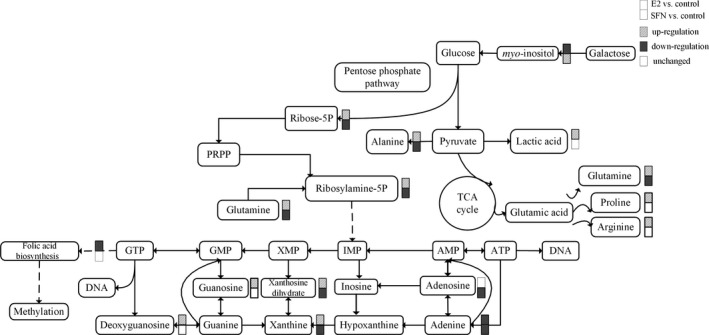
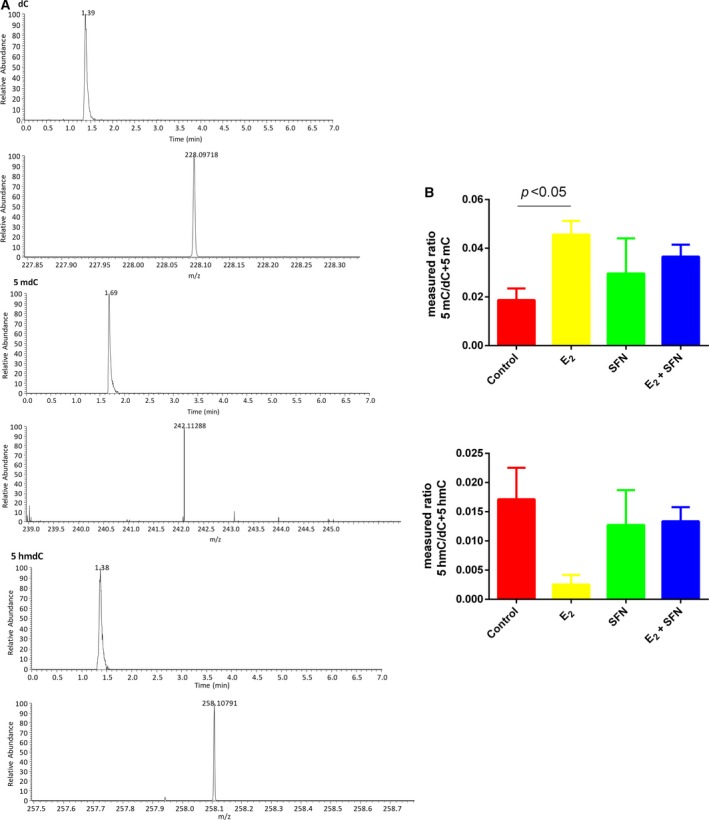
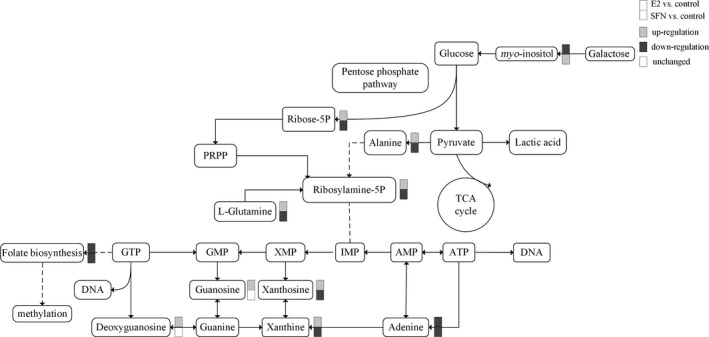
Estrogen is a risk factor for breast cancer. The isothiocyanate sulforaphane (SFN), found in cruciferous vegetables, has been identified as an effective chemopreventive agent, and may prevent or treat breast cancer by reversing estrogen-induced metabolic changes. Here, we investigated metabolic changes in estrogen receptor-positive breast cancer (MCF-7) cells treated with estradiol (E) and/or SFN to identify key metabolite panels that might provide new insights into the underlying mechanisms of the antitumor effects of SFN. Gas chromatography-mass spectrometry and ultra performance liquid chromatography-mass spectrometry (UPLC-Orbitrap MS) were used to obtain the metabolic profiles of MCF-7 cells. The data were analyzed using Student's -test and multivariate statistics, including principal component analysis and partial least squares discriminant analysis. Hydroxymethylation was detected by UPLC-Orbitrap MS and verified by immunofluorescence assay. We report that significant changes in metabolites induced by E and SFN were associated with differences in glycolysis and energy metabolism, and also amino acid, purine, and folic acid metabolism. E may alter methylation and hydroxymethylation status via the folic acid pathway. We also identified biomarkers that may be of use in interpretation of the metabolic pathways evoked by the effects of E and SFN on breast cancer cells. The identified biomarkers associated with metabolic pathways provide new insight into the chemopreventive mechanisms of SFN.
雌激素是乳腺癌的一个风险因素。在十字花科蔬菜中发现的异硫氰酸酯萝卜硫素(SFN)已被确定为一种有效的化学预防剂,并且可能通过逆转雌激素诱导的代谢变化来预防或治疗乳腺癌。在此,我们研究了用雌二醇(E)和/或SFN处理的雌激素受体阳性乳腺癌(MCF-7)细胞中的代谢变化,以确定可能为SFN抗肿瘤作用的潜在机制提供新见解的关键代谢物组。采用气相色谱-质谱联用技术和超高效液相色谱-质谱联用技术(UPLC-Orbitrap MS)获取MCF-7细胞的代谢谱。使用学生t检验和多元统计分析,包括主成分分析和偏最小二乘判别分析对数据进行分析。通过UPLC-Orbitrap MS检测羟甲基化,并通过免疫荧光测定进行验证。我们报告称,E和SFN诱导的代谢物显著变化与糖酵解和能量代谢以及氨基酸、嘌呤和叶酸代谢的差异有关。E可能通过叶酸途径改变甲基化和羟甲基化状态。我们还鉴定了可能有助于解释E和SFN对乳腺癌细胞作用所引发的代谢途径的生物标志物。所鉴定的与代谢途径相关的生物标志物为SFN的化学预防机制提供了新的见解。