Reddy Ravi Kondama, Pooni Rubin, Zaharieva Dessi P, Senf Brian, El Youssef Joseph, Dassau Eyal, Doyle Iii Francis J, Clements Mark A, Rickels Michael R, Patton Susana R, Castle Jessica R, Riddell Michael C, Jacobs Peter G
Department of Biomedical Engineering, Oregon Health & Science University, Portland, OR, United States.
School of Kinesiology and Health Science, York University, Toronto, ON, Canada.
JMIR Mhealth Uhealth. 2018 Dec 10;6(12):e10338. doi: 10.2196/10338.
Wrist-worn activity monitors are often used to monitor heart rate (HR) and energy expenditure (EE) in a variety of settings including more recently in medical applications. The use of real-time physiological signals to inform medical systems including drug delivery systems and decision support systems will depend on the accuracy of the signals being measured, including accuracy of HR and EE. Prior studies assessed accuracy of wearables only during steady-state aerobic exercise.
The objective of this study was to validate the accuracy of both HR and EE for 2 common wrist-worn devices during a variety of dynamic activities that represent various physical activities associated with daily living including structured exercise.
We assessed the accuracy of both HR and EE for two common wrist-worn devices (Fitbit Charge 2 and Garmin vívosmart HR+) during dynamic activities. Over a 2-day period, 20 healthy adults (age: mean 27.5 [SD 6.0] years; body mass index: mean 22.5 [SD 2.3] kg/m; 11 females) performed a maximal oxygen uptake test, free-weight resistance circuit, interval training session, and activities of daily living. Validity was assessed using an HR chest strap (Polar) and portable indirect calorimetry (Cosmed). Accuracy of the commercial wearables versus research-grade standards was determined using Bland-Altman analysis, correlational analysis, and error bias.
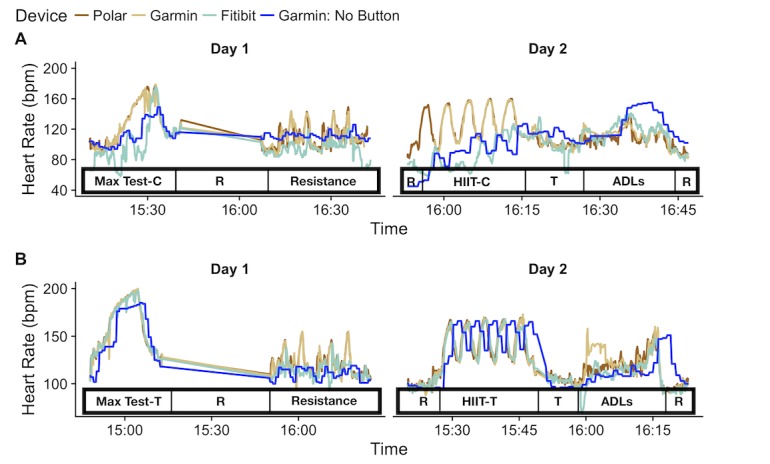
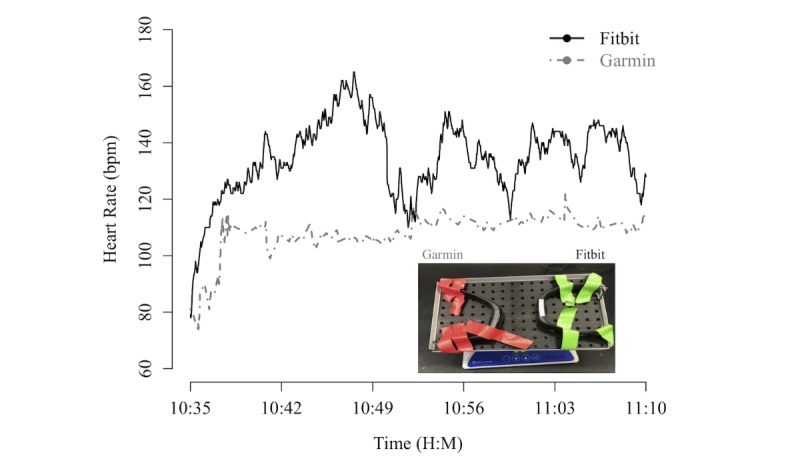
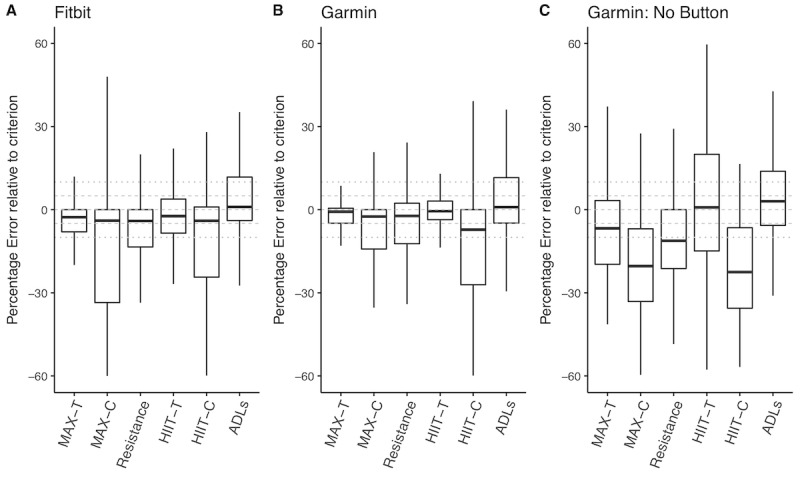
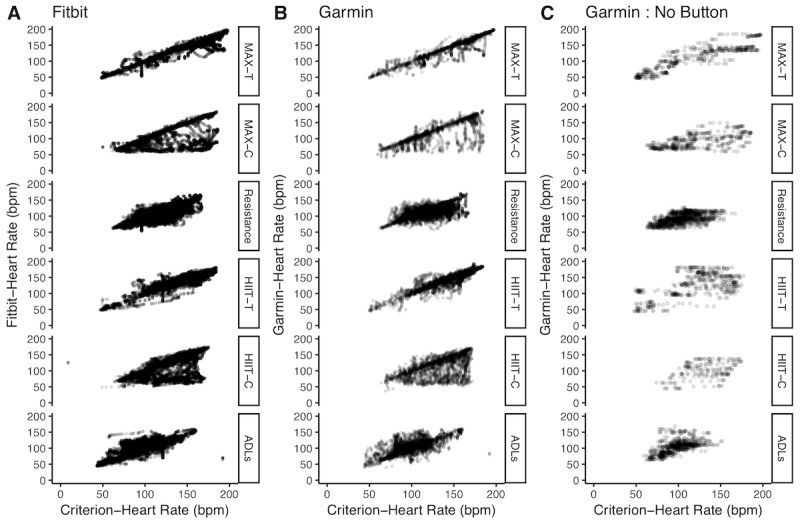
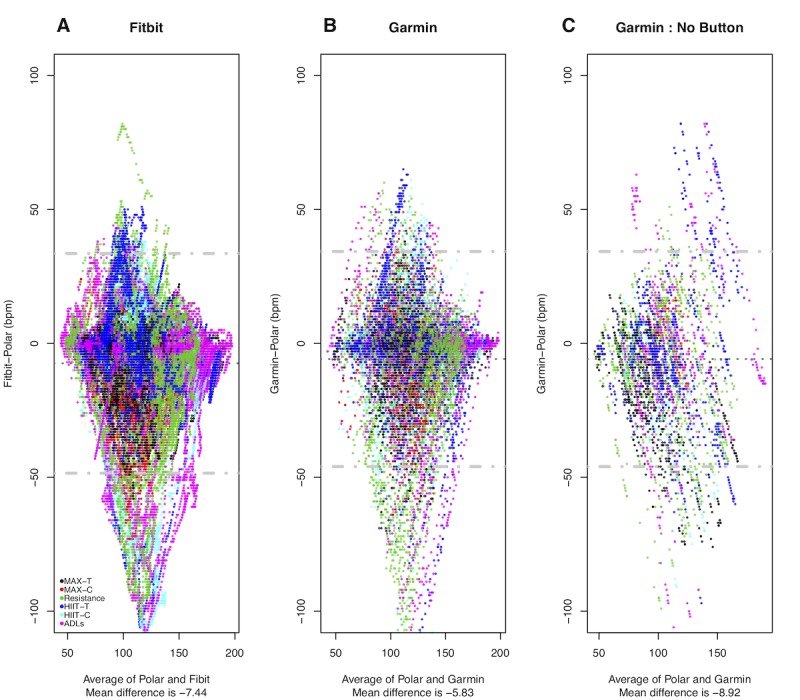
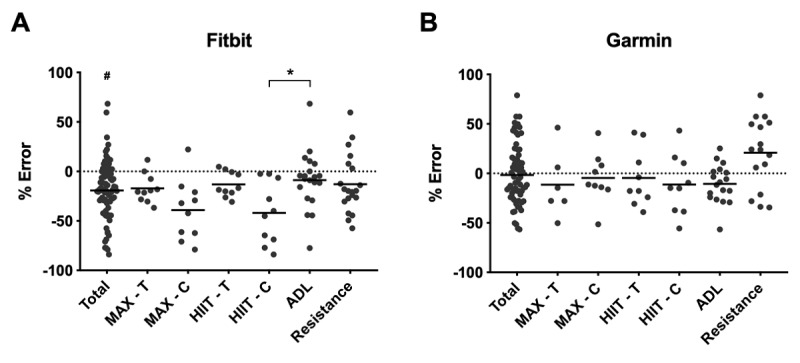
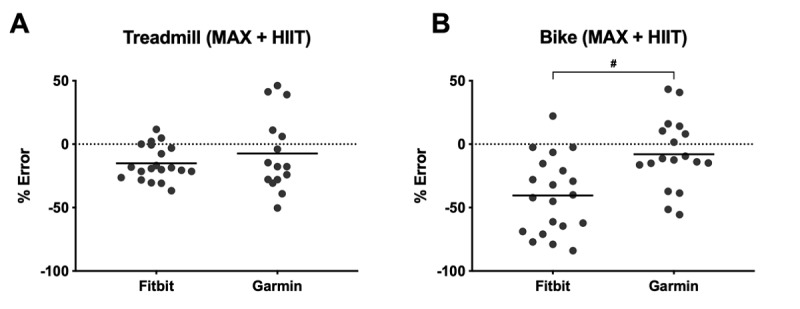
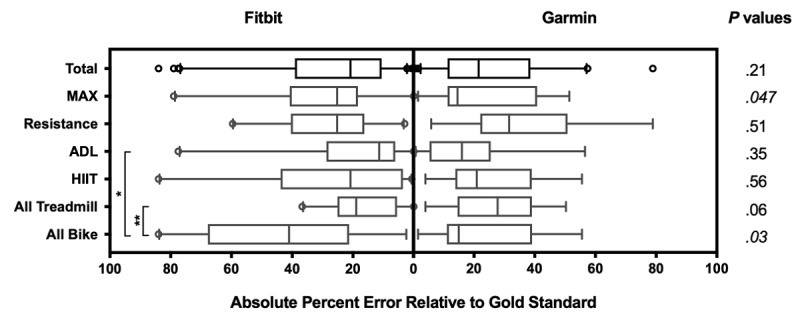
Fitbit and Garmin were reasonably accurate at measuring HR but with an overall negative bias. There was more error observed during high-intensity activities when there was a lack of repetitive wrist motion and when the exercise mode indicator was not used. The Garmin estimated HR with a mean relative error (RE, %) of -3.3% (SD 16.7), whereas Fitbit estimated HR with an RE of -4.7% (SD 19.6) across all activities. The highest error was observed during high-intensity intervals on bike (Fitbit: -11.4% [SD 35.7]; Garmin: -14.3% [SD 20.5]) and lowest error during high-intensity intervals on treadmill (Fitbit: -1.7% [SD 11.5]; Garmin: -0.5% [SD 9.4]). Fitbit and Garmin EE estimates differed significantly, with Garmin having less negative bias (Fitbit: -19.3% [SD 28.9], Garmin: -1.6% [SD 30.6], P<.001) across all activities, and with both correlating poorly with indirect calorimetry measures.
Two common wrist-worn devices (Fitbit Charge 2 and Garmin vívosmart HR+) show good HR accuracy, with a small negative bias, and reasonable EE estimates during low to moderate-intensity exercise and during a variety of common daily activities and exercise. Accuracy was compromised markedly when the activity indicator was not used on the watch or when activities involving less wrist motion such as cycle ergometry were done.
腕部佩戴的活动监测器常用于在各种场景下监测心率(HR)和能量消耗(EE),包括最近在医疗应用中。利用实时生理信号为包括药物输送系统和决策支持系统在内的医疗系统提供信息,将取决于所测信号的准确性,包括心率和能量消耗的准确性。先前的研究仅在稳态有氧运动期间评估了可穿戴设备的准确性。
本研究的目的是在各种动态活动中验证两种常见腕部佩戴设备的心率和能量消耗的准确性,这些动态活动代表了与日常生活相关的各种身体活动,包括有组织的锻炼。
我们在动态活动期间评估了两种常见腕部佩戴设备(Fitbit Charge 2和佳明vívosmart HR+)的心率和能量消耗的准确性。在为期2天的时间里,20名健康成年人(年龄:平均27.5[标准差6.0]岁;体重指数:平均22.5[标准差2.3]kg/m²;11名女性)进行了最大摄氧量测试、自由重量阻力循环训练、间歇训练课程以及日常生活活动。使用心率胸带(博能)和便携式间接测热法(科迈德)评估有效性。使用布兰德-奥特曼分析、相关性分析和误差偏差来确定商业可穿戴设备相对于研究级标准的准确性。
Fitbit和佳明在测量心率方面相当准确,但总体存在负偏差。在缺乏重复性腕部运动以及未使用运动模式指示器的高强度活动期间,观察到的误差更多。在所有活动中,佳明估计心率的平均相对误差(RE,%)为-3.3%(标准差16.7),而Fitbit估计心率的RE为-4.7%(标准差19.6)。在自行车上进行的高强度间歇训练期间观察到最高误差(Fitbit:-11.4%[标准差35.7];佳明:-14.3%[标准差20.5]),而在跑步机上进行的高强度间歇训练期间误差最低(Fitbit:-1.7%[标准差11.5];佳明:-0.5%[标准差9.4])。Fitbit和佳明的能量消耗估计值有显著差异,在所有活动中佳明的负偏差较小(Fitbit:-19.3%[标准差28.9],佳明:-1.6%[标准差30.6],P<0.001),并且两者与间接测热法测量值的相关性都很差。
两种常见的腕部佩戴设备(Fitbit Charge 2和佳明vívosmart HR+)在低至中等强度运动以及各种常见日常活动和锻炼期间显示出良好的心率准确性,负偏差较小,能量消耗估计合理。当手表未使用活动指示器或进行诸如自行车测力计等涉及较少腕部运动的活动时,准确性会明显受损。