Department of Systems Biology, Beckman Research Institute, City of Hope, Duarte, CA.
Division of Biology and Biological Engineering, California Institute of Technology, Pasadena, CA.
Blood. 2019 Jan 24;133(4):306-318. doi: 10.1182/blood-2018-05-851667. Epub 2018 Dec 10.
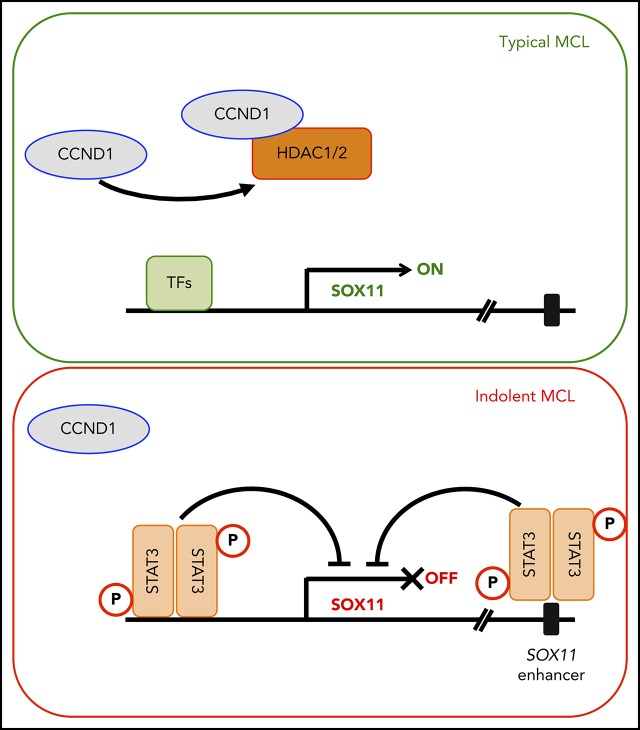
The neural transcription factor SOX11 is usually highly expressed in typical mantle cell lymphoma (MCL), but it is absent in the more indolent form of MCL. Despite being an important diagnostic marker for this hard-to-treat malignancy, the mechanisms of aberrant SOX11 expression are largely unknown. Herein, we describe 2 modes of SOX11 regulation by the cell-cycle regulator cyclin D1 (CCND1) and the signal transducer and activator of transcription 3 (STAT3). We found that ectopic expression of CCND1 in multiple human MCL cell lines resulted in increased SOX11 transcription, which correlated with increased acetylated histones H3K9 and H3K14 (H3K9/14Ac). Increased H3K9/14Ac and SOX11 expression was also observed after histone deacetylase 1 (HDAC1) or HDAC2 was depleted by RNA interference or inhibited by the HDAC inhibitor vorinostat. Mechanistically, we showed that CCND1 interacted with and sequestered HDAC1 and HDAC2 from the locus, leading to SOX11 upregulation. Interestingly, our data revealed a potential inverse relationship between phosphorylated Y705 STAT3 and SOX11 expression in MCL cell lines, primary tumors, and patient-derived xenografts. Functionally, inactivation of STAT3 by inhibiting the upstream Janus kinase (JAK) 1 or JAK2 or by STAT3 knockdown was found to increase SOX11 expression, whereas interleukin-21 (IL-21)-induced STAT3 activation or overexpression of the constitutively active form of STAT3 decreased SOX11 expression. In addition, targeting SOX11 directly by RNA interference or indirectly by IL-21 treatment induced toxicity in SOX11 MCL cells. Collectively, we demonstrate the involvement of CCND1 and STAT3 in the regulation of SOX11 expression, providing new insights and therapeutic implications in MCL.
神经转录因子 SOX11 通常在典型套细胞淋巴瘤 (MCL) 中高度表达,但在更惰性的 MCL 中不存在。尽管 SOX11 是这种难以治疗的恶性肿瘤的重要诊断标志物,但异常 SOX11 表达的机制在很大程度上尚不清楚。在此,我们描述了细胞周期调节剂 cyclin D1 (CCND1) 和信号转导和转录激活因子 3 (STAT3) 对 SOX11 调节的 2 种模式。我们发现,在多种人 MCL 细胞系中外源性表达 CCND1 会导致 SOX11 转录增加,这与乙酰化组蛋白 H3K9 和 H3K14 (H3K9/14Ac) 的增加相关。在用 RNA 干扰耗尽组蛋白去乙酰化酶 1 (HDAC1) 或 HDAC2 或用 HDAC 抑制剂伏立诺他抑制后,也观察到 H3K9/14Ac 和 SOX11 表达增加。从机制上讲,我们表明 CCND1 与 HDAC1 和 HDAC2 相互作用,并将其从 基因座上隔离出来,导致 SOX11 上调。有趣的是,我们的数据显示,在 MCL 细胞系、原发肿瘤和患者来源的异种移植中,磷酸化 Y705 STAT3 与 SOX11 表达之间存在潜在的反比关系。功能上,通过抑制上游 Janus 激酶 (JAK) 1 或 JAK2 或通过 STAT3 敲低使 STAT3 失活,发现会增加 SOX11 的表达,而白细胞介素-21 (IL-21) 诱导的 STAT3 激活或组成型激活形式的 STAT3 的过表达会降低 SOX11 的表达。此外,通过 RNA 干扰直接靶向 SOX11 或通过 IL-21 处理间接靶向 SOX11 会诱导 SOX11 MCL 细胞毒性。总之,我们证明了 CCND1 和 STAT3 参与了 SOX11 表达的调节,为 MCL 提供了新的见解和治疗意义。