Oluwagbemigun Kolade, Dietrich Thomas, Pischon Nicole, Bergmann Manuela, Boeing Heiner
Department of Epidemiology, German Institute of Human Nutrition, Potsdam-Nuthetal, Germany.
Department of Oral Surgery, the School of Dentistry, University of Birmingham, Birmingham, United Kingdom.
PLoS One. 2015 May 6;10(5):e0123879. doi: 10.1371/journal.pone.0123879. eCollection 2015.
There is growing evidence of an association between oral health, specifically dental status, and chronic systemic diseases. However, varying measures of dental status across different populations and low study sample has made comparison of studies and conclusion of findings unclear. Our aim is to examine whether the number of teeth as a measure of dental status is associated with incident chronic diseases in a cohort setting.
We conducted a cohort study among 24,313 middle-aged Germans followed up for 13 years. Data on number of teeth as a measure of dental status were obtained through self-reports. Outcomes were clinically-verified incident non-fatal myocardial infarction, stroke, type 2 diabetes mellitus, and cancer. Hazard ratio (HR) and 95% confidence intervals (CI) were obtained from Cox regression models.
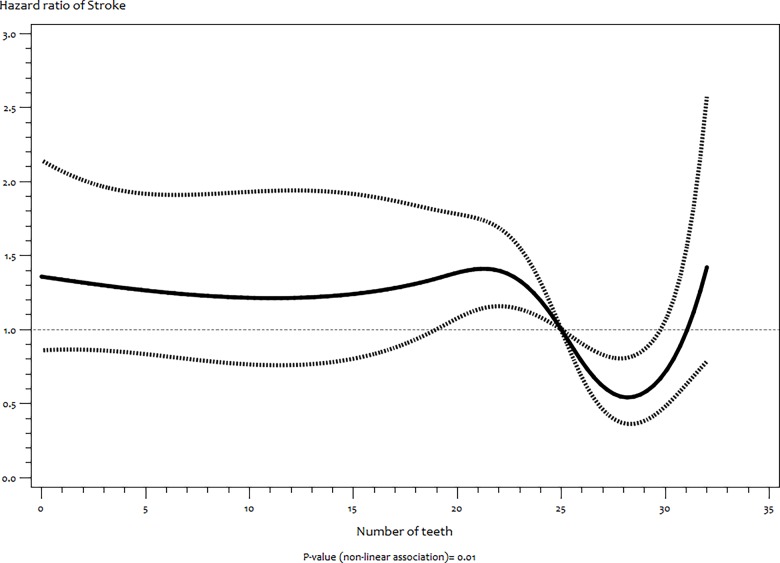
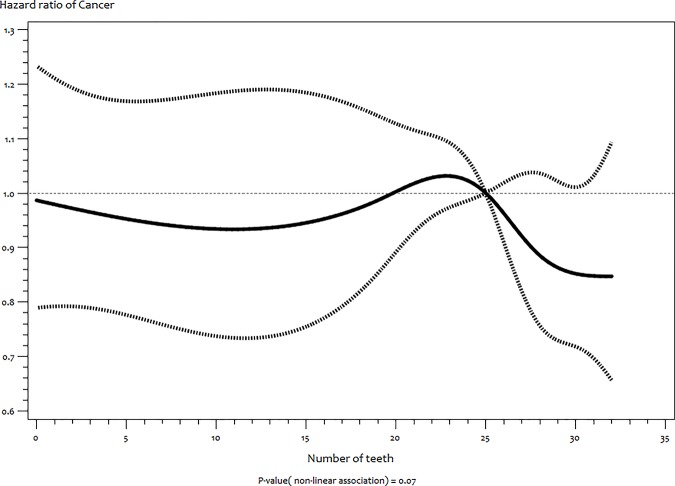
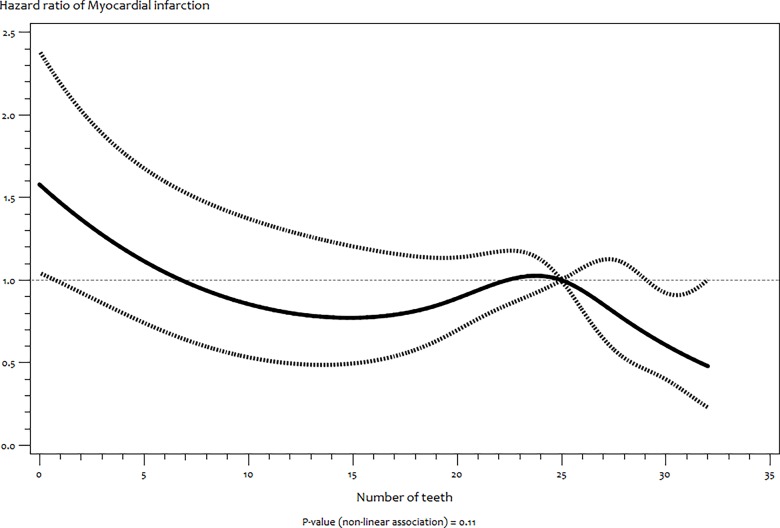
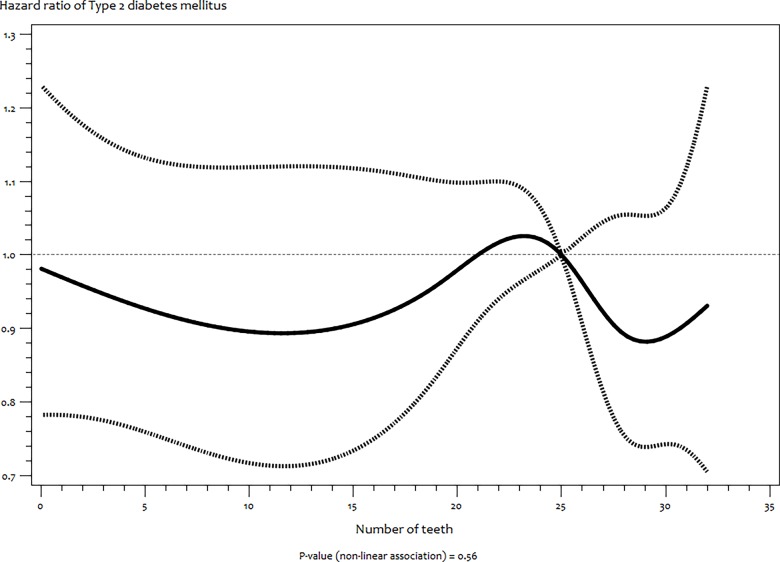
Increasing number of teeth is inversely related to risk of myocardial infarction (HR: 0.97; 95% CI: 0.96, 0.99). The full multivariate model of teeth groups showed a strong linear trend for myocardial infarction, a less strong trend for stroke, and no relation with type 2 diabetes mellitus and cancer in a competing risk model. Participants with 18-23 teeth and those without teeth were at 76% (95%CI: 1.04, 3) and 2.93 times (95%CI: 1.61, 5.18) higher risk of myocardial infarction compared to those with nearly all teeth (28-32 teeth).
Number of teeth is specifically associated with myocardial infarction and not with other chronic disease indicating that dental status further strengthens the link between oral health and cardiovascular diseases.
越来越多的证据表明口腔健康,特别是牙齿状况与慢性全身性疾病之间存在关联。然而,不同人群对牙齿状况的衡量标准不同,且研究样本量较小,使得各研究之间的比较以及研究结果的结论并不明确。我们的目的是在队列研究中检验牙齿数量作为牙齿状况的一种衡量指标是否与慢性疾病的发生有关。
我们对24313名中年德国人进行了一项为期13年的队列研究。通过自我报告获取作为牙齿状况衡量指标的牙齿数量数据。结局指标为经临床验证的非致命性心肌梗死、中风、2型糖尿病和癌症。从Cox回归模型中获得风险比(HR)和95%置信区间(CI)。
牙齿数量增加与心肌梗死风险呈负相关(HR:0.97;95%CI:0.96,0.99)。牙齿分组的全多元模型显示,心肌梗死有很强的线性趋势,中风的趋势较弱,在竞争风险模型中与2型糖尿病和癌症无关。与几乎拥有全部牙齿(28 - 32颗)的参与者相比,拥有18 - 23颗牙齿的参与者和没有牙齿的参与者发生心肌梗死的风险分别高76%(95%CI:1.04,3)和2.93倍(95%CI:1.61,5.18)。
牙齿数量与心肌梗死有特定关联,与其他慢性疾病无关,这表明牙齿状况进一步加强了口腔健康与心血管疾病之间的联系。