School of Sciences, Inner Mongolia University of Technology, Department of Mathematics, Hohhot, 010051, China.
The Affiliated Hospital of Inner Mongolia Medical University, Department of Neurology, Hohhot, 010050, China.
Sci Rep. 2018 Dec 7;8(1):17707. doi: 10.1038/s41598-018-35721-9.
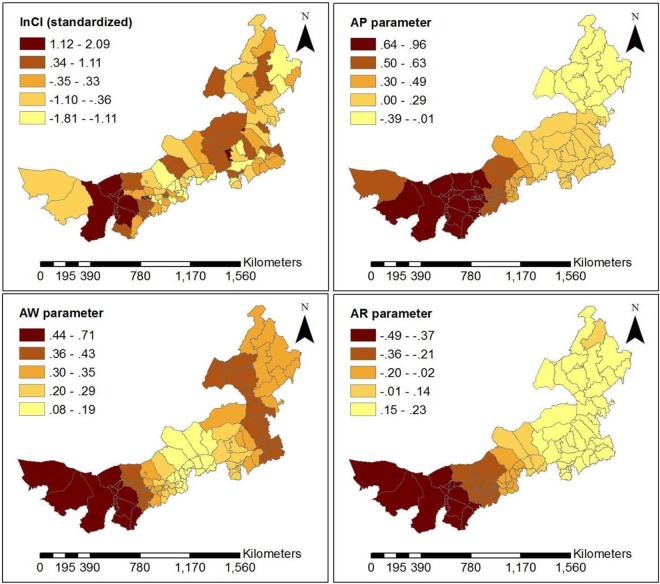
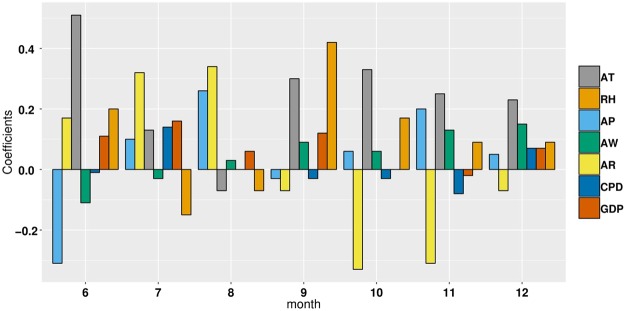
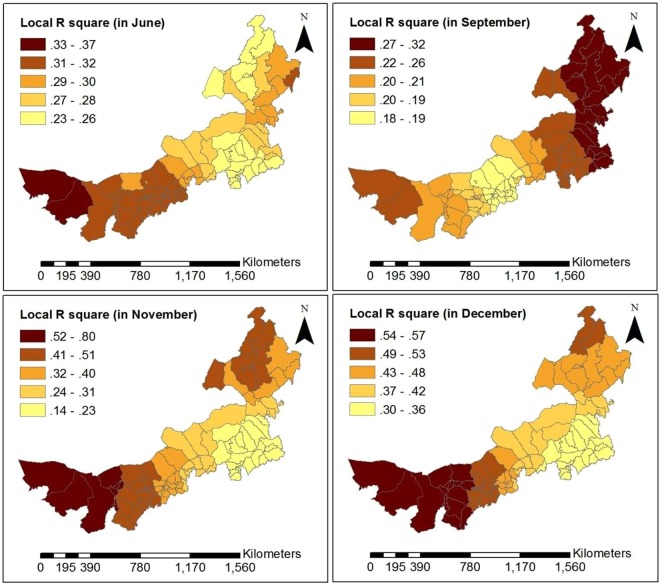
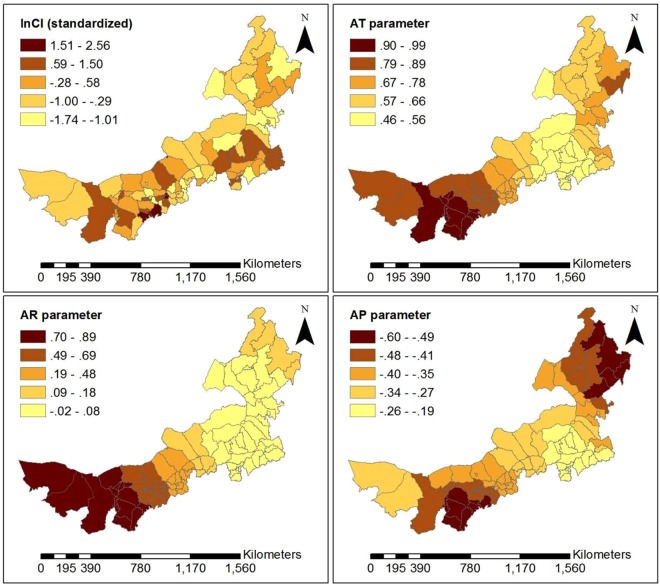
To quantify the associations between the spatial characteristics of hand, foot, and mouth disease (HFMD) epidemic and meteorological factors (average temperature (AT), relative humidity (RH), average pressure (AP), average wind speed (AW) and average rainfall (AR)), child population density (CPD) and Per capita GDP (GDP) in Inner Mongolia Autonomous Region, China, and to detect the variation of influence in different seasons and counties, geographically weighted regression (GWR) model was constructed. The monthly cumulative incidence (CI) of HFMD was worked out for children ≤9 years from June to December, 2016. The results revealed that GWR model had a far superior goodness-of-fit for describing the relationship between the risk factors and HFMD incidence. Meteorological factors had different significance in their effect on HFMD incidence depending on the season. AT and AR had the greatest impact on HFMD in summer. The influence of RH on HFMD was significant in early autumn. AW was negatively correlated with HFMD in summer and positively correlated in autumn and winter. The effects of AW and AP on the incidence of HFMD were statistically significant in winter. GDP and CPD were not significantly related to HFMD occurrence for most time periods.
为了量化中国内蒙古自治区手足口病(HFMD)流行的空间特征与气象因素(平均气温(AT)、相对湿度(RH)、平均气压(AP)、平均风速(AW)和平均降雨量(AR))、儿童人口密度(CPD)和人均国内生产总值(GDP)之间的相关性,并探测不同季节和县区影响的变化,构建了地理加权回归(GWR)模型。计算了 2016 年 6 月至 12 月≤9 岁儿童的每月累积发病率(CI)。结果表明,GWR 模型在描述危险因素与 HFMD 发病率之间的关系方面具有更好的拟合优度。气象因素对 HFMD 发病率的影响因季节而异。在夏季,AT 和 AR 对 HFMD 的影响最大。在初秋,RH 对 HFMD 的影响显著。在夏季和冬季,AW 与 HFMD 呈负相关,而在秋季和冬季,AW 与 HFMD 呈正相关。在冬季,AW 和 AP 对 HFMD 发病率的影响具有统计学意义。在大多数时期,GDP 和 CPD 与 HFMD 的发生没有显著关系。