Bergmark Magnus, Bejerholm Ulrika, Svensson Bengt, Markström Urban
Department of Social Work, Umeå University, Umeå, SE.
Department of Health Sciences, Lund University, Lund, SE.
Int J Integr Care. 2018 Dec 6;18(4):11. doi: 10.5334/ijic.3547.
There is increasing interest in implementing evidence-based integrated models of care in community-based mental health service systems. Assertive Community Treatment (ACT) is seen as an attractive, and at the same time challenging, model to implement in sectored service settings. This study investigates the implementation process of such an initiative.
Interviews were conducted with ACT team members, the process leader, steering group members, and collaboration partners. The "Sustainable Implementation Scale" helped to identify critical implementation components, and these were further explored using the qualitative interview data. The "Tool for Measuring Assertive Community Treatment" addressed programme fidelity, and the initiative's sustainability was assessed.
High-fidelity implementation of ACT in a sectored service setting is possible. Prominent components that facilitated implementation were careful preparations, team members' characteristics, and efforts by the process leader and the steering group to improve networking. Implementation was hampered by conflicting goals among the involved authorities and a mismatch between the ACT model's characteristics and existing organisational traditions and regulations.
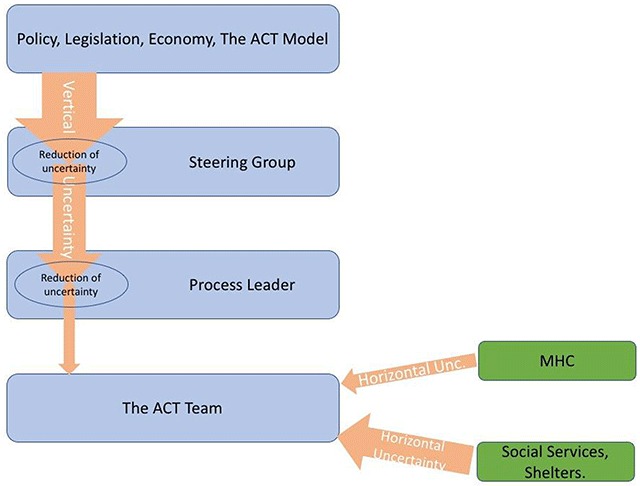
Reducing the uncertainty caused by conflicting goals is an important step in improving the implementation of ACT. In order to facilitate implementation, the goals, regulations, and availability of resources should be aligned horizontally and vertically through the involved organisations.
在社区心理健康服务系统中实施基于证据的综合护理模式的兴趣日益浓厚。积极社区治疗(ACT)被视为一种在部门服务环境中实施具有吸引力但同时也具有挑战性的模式。本研究调查了这一举措的实施过程。
对ACT团队成员、流程负责人、指导小组成员和合作伙伴进行了访谈。“可持续实施量表”有助于确定关键的实施组成部分,并利用定性访谈数据对这些部分进行进一步探讨。“积极社区治疗测量工具”涉及项目保真度,并评估了该举措的可持续性。
在部门服务环境中高保真实施ACT是可能的。促进实施的突出组成部分包括精心准备、团队成员的特点以及流程负责人和指导小组为改善网络所做的努力。实施受到相关当局之间目标冲突以及ACT模式特点与现有组织传统和规定不匹配的阻碍。
减少目标冲突导致的不确定性是改善ACT实施的重要一步。为了促进实施,应通过相关组织在横向和纵向层面使目标、规定和资源可用性保持一致。