Kim Seul I, Kim Seongok, Kim Eunsuk, Hwang Seo Yeon, Yoon Hyunjin
Department of Molecular Science and Technology, Ajou University, Suwon, South Korea.
Department of Applied Chemistry and Biological Engineering, Ajou University, Suwon, South Korea.
Front Microbiol. 2018 Nov 23;9:2810. doi: 10.3389/fmicb.2018.02810. eCollection 2018.
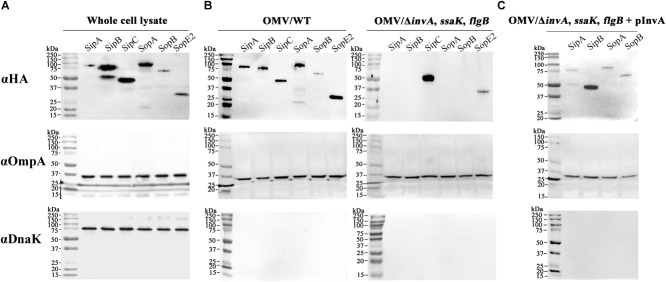
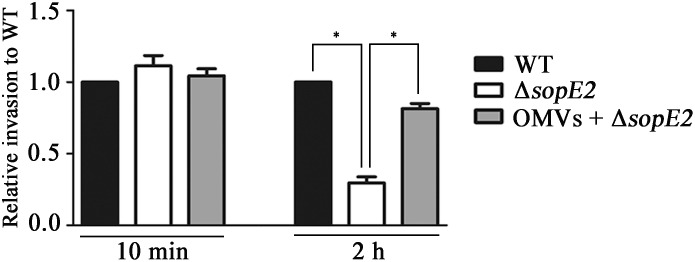
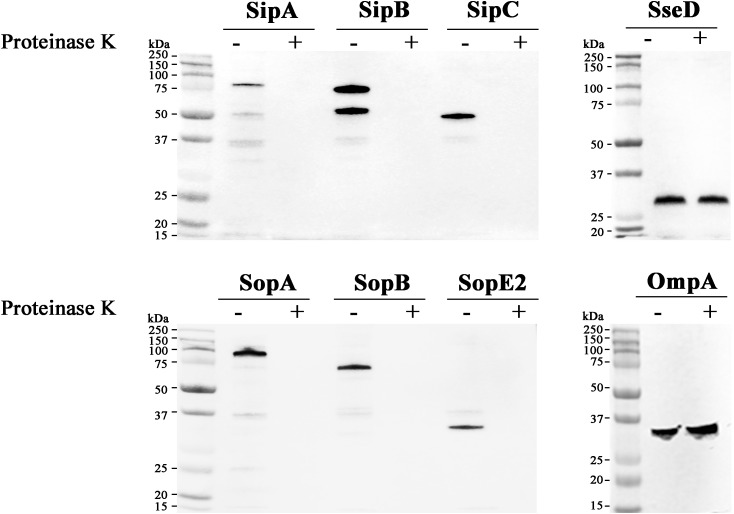
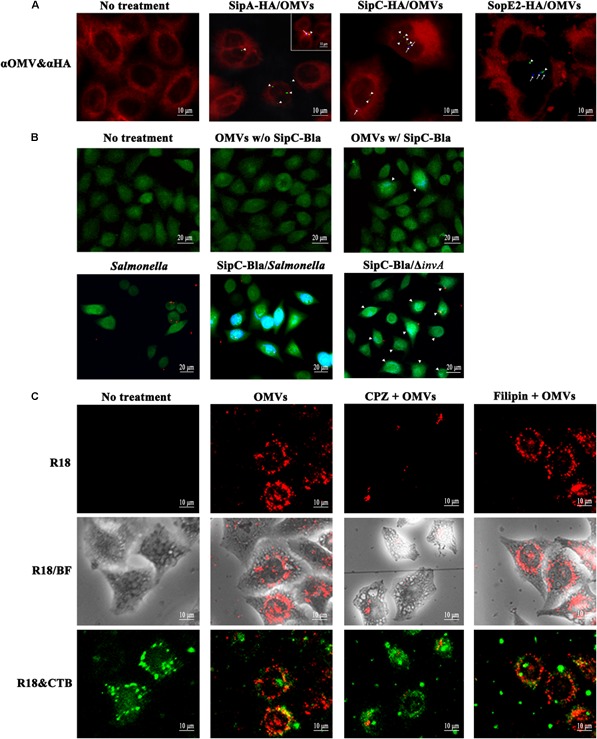
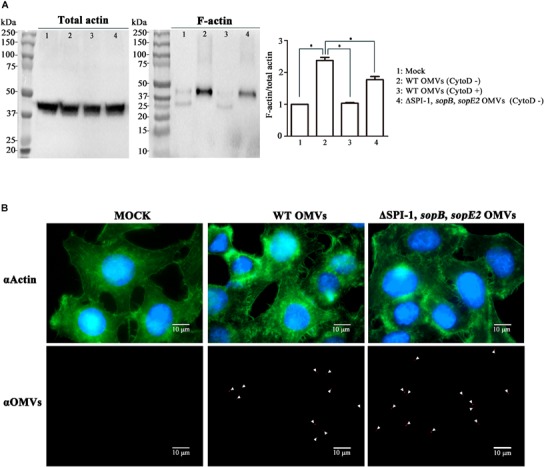
Outer membrane vesicles (OMVs) are spherical membranous structures released by Gram-negative bacteria. Several bacterial pathogens utilize OMVs as vehicles for the delivery of virulence factors into host cells. Results of our previous study on proteomic analysis revealed that OMVs isolated from serovar Typhimurium had virulence effectors that are known to be translocated by pathogenicity island 1 (SPI-1)-encoded type III secretion system (T3SS1) into the host cell. In the present study, immunoblot analysis confirmed the secretion of the six T3SS1 effector proteins, namely SipB and SipC (translocators of T3SS1), and SipA, SopA, SopB, and SopE2 (effectors translocated by T3SS1), by OMVs. Results of proteinase K treatment revealed the localization of these T3SS1 effector proteins on the outer surface of OMVs. SipC and SopE2 were secreted by OMVs independent of the three secretion systems T3SS1, T3SS2, and flagella, signifying OMVs to be an alternative delivery system to T3SSs. T3SS1 effectors SipA, SipC, and SopE2 were internalized into the cytoplasm of the host cell by OMVs independent of cellular host cell contact. In epithelial cells, addition of OMVs harboring T3SS1 effectors stimulated the production of F-actin, thereby complementing the attenuated invasion of Δ into host cells. These results suggest that Typhimurium might exploit OMVs as a long-distance vehicle to deliver T3SS1 effectors into the cytoplasm of the host cell independent of bacteria-host cell interaction.
外膜囊泡(OMVs)是革兰氏阴性细菌释放的球形膜结构。几种细菌病原体利用OMVs作为将毒力因子递送至宿主细胞的载体。我们先前蛋白质组学分析的结果显示,从鼠伤寒血清型分离的OMVs具有已知通过1型致病岛(SPI-1)编码的III型分泌系统(T3SS1)转运至宿主细胞的毒力效应物。在本研究中,免疫印迹分析证实了OMVs分泌六种T3SS1效应蛋白,即SipB和SipC(T3SS1的转运蛋白),以及SipA、SopA、SopB和SopE2(由T3SS1转运的效应物)。蛋白酶K处理结果揭示了这些T3SS1效应蛋白在OMVs外表面的定位。SipC和SopE2由OMVs分泌,独立于T3SS1、T3SS2和鞭毛这三种分泌系统,这表明OMVs是T3SSs的一种替代递送系统。T3SS1效应物SipA、SipC和SopE2由OMVs内化至宿主细胞的细胞质中,独立于与宿主细胞的接触。在上皮细胞中,添加携带T3SS1效应物的OMVs刺激了F-肌动蛋白的产生,从而补充了Δ对宿主细胞侵袭减弱的情况。这些结果表明,鼠伤寒沙门氏菌可能利用OMVs作为一种远距离载体,独立于细菌与宿主细胞的相互作用将T3SS1效应物递送至宿主细胞的细胞质中。