Backert Steffen, Tegtmeyer Nicole
Division of Microbiology, Department of Biology, Friedrich Alexander University Erlangen-Nuremberg, Staudtstr. 5, D-91058 Erlangen, Germany.
Toxins (Basel). 2017 Mar 24;9(4):115. doi: 10.3390/toxins9040115.
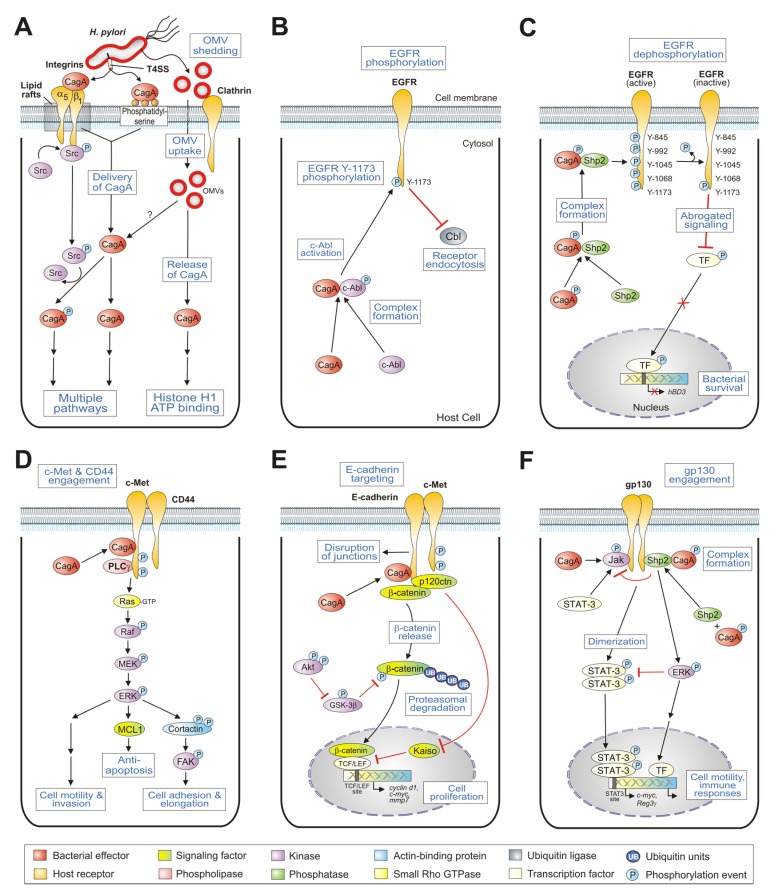
is a highly successful human bacterium, which is exceptionally equipped to persistently inhabit the human stomach. Colonization by this pathogen is associated with gastric disorders ranging from chronic gastritis and peptic ulcers to cancer. Highly virulent strains express the well-established adhesins BabA/B, SabA, AlpA/B, OipA, and HopQ, and a type IV secretion system (T4SS) encoded by the pathogenicity island (PAI). The adhesins ascertain intimate bacterial contact to gastric epithelial cells, while the T4SS represents an extracellular pilus-like structure for the translocation of the effector protein CagA. Numerous T4SS components including CagI, CagL, CagY, and CagA have been shown to target the integrin-β₁ receptor followed by translocation of CagA across the host cell membrane. The interaction of CagA with membrane-anchored phosphatidylserine and CagA-containing outer membrane vesicles may also play a role in the delivery process. Translocated CagA undergoes tyrosine phosphorylation in C-terminal EPIYA-repeat motifs by oncogenic Src and Abl kinases. CagA then interacts with an array of host signaling proteins followed by their activation or inactivation in phosphorylation-dependent and phosphorylation-independent fashions. We now count about 25 host cell binding partners of intracellular CagA, which represent the highest quantity of all currently known virulence-associated effector proteins in the microbial world. Here we review the research progress in characterizing interactions of CagA with multiple host cell receptors in the gastric epithelium, including integrin-β₁, EGFR, c-Met, CD44, E-cadherin, and gp130. The contribution of these interactions to colonization, signal transduction, and gastric pathogenesis is discussed.
是一种非常成功的人类细菌,特别适合在人类胃部持续生存。这种病原体的定植与从慢性胃炎、消化性溃疡到癌症等一系列胃部疾病有关。高毒力菌株表达已明确的黏附素BabA/B、SabA、AlpA/B、OipA和HopQ,以及由致病岛(PAI)编码的IV型分泌系统(T4SS)。黏附素确保细菌与胃上皮细胞紧密接触,而T4SS代表一种细胞外菌毛样结构,用于效应蛋白CagA的转运。许多T4SS成分,包括CagI、CagL、CagY和CagA,已被证明靶向整合素-β₁受体,随后CagA穿过宿主细胞膜进行转运。CagA与膜锚定的磷脂酰丝氨酸和含CagA的外膜囊泡之间的相互作用也可能在递送过程中发挥作用。转运的CagA在C端EPIYA重复基序中被致癌性Src和Abl激酶进行酪氨酸磷酸化。然后CagA与一系列宿主信号蛋白相互作用,随后以磷酸化依赖性和磷酸化非依赖性方式激活或失活这些蛋白。我们现在已经确定了细胞内CagA约25个宿主细胞结合伙伴,这在微生物世界中代表了所有目前已知的毒力相关效应蛋白中的最大数量。在这里,我们综述了在表征CagA与胃上皮中多种宿主细胞受体相互作用方面的研究进展,包括整合素-β₁、表皮生长因子受体(EGFR)、c-Met、CD44、E-钙黏蛋白和gp130。讨论了这些相互作用对定植、信号转导和胃部发病机制的贡献。