Veltroni A, Zambon G, Cingarlini S, Davì M V
ENETS Center of Excellence, Department of Medicine, University of Verona, Verona, Italy.
ENETS Center of Excellence, Department of Oncology, University of Verona, Verona, Italy.
Endocrinol Diabetes Metab Case Rep. 2018;2018. doi: 10.1530/EDM-18-0011. Epub 2018 Dec 11.
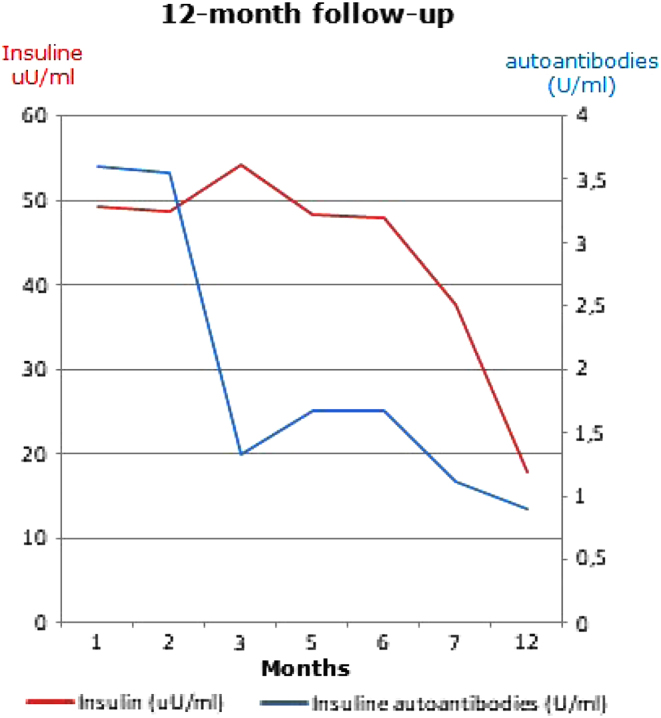
Insulin autoimmune syndrome (IAS), a rare cause of autoimmune hyperinsulinaemic hypoglycaemia, is relatively well known in Japan. The incidence in Caucasians is less than one-fifth of that reported in Japanese people, but it is becoming increasingly recognised worldwide in non-Asians as well. Drugs containing sulphydryl groups are known to be associated with the disease in genetically predisposed individuals. Moreover, several recent reports showed a direct association between the onset of IAS and the consumption of dietary supplements containing alpha-lipoic acid (LA). Insulinoma remains the most prevalent cause of hypersulinaemic hypoglycaemia in Caucasians. Consequently, primary investigation in these patients is generally focused on localisation of the pancreatic tumour, often with invasive procedures followed by surgery. We described a case of an Italian woman presenting to us with severe recurrent hypoglycaemia associated with high insulin and C-peptide levels and no evidence of pancreatic lesions at imaging diagnostic procedures. She had taken LA until 2 weeks before hospitalisation. After an evaluation of her drug history, an autoimmune form of hypoglycaemia was suspected and the titre of insulin autoantibodies was found to be markedly elevated. This allowed us to diagnose LA-related IAS, thus preventing any unnecessary surgery and avoiding invasive diagnostic interventions. Learning points: IAS is a rare cause of hyperinsulinaemic hypoglycaemia that typically affects Asian population, but it has been increasingly recognised in Caucasian patients. It should be considered among the differential diagnosis of hyperinsulinaemic hypoglycaemia to avoid unnecessary diagnostic investigations and surgery. It should be suspected in the presence of very high serum insulin levels (100-10 000 μU/mL) associated with high C-peptide levels. There is a strong association with administration of drugs containing sulphydryl groups included LA, a dietary supplement commonly used in Western countries to treat peripheral neuropathy.
胰岛素自身免疫综合征(IAS)是自身免疫性高胰岛素血症性低血糖症的一种罕见病因,在日本相对较为人熟知。白种人中的发病率不到日本人报道发病率的五分之一,但在非亚洲人群中也越来越受到全世界的认可。已知含巯基的药物在遗传易感性个体中与该疾病有关。此外,最近的几份报告显示IAS的发病与食用含α-硫辛酸(LA)的膳食补充剂之间存在直接关联。胰岛素瘤仍然是白种人高胰岛素血症性低血糖症最常见的病因。因此,这些患者的初步检查通常集中在胰腺肿瘤的定位上,通常采用侵入性检查,随后进行手术。我们描述了一例意大利女性病例,她因严重复发性低血糖症前来就诊,胰岛素和C肽水平升高,影像学诊断检查未发现胰腺病变证据。她在住院前2周一直在服用LA。在评估她的用药史后,怀疑是自身免疫性低血糖症,发现胰岛素自身抗体滴度明显升高。这使我们能够诊断出与LA相关的IAS,从而避免了任何不必要的手术,并避免了侵入性诊断干预。学习要点:IAS是高胰岛素血症性低血糖症的一种罕见病因,通常影响亚洲人群,但在白种人患者中也越来越受到认可。在高胰岛素血症性低血糖症的鉴别诊断中应考虑到它,以避免不必要的诊断检查和手术。当存在与高C肽水平相关的非常高的血清胰岛素水平(100 - 10000 μU/mL)时应怀疑该病。它与含巯基的药物(包括LA)的使用密切相关,LA是西方国家常用于治疗周围神经病变的一种膳食补充剂。