Marta Guilherme Rodrigues, Doretto Victoria Fogaça, Scivoletto Sandra
Faculdade de Medicina FMUSP, São Paulo Research Foundation (FAPESP), Universidade de São Paulo, São Paulo, Brazil.
Departamento de Psiquiatria, Faculdade de Medicina, Hospital das Clinicas HCFMUSP, Universidade de São Paulo, São Paulo, Brazil.
Front Psychiatry. 2018 Nov 26;9:625. doi: 10.3389/fpsyt.2018.00625. eCollection 2018.
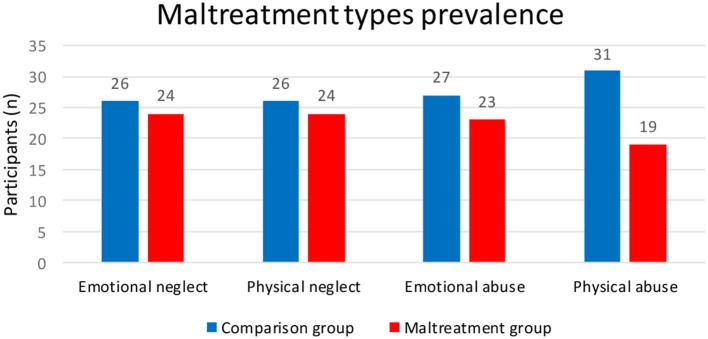
The experience of maltreatment can impair child development, including changes in the process of emotions recognition, which may result in impairment of social interactions and behavioral disabilities. In order to measure the association between maltreatment and changes on emotion recognition among Brazilian adolescents, the Emotional Recognition Test on Human Faces (ERTHF) was applied to a sample of 50 adolescents who had suffered different intensities and types of abuse. The social and clinical characteristics of the participants were analyzed and, from ERTHF data, the accuracy and response time for the emotion recognition. Males were 60%, with mean age of 13 years and 3 months; 60% were living in shelters. Emotion recognition changes were associated with intensity and types of maltreatment. Physical neglect (48%) was associated with changes in neutral and negative emotions recognition. Emotional neglect (48%) and emotional abuse (46%) were associated with changes in both positive and negative emotions recognition. Physical abuse (38%) was associated with changes in positive emotion recognition only. False recognition of anger was the most common outcome of maltreatment, being associated with physical neglect ( = 0.015) and emotional neglect ( = 0.047). Our results point out to the need to add emotional and facial recognition's rehabilitation interventions to better attend the specific demands of maltreated children and to increase the chances of social and family reintegration.
虐待经历会损害儿童的发育,包括情绪识别过程的改变,这可能导致社交互动受损和行为障碍。为了衡量巴西青少年中虐待与情绪识别变化之间的关联,对50名遭受不同强度和类型虐待的青少年样本进行了人脸情绪识别测试(ERTHF)。分析了参与者的社会和临床特征,并根据ERTHF数据得出情绪识别的准确性和反应时间。男性占60%,平均年龄为13岁零3个月;60%的人住在收容所。情绪识别变化与虐待的强度和类型有关。身体忽视(48%)与中性和负面情绪识别的变化有关。情感忽视(48%)和情感虐待(46%)与积极和消极情绪识别的变化有关。身体虐待(38%)仅与积极情绪识别的变化有关。对愤怒的错误识别是虐待最常见的结果,与身体忽视(P = 0.015)和情感忽视(P = 0.047)有关。我们的结果指出,需要增加情绪和面部识别方面的康复干预措施,以更好地满足受虐待儿童的特殊需求,并增加社会和家庭重新融入的机会。